

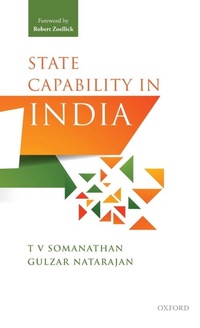
State Capability in India
Published on 25. November 2022
Book
Hardback
446 pages
978-0-19-285661-6 (ISBN)
Description
The deficiencies in the capability of the state to design and implement effective policies are arguably the biggest development challenge facing developing countries like India. This book seeks to assess state capability in India, identify weaknesses in policy design and programme implementation, and their causes, and propose some measures to remedy them. Importantly, it does so while recognizing political economy constraints and focusing predominantly on the administrative contributors. To this extent, the book's suggestions are practical enough for adoption by stakeholders at different levels.
It describes the institutional design, constitutional provisions, the organizational structure, and the personnel of the Indian state. It covers a wide spectrum of aspects impacting state capability, ranging from ideological narratives and systemic constraints to procedural and personnel management issues to the behaviours and attitudes of individual bureaucrats. It offers a new analytical framework to think about effectiveness of state on the policy-making process. It also offers a nuanced perspective and suggestions on many of the popular themes in public administration - size of the state, generalist and specialist debates, lateral entry, digital monitoring systems in governance, outsourcing and private participation, use of consultants, risk aversion in bureaucracies, performance-based incentives, programme evaluations, and so on.
Finally, being participants and observers in the bureaucratic system, the authors describe reality without always seeking to locate it in the framework of existing academic literature, thereby offering fresh insights and enriching the discourse on state capability.
It describes the institutional design, constitutional provisions, the organizational structure, and the personnel of the Indian state. It covers a wide spectrum of aspects impacting state capability, ranging from ideological narratives and systemic constraints to procedural and personnel management issues to the behaviours and attitudes of individual bureaucrats. It offers a new analytical framework to think about effectiveness of state on the policy-making process. It also offers a nuanced perspective and suggestions on many of the popular themes in public administration - size of the state, generalist and specialist debates, lateral entry, digital monitoring systems in governance, outsourcing and private participation, use of consultants, risk aversion in bureaucracies, performance-based incentives, programme evaluations, and so on.
Finally, being participants and observers in the bureaucratic system, the authors describe reality without always seeking to locate it in the framework of existing academic literature, thereby offering fresh insights and enriching the discourse on state capability.
More details
Language
English
Place of publication
Oxford
United Kingdom
Target group
College/higher education
Dimensions
Height: 222 mm
Width: 145 mm
Thickness: 27 mm
Weight
689 gr
ISBN-13
978-0-19-285661-6 (9780192856616)
Copyright in bibliographic data and cover images is held by Nielsen Book Services Limited or by the publishers or by their respective licensors: all rights reserved.
Schweitzer Classification
Other editions
Additional editions
T. V. Somanathan | Gulzar Natarajan
State Capability in India
E-Book
04/2022
1st Edition
OUP eBook
€111.99
Available for download
T. V. Somanathan | Gulzar Natarajan
State Capability in India
E-Book
04/2022
1st Edition
OUP eBook
€111.99
Available for download
Persons
T.V. Somanathan holds a Ph.D in Economics (Calcutta). He is a Chartered Accountant (England & Wales), Fellow of the Chartered Governance Institute (London), FCMA (London), FCCA (London), ACS, and ACMA (India). He is also a part of the Executive Development Program at Harvard. Somanathan served in numerous leadership positions in the Indian government. He was a young professional, financial economist, manager at the World Bank, Washington in the 1990s. He returned to the world BanW (2011 - 2015) as Director. An author of several books and numerous papers on economics and public policy, he is currently India's Finance Secretary.
Gulzar Natarajan did his Bachelor in Technology at the Indian Institute of Technology, Chennai and later completed his Masters in Public Administration (International Development), MPA/ID, from Harvard Kennedy School. He joined the Indian Administrative Service in 1999 and has worked in various positions in the local, state, and central governments. From 2016-2020, he was Senior Managing Director leading the global portfolio of grant investments at the London-based social impact investment firm, Global Innovation Fund. He writes a top-rated blog on economics, finance, and public policy, Urbanomics, and is Secretary, Finance, Government of Andhra Pradesh.
Gulzar Natarajan did his Bachelor in Technology at the Indian Institute of Technology, Chennai and later completed his Masters in Public Administration (International Development), MPA/ID, from Harvard Kennedy School. He joined the Indian Administrative Service in 1999 and has worked in various positions in the local, state, and central governments. From 2016-2020, he was Senior Managing Director leading the global portfolio of grant investments at the London-based social impact investment firm, Global Innovation Fund. He writes a top-rated blog on economics, finance, and public policy, Urbanomics, and is Secretary, Finance, Government of Andhra Pradesh.
Content
1: Introduction
2: State Capability: A Conceptual Overview
3: Constitutional Provisions and Structure of Governments
4: Personnel of the Indian State
5: Civil Service Effectiveness: An Assessment
6: The Size of the Indian State
7: Challenges in Policy Making
8: Decision Paralysis
9: Challenges in Execution
10: Addressing Policy Making Challenges - I
11: Addressing Policy Making Challenges - II: Overcoming Decision Paralysis
12: Becoming Better Policy Makers - Behavioural Change
13: Addressing Execution Challenges -I
14: Addressing Execution Challenges - II: Personnel, Procurement, and Permits
15: Addressing Execution Challenges - III
16: A Practical Approach to Better Capability
2: State Capability: A Conceptual Overview
3: Constitutional Provisions and Structure of Governments
4: Personnel of the Indian State
5: Civil Service Effectiveness: An Assessment
6: The Size of the Indian State
7: Challenges in Policy Making
8: Decision Paralysis
9: Challenges in Execution
10: Addressing Policy Making Challenges - I
11: Addressing Policy Making Challenges - II: Overcoming Decision Paralysis
12: Becoming Better Policy Makers - Behavioural Change
13: Addressing Execution Challenges -I
14: Addressing Execution Challenges - II: Personnel, Procurement, and Permits
15: Addressing Execution Challenges - III
16: A Practical Approach to Better Capability