

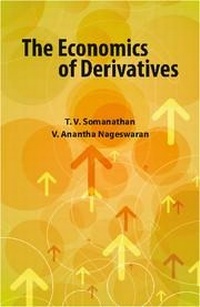
The Economics of Derivatives
Published on 2. March 2015
Book
Hardback
269 pages
978-1-107-09150-4 (ISBN)
Description
While most books on derivatives discuss how they work, this book looks at the contributions of derivatives to overall economic well-being. It examines both the beneficial and adverse effects of derivatives trading from the perspectives of economic theory, empirical evidence and recent economic history. Aiming to present the concepts in a fair, non-ideological, non-mathematical and simple manner, and with the authors' own synthesis, it draws on economic insights from relevant work in other disciplines, particularly sociology and law. The book also presents some new theoretical ideas and recommendations towards a pragmatic and practical approach for policy-makers. The ultimate objective is to provide a basic conceptual framework which will help its readers form a judgement on whether, when and how derivatives are beneficial or harmful to the economy.
Reviews / Votes
'... this book is well researched and includes excellent references ... recommended.' E. Kacapyr, ChoiceMore details
Language
English
Place of publication
Cambridge
United Kingdom
Target group
Professional and scholarly
Product notice
sewn/stitched
Cloth over boards
Dimensions
Height: 236 mm
Width: 154 mm
Thickness: 30 mm
Weight
585 gr
ISBN-13
978-1-107-09150-4 (9781107091504)
Copyright in bibliographic data and cover images is held by Nielsen Book Services Limited or by the publishers or by their respective licensors: all rights reserved.
Schweitzer Classification
Other editions
Additional editions
T. V. Somanathan
Economics of Derivatives
E-Book
03/2015
Cambridge University Press
€76.99
Available for download
Persons
T. V. Somanathan is Director with the World Bank, Washington and is a member of the Indian Administrative Service. He has served in various positions in the World Bank and in State and Union governments in India. V. Anantha Nageswaran holds a doctorate in finance (on exchange rate behaviour) and has over two decades of experience in global capital markets with leading financial institutions such as UBS, Credit Suisse and Bank Julius Baer. He is an adjunct faculty on international finance and economics at the Indian Institute of Management Bangalore (IIMB) and Singapore Management University. He is a weekly columnist for MINT, a regular contributor to CNBC, Reuters and Bloomberg Television networks and is also a co-founder of the Takshashila Institution.
Content
1. Introduction; 2. Definition and typology; 3. The economic functions of derivatives markets; 4. Market completion; 5. Derivatives and price stabilization; 6. Derivatives and price destabilization; 7. The effects of derivatives on prices of the underlying: a synthesis; 8. Causes of the rapid growth in derivatives trading: a historical perspective; 9. The role of derivatives in the global financial crisis of 2008; 10. Models and their effects on markets; 11. Derivatives and emerging markets; 12. Derivatives and emerging markets; 13. Regulation of derivatives; 14. Derivatives and development: a critique; 15. Regulatory policy for derivatives: a pragmatic approach.