

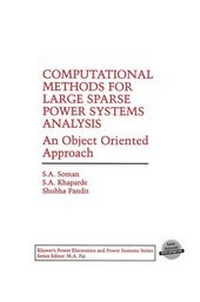
Computational Methods for Large Sparse Power Systems Analysis
An Object Oriented Approach CD-ROM included
1st Edition
Published on 30. November 2001
Book
Mixed media product
360 pages
978-0-7923-7591-3 (ISBN)
Description
Computational methods in Power Systems require significant inputs from diverse disciplines, such as data base structures, numerical analysis etc. Strategic decisions in sparsity exploitation and algorithm design influence large-scale simulation and high-speed computations. Selection of programming paradigm shapes the design, its modularity and reusability. This has a far reaching effect on software maintenance.
Computational Methods for Large Sparse Power Systems Analysis: An Object Oriented Approach provides a unified object oriented (OO) treatment for power system analysis. Sparsity exploitation techniques in OO paradigm are emphasized to facilitate large scale and fast computing. Specific applications like large-scale load flow, short circuit analysis, state estimation and optimal power flow are discussed within this framework. A chapter on modeling and computational issues in power system dynamics is also included. Motivational examples and illustrations are included throughout the book.
A library of C++ classes provided along with this book has classes for transmission lines, transformers, substation etc. A CD-ROM with C++ programs is also included. It contains load flow, short circuit analysis and network topology processor applications. Power system data is provided and systems up to 150 buses can be studied.
Other Special Features:
This book is the first of its kind, covering power system applications designed with an OO perspective. Chapters on object orientation for modeling of power system computations, data structure, large sparse linear system solver, sparse QR decomposition in an OO framework are special features of this book.
Computational Methods for Large Sparse Power Systems Analysis: An Object Oriented Approach provides a unified object oriented (OO) treatment for power system analysis. Sparsity exploitation techniques in OO paradigm are emphasized to facilitate large scale and fast computing. Specific applications like large-scale load flow, short circuit analysis, state estimation and optimal power flow are discussed within this framework. A chapter on modeling and computational issues in power system dynamics is also included. Motivational examples and illustrations are included throughout the book.
A library of C++ classes provided along with this book has classes for transmission lines, transformers, substation etc. A CD-ROM with C++ programs is also included. It contains load flow, short circuit analysis and network topology processor applications. Power system data is provided and systems up to 150 buses can be studied.
Other Special Features:
This book is the first of its kind, covering power system applications designed with an OO perspective. Chapters on object orientation for modeling of power system computations, data structure, large sparse linear system solver, sparse QR decomposition in an OO framework are special features of this book.
More details
Series
Language
English
Place of publication
United States
Target group
College/higher education
Professional and scholarly
Research
Edition type
New edition
Illustrations
1
Dimensions
Height: 234 mm
Width: 156 mm
Thickness: 20 mm
Weight
685 gr
ISBN-13
978-0-7923-7591-3 (9780792375913)
Schweitzer Classification
Other editions
Additional editions
S.A. Soman | S.A. Khaparde | Shubha Pandit
Computational Methods for Large Sparse Power Systems Analysis
An Object Oriented Approach
Book
04/2013
Springer
€106.99
Shipment within 7-9 days
Content
Preface. Acknowledgments. 1. Introduction. 2. Object Orientation for Modeling Computations. 3. Data Structure for Sparse Matrix Computation. 4. Sparse Symmetric Linear System Solver. 5. Sparse QR Decomposition. 6. Optimization Methods. 7. Sparse LP and QP Solvers. 8. Load Flow Analysis. 9. Short Circuit Analysis. 10. Power System State Estimation. 11. Optimal Power Flow. 12. Power System Dynamics. Appendices. References. Index.