

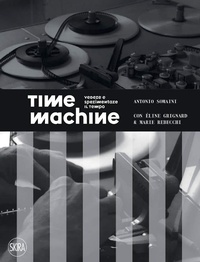
Time Machine
Cinematic Temporalities
Published on 3. September 2020
Book
Paperback/Softback
336 pages
978-88-572-4329-0 (ISBN)
Description
How cinema and other moving-image media have transformed, throughout their history, our perception of time.
Both a book and an exhibition, Time Machine: Cinematic Temporalities takes as a starting point two events that occurred in the same year, 1895: the publication of H.G. Wells¿s ¿scientific romance¿ The Time Machine: An Invention, the first literary work in which movement through time is made possible by a technical device, and the first public presentation, on the evening of December 28, 1895, of the Lumière Brothers¿s Cinématographe.
Based on this double starting point, Time Machine: Cinematic Temporalities tackles the way in which cinema and other moving-image media such as video and video installations have transformed, throughout their history, our perception of time through the different techniques of slow motion and acceleration, loops and reversals, time lapse and freeze-frame, multiple exposures, stop-motion animation, in addition to the endless variations of the operation of montage: that crucial act of separating and joining images and sounds which has often been considered as one of cinemäs defining traits.
Written by the editors of this volume and by a series of leading figures in the field of film and media theory¿Emmanuel Alloa, Jacques Aumont, Raymond Bellour, Christa Blümlinger, Georges Didi-Huberman, Philippe Dubois and Noam Elcott, plus a machine-written text produced by a ¿collaboration¿ between Grégory Chatonsky and different recursive neural networks¿the eleven texts in this volume shed new light on the aesthetic, epistemological, political and media-theoretical implications of different techniques of cinematic time manipulation.
The eleven image sections or entractes (Time Machines; Time Axis Manipulations; Flows; Instants; Time Lapse; Multiple Exposures; Animate, Inanimate; Re-montage; Loops & Reversals; Deep Time; Machine Visions), conceived of as sections of an exhibition unfolding throughout the pages of a book, explore in different ways the idea of considering cinema and other moving-image media as time machines.
Both a book and an exhibition, Time Machine: Cinematic Temporalities takes as a starting point two events that occurred in the same year, 1895: the publication of H.G. Wells¿s ¿scientific romance¿ The Time Machine: An Invention, the first literary work in which movement through time is made possible by a technical device, and the first public presentation, on the evening of December 28, 1895, of the Lumière Brothers¿s Cinématographe.
Based on this double starting point, Time Machine: Cinematic Temporalities tackles the way in which cinema and other moving-image media such as video and video installations have transformed, throughout their history, our perception of time through the different techniques of slow motion and acceleration, loops and reversals, time lapse and freeze-frame, multiple exposures, stop-motion animation, in addition to the endless variations of the operation of montage: that crucial act of separating and joining images and sounds which has often been considered as one of cinemäs defining traits.
Written by the editors of this volume and by a series of leading figures in the field of film and media theory¿Emmanuel Alloa, Jacques Aumont, Raymond Bellour, Christa Blümlinger, Georges Didi-Huberman, Philippe Dubois and Noam Elcott, plus a machine-written text produced by a ¿collaboration¿ between Grégory Chatonsky and different recursive neural networks¿the eleven texts in this volume shed new light on the aesthetic, epistemological, political and media-theoretical implications of different techniques of cinematic time manipulation.
The eleven image sections or entractes (Time Machines; Time Axis Manipulations; Flows; Instants; Time Lapse; Multiple Exposures; Animate, Inanimate; Re-montage; Loops & Reversals; Deep Time; Machine Visions), conceived of as sections of an exhibition unfolding throughout the pages of a book, explore in different ways the idea of considering cinema and other moving-image media as time machines.
More details
Language
English
Place of publication
Milan
Italy
Product notice
Paperback (trade)
Unsewn / adhesive bound
Illustrations
690 Illustrations, color
Dimensions
Height: 216 mm
Width: 168 mm
Thickness: 28 mm
Weight
953 gr
ISBN-13
978-88-572-4329-0 (9788857243290)
Copyright in bibliographic data and cover images is held by Nielsen Book Services Limited or by the publishers or by their respective licensors: all rights reserved.
Schweitzer Classification
Persons
Antonio Somaini is professor in Film, Media, and Visual Culture Studies. Département Cinéma et Audiovisuel. Université Sorbonne Nouvelle ¿ Paris 3.