

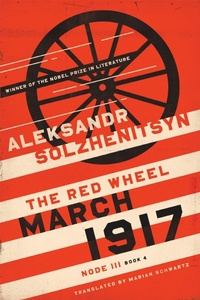
March 1917
The Red Wheel, Node III, Book 4
Will be published approx. on 1. October 2026
Book
Paperback/Softback
632 pages
978-0-268-20880-6 (ISBN)
Description
In March 1917, Book 4 the willing and unwilling participants of the Russian Revolution try to make sense of their next steps amidst unraveling chaos.
One of the masterpieces of world literature, The Red Wheel is Nobel prize-winner Aleksandr Solzhenitsyn's multivolume epic work about the Russian Revolution told in the form of a historical novel. March 1917-the third node-chronicles the mayhem, day by day, of the Russian Revolution. Book 4 presents, for the first time in English, the conclusion of this four-volume revolutionary saga.
The action of Book 4 is set during March 23-31, 1917. Book 4 portrays a cast of thousands in motion and agitation as every stratum of Russian society-the army on the front lines, the countryside, the Volga merchants, the Don Cossacks, the Orthodox Church-is racked by the confusing new reality. Soldiers start to fraternize across trenches with the enemy. The Grand Duke Nikolai Nikolaevich, the emperor's uncle, arrives at military headquarters to assume the supreme command but is promptly dismissed by the new Provisional Government. Even this government holds no power, for at every step it is cowed and hemmed in by a self-proclaimed and unaccountable Executive Committee acting in the name of the Soviets-councils of workers and soldiers. Yet the Soviets themselves are divided-on whether to call for an end to the war or for its continuation, on whether to topple the Provisional Government or to let it try to govern. Meanwhile, in Switzerland, Lenin quietly dictates his own terms to the German General Staff, setting the stage for his return to Russia.
One of the masterpieces of world literature, The Red Wheel is Nobel prize-winner Aleksandr Solzhenitsyn's multivolume epic work about the Russian Revolution told in the form of a historical novel. March 1917-the third node-chronicles the mayhem, day by day, of the Russian Revolution. Book 4 presents, for the first time in English, the conclusion of this four-volume revolutionary saga.
The action of Book 4 is set during March 23-31, 1917. Book 4 portrays a cast of thousands in motion and agitation as every stratum of Russian society-the army on the front lines, the countryside, the Volga merchants, the Don Cossacks, the Orthodox Church-is racked by the confusing new reality. Soldiers start to fraternize across trenches with the enemy. The Grand Duke Nikolai Nikolaevich, the emperor's uncle, arrives at military headquarters to assume the supreme command but is promptly dismissed by the new Provisional Government. Even this government holds no power, for at every step it is cowed and hemmed in by a self-proclaimed and unaccountable Executive Committee acting in the name of the Soviets-councils of workers and soldiers. Yet the Soviets themselves are divided-on whether to call for an end to the war or for its continuation, on whether to topple the Provisional Government or to let it try to govern. Meanwhile, in Switzerland, Lenin quietly dictates his own terms to the German General Staff, setting the stage for his return to Russia.
Reviews / Votes
"In The Red Wheel, Aleksandr Solzhenitsyn produced a masterpiece and proved himself a worthy companion of Dostoevsky and rival of Tolstoy." -Law and Liberty"Contrary to Tolstoy in War and Peace, Solzhenitsyn means to demonstrate that, at the decisive 'nodal' moments of history, the action or inaction of a single individual may have a decisive impact on the course of events." -National Review
"If Aleksandr Solzhenitsyn's The Gulag Archipelago presented a mindset-changing view of the history of the USSR, the historical novels that make up his epopee The Red Wheel are a counterweight to the heroics of the October Revolution." -Russian Review
"[A] magisterial depiction of the long, slow collapse of the Tsarist regime in which everybody gets a voice, but nobody feels that he or she can prevent the worst of it. Eerily prescient for the binary confusions of the present." -VoegelinView
"This is the principal work of the Nobel laureate's life, to which Solzhenitsyn dedicated several decades and into which poured all his thoughts about the senseless chaos of the modern and postmodern worlds, all told through the prism of that most contingent of events, the Russian Revolution." -The New Criterion
"A work that combines deep civic and spiritual wisdom, literary art of high quality, and dramatic history that informs and instructs, The Red Wheel deserves a readership that is receptive to its enduring lessons. With the publication of the whole of March 1917, those lessons are much easier to discern." -Law & Liberty
"Solzhenitsyn crafts 655 brief chapters in which diverse actors, unaware of what others are doing, blindly shape events. . . . [His] novel allows us to glimpse those deeper meanings and elusive powers." -Wall Street Journal
"Newspaper excerpts, military orders, screenplays, and biographies of real figures augment the fictional voices. Solzhenitsyn is everywhere and nowhere, like the spirit of the revolution or the God it replaces." -The Lamp
More details
Series
Language
English
Place of publication
Notre Dame IN
United States
Product notice
Paperback (trade)
Illustrations
7 illustrations - 7 maps - 7 Maps
Dimensions
Height: 234 mm
Width: 156 mm
ISBN-13
978-0-268-20880-6 (9780268208806)
Copyright in bibliographic data and cover images is held by Nielsen Book Services Limited or by the publishers or by their respective licensors: all rights reserved.
Schweitzer Classification
Other editions
Additional editions

E-Book
10/2024
1st Edition
University of Notre Dame Press
from
€74.99
Available for download
Persons
Aleksandr Solzhenitsyn (1918-2008), Nobel Prize laureate in literature, was a Soviet political prisoner from 1945 to 1953. His story One Day in the Life of Ivan Denisovich (1962) made him famous, and The Gulag Archipelago (1973) further unmasked Communism and played a critical role in its eventual defeat. Solzhenitsyn was exiled to the West in 1974. He ultimately published dozens of plays, poems, novels, and works of history, nonfiction, and memoir, including In the First Circle, Cancer Ward, The Red Wheel epic, The Oak and the Calf, and the two-volume Between Two Millstones memoir (University of Notre Dame Press, 2018 and 2020).
Marian Schwartz is a prizewinning translator of classic and contemporary Russian literature, including works by Leo Tolstoy, Nina Berberova, Olga Slavnikova, and Leonid Yuzefovich.
Marian Schwartz is a prizewinning translator of classic and contemporary Russian literature, including works by Leo Tolstoy, Nina Berberova, Olga Slavnikova, and Leonid Yuzefovich.
Content
23 MARCH, Friday
24 MARCH, Saturday
25 MARCH, Sunday
26 MARCH, Monday
27 MARCH, Tuesday
28 MARCH, Wednesday
29 MARCH, Thursday
30 MARCH, Friday
31 MARCH, Saturday
24 MARCH, Saturday
25 MARCH, Sunday
26 MARCH, Monday
27 MARCH, Tuesday
28 MARCH, Wednesday
29 MARCH, Thursday
30 MARCH, Friday
31 MARCH, Saturday