

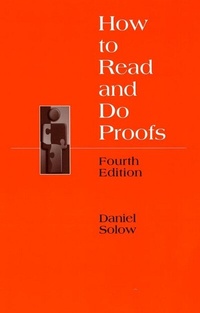
How to Read and Do Proofs
An Introduction to Mathematical Thought Processes
4th Edition
Published on 25. October 2004
Book
Paperback/Softback
288 pages
978-0-471-68058-1 (ISBN)
Description
An essential reference for anyone grappling with advanced mathematics, this Fourth Edition help readers master the basic techniques that are used in all proofs, regardless of the mathematical subject matter in which the proof arises. Once the reader has a firm grasp of the techniques, they'll be better equipped to read, understand and actually do proofs. They'll also learn when each techniques is likely to be successful, based on the form of the theorem.
"The book covers all the basic proof techniques in a very readable, concise way without overwhelming the student. The organization is great. I like the short chapters highlighting only one concept at a time." (Josephine Hamer, Western Connecticut State University)
"Very clear, rigorous, extremely thorough, almost unique in what it tries to do, reaches out to weaker students." (Michael Thaddeus, Columbia University)
"The book covers all the basic proof techniques in a very readable, concise way without overwhelming the student. The organization is great. I like the short chapters highlighting only one concept at a time." (Josephine Hamer, Western Connecticut State University)
"Very clear, rigorous, extremely thorough, almost unique in what it tries to do, reaches out to weaker students." (Michael Thaddeus, Columbia University)
Reviews / Votes
"I think that Solow has written an excellent text that I will highly recommend as a supplementary text for several upper division mathematics courses including abstract algebra and mathematical analysis." (Phillip Bean, Mercer University) "His already fine book becomes more usable by having the four subject-targeted appendices." (Richard Delaware, UMKC) "The book covers all the basic proof techniques in a very readable, concise way without overwhelming the student. The organization is great. I like the short chapters highlighting only one concept at a time." (Josephine Hamer, Western Connecticut State University) "Very clear, rigorous, extremely thorough, almost unique in what it tries to do, reaches out to weaker students." (Michael Thaddeus, Columbia University)More details
Edition
4., Auflage
Language
English
Place of publication
New York
United States
Publishing group
John Wiley and Sons Ltd
Target group
Professional and scholarly
Edition type
Revised edition
Illustrations
Illustrations
Dimensions
Height: 23.8 cm
Width: 15.7 cm
Thickness: 9 mm
Weight
340 gr
ISBN-13
978-0-471-68058-1 (9780471680581)
Schweitzer Classification
Other editions
Previous edition

Book
07/2001
3rd Edition
Wiley
€37.90
Article exhausted; check for reprint
Content
Foreword.
Preface to the Student.
Preface to the Instructor.
Acknowledgments.
1. The Truth of It All.
2. The Forward-Backward Method.
3. On Definitions and Mathematical Terminology.
4. Quantifiers I: The Construction Method.
5. Quantifiers II: The Choose Method.
6. Quantifiers III: Specialization.
7. Quantifiers IV: Nested Quantifiers.
8. Nots of Nots Leads to Knots.
9. The Contradiction Method.
10. The Contrapositive Method.
11. Uniqueness Methods and Induction.
12. Either/Or and Max/Min Methods.
13. Summary.
Appendix A: Examples of Proofs from Discrete Mathematics.
Appendix B: Examples of Proofs from Linear Algebra.
Appendix C: Examples of Proofs from Modern Algebra.
Appendix D: Examples of Proofs from Real Analysis.
Solutions to Selected Exercises.
Glossary.
References.
Index.
Preface to the Student.
Preface to the Instructor.
Acknowledgments.
1. The Truth of It All.
2. The Forward-Backward Method.
3. On Definitions and Mathematical Terminology.
4. Quantifiers I: The Construction Method.
5. Quantifiers II: The Choose Method.
6. Quantifiers III: Specialization.
7. Quantifiers IV: Nested Quantifiers.
8. Nots of Nots Leads to Knots.
9. The Contradiction Method.
10. The Contrapositive Method.
11. Uniqueness Methods and Induction.
12. Either/Or and Max/Min Methods.
13. Summary.
Appendix A: Examples of Proofs from Discrete Mathematics.
Appendix B: Examples of Proofs from Linear Algebra.
Appendix C: Examples of Proofs from Modern Algebra.
Appendix D: Examples of Proofs from Real Analysis.
Solutions to Selected Exercises.
Glossary.
References.
Index.