

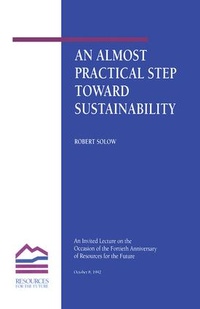
An Almost Practical Step Toward Sustainability
1st Edition
Published on 21. December 2017
Book
Hardback
28 pages
978-1-138-47195-5 (ISBN)
Description
Nobel Laureate Robert Solow explores how changes in social accounting practice could contribute to more rational debate and action in crafting economic and environmental policy. A thoughtful work about the wise use of society's natural resources, intergenerational equity, and the translation of ideas about sustainability into real policy.
More details
Language
English
Place of publication
London
United Kingdom
Publishing group
Taylor & Francis Ltd
Target group
Professional and scholarly
Professional Practice & Development
Dimensions
Height: 229 mm
Width: 152 mm
Weight
453 gr
ISBN-13
978-1-138-47195-5 (9781138471955)
Copyright in bibliographic data and cover images is held by Nielsen Book Services Limited or by the publishers or by their respective licensors: all rights reserved.
Schweitzer Classification
Other editions
Additional editions
Robert M. Solow
An Almost Practical Step Toward Sustainability
E-Book
07/2014
1st Edition
Routledge
€45.99
Available for download
Robert M. Solow
An Almost Practical Step Toward Sustainability
E-Book
07/2014
1st Edition
Routledge
€45.99
Available for download
Robert M. Solow
An Almost Practical Step Toward Sustainability
Book
01/1998
1st Edition
Resources for the Future Press (RFF Press)
€51.40
Shipment within 3-4 weeks
Person
Robert M. Solow is Institute Professor of Economics Emeritus at Massachusetts Institute of Technology and Nobel Laureate in Economics.
Content
Introductory Remarks
Paul R. Portney
An Almost Practical Step to Sustainability
Robert M. Solow
Previewing the Argument
Finding the True Net Product of Our Economy
Analyzing Sustainable Paths for a Modern Industrial Society
Connecting Up the Arguments
Concluding Comments
Paul R. Portney
An Almost Practical Step to Sustainability
Robert M. Solow
Previewing the Argument
Finding the True Net Product of Our Economy
Analyzing Sustainable Paths for a Modern Industrial Society
Connecting Up the Arguments
Concluding Comments