

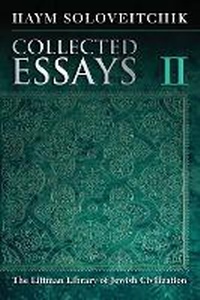
Collected Essays
Volume II
Published on 12. June 2019
Book
Paperback/Softback
448 pages
978-1-78694-166-4 (ISBN)
Description
In this second volume of his essays on the history of halakhah, Haym Soloveitchik grapples with much-disputed topics in medieval Jewish history and takes issue with a number of reigning views. His insistence that proper understanding requires substantive, in-depth analysis of the sources leads him to a searching analysis of oft-cited halakhic texts of Ashkenaz, frequently with conclusions that differ from the current consensus. Medieval Jewish historians cannot, he argues, avoid engaging in detailed textual criticism, and texts must always be interpreted in the context of the legal culture of their time. Historians who shirk these tasks risk reinforcing a version that supports their own preconceptions, and retrojecting later notions on to an earlier age. These basic methodological points underlie every topic discussed.
In Part I, devoted to the cultural origins of Ashkenaz and its lasting impact, Professor Soloveitchik questions the scholarly consensus that the roots of Ashkenaz lie deep in Palestinian soil. He challenges the widespread notion that it was immemorial custom (minhag kadmon) that primarily governed Early Ashkenaz, the culture that emerged in the Rhineland in the late tenth century and which was ended by the ravages of the First Crusade (1096). He similarly rejects the theory that it was only towards the middle of the eleventh century that the Babylonian Talmud came to be regarded as fully authoritative. On the basis of an in-depth analysis of the literature of the time, he shows that the scholars of Early Ashkenaz displayed an astonishing command of the complex corpus of the Babylonian Talmud and viewed it at all times as the touchstone of the permissible and the forbidden. The section concludes with his own radical proposal as to the source of Ashkenazi culture and the stamp it left upon the Jews of northern Europe for close to a millennium.
The second part of the volume treats the issue of martyrdom as perceived and practised by Jews under Islam and Christianity. In one of the longer essays, Soloveitchik claims that Maimonides' problematic Iggeret ha-Shemad is a work of rhetoric, not halakhah-a conclusion that has generated much criticism from other scholars, to whom he replies one by one. This is followed by a comprehensive study of kiddush ha-shem in Ashkenaz, which draws him into an analysis of whether aggadic sources were used by the Tosafists in halakhic arguments, as some historians claim; whether there was any halakhic validation of the widespread phenomenon of voluntary martyrdom; and, indeed, whether halakhic considerations played any part in such tragic life-and-death issues. The book concludes with two essays on Mishneh torah which argue that that famed code must also be viewed as a work of art which sustains, as masterpieces do, multiple conflicting interpretations.
Volume I available: https://liverpooluniversitypress.co.uk/doi/book/10.3828/9781904113973
Volume III available: https://liverpooluniversitypress.co.uk/doi/book/10.3828/9781904113997
In Part I, devoted to the cultural origins of Ashkenaz and its lasting impact, Professor Soloveitchik questions the scholarly consensus that the roots of Ashkenaz lie deep in Palestinian soil. He challenges the widespread notion that it was immemorial custom (minhag kadmon) that primarily governed Early Ashkenaz, the culture that emerged in the Rhineland in the late tenth century and which was ended by the ravages of the First Crusade (1096). He similarly rejects the theory that it was only towards the middle of the eleventh century that the Babylonian Talmud came to be regarded as fully authoritative. On the basis of an in-depth analysis of the literature of the time, he shows that the scholars of Early Ashkenaz displayed an astonishing command of the complex corpus of the Babylonian Talmud and viewed it at all times as the touchstone of the permissible and the forbidden. The section concludes with his own radical proposal as to the source of Ashkenazi culture and the stamp it left upon the Jews of northern Europe for close to a millennium.
The second part of the volume treats the issue of martyrdom as perceived and practised by Jews under Islam and Christianity. In one of the longer essays, Soloveitchik claims that Maimonides' problematic Iggeret ha-Shemad is a work of rhetoric, not halakhah-a conclusion that has generated much criticism from other scholars, to whom he replies one by one. This is followed by a comprehensive study of kiddush ha-shem in Ashkenaz, which draws him into an analysis of whether aggadic sources were used by the Tosafists in halakhic arguments, as some historians claim; whether there was any halakhic validation of the widespread phenomenon of voluntary martyrdom; and, indeed, whether halakhic considerations played any part in such tragic life-and-death issues. The book concludes with two essays on Mishneh torah which argue that that famed code must also be viewed as a work of art which sustains, as masterpieces do, multiple conflicting interpretations.
Volume I available: https://liverpooluniversitypress.co.uk/doi/book/10.3828/9781904113973
Volume III available: https://liverpooluniversitypress.co.uk/doi/book/10.3828/9781904113997
Reviews / Votes
Reviews'Reading Soloveitchik is always a delight as his careful writing, perceptive insights, and vast scholarship and erudition can be found on every page.'
David Tesler, Association of Jewish Libraries Reviews 'A very important work, especially since nine of the essays have never before appeared in print . . . There is so much learning in this book, and it is written in such an engaging style, that anyone with an appreciation for the history of halakhah will be spellbound.'
Marc B.
Shapiro, Seforim blog
More details
Series
Language
English
Place of publication
Liverpool
United Kingdom
Target group
College/higher education
Illustrations
Maps
Dimensions
Height: 234 mm
Width: 156 mm
Thickness: 43 mm
Weight
816 gr
ISBN-13
978-1-78694-166-4 (9781786941664)
Copyright in bibliographic data and cover images is held by Nielsen Book Services Limited or by the publishers or by their respective licensors: all rights reserved.
Schweitzer Classification
Person
Haym Soloveitchik is the Merkin Family Research Professor at Yeshiva University, New York, and the former director of the School of Jewish Studies at the Institute of Advanced Studies, Hebrew University of Jerusalem. He has also taught at the Sorbonne and the Ecole des Hautes Etudes en Sciences Sociales in Paris. He has published books in Hebrew on pawnbroking and usury, Jewish involvement in the medieval wine trade, and the use of responsa as a historical source. Three volumes of his Collected Essays have been published by the Littman Library, as well as a new edition of his landmark essay, Rupture and Reconstruction: The Transformation of Modern Orthodoxy.
Content
Part I. Re-evaluation of Eleventh-Century Ashkenaz
Introduction
(1) Agobard of Lyons, Megillat A?ima'ats, and the Babylonian Orientation of Early Ashkenaz
(2) Dialectics, Scholasticism, and the Origin of the Tosafot
(3) Minhag Ashkenaz ha-Kadmon: An Assessment
(4) The Authority of the Babylonian Talmud and the Use of Biblical Verses and Aggadah in Early Ashkenaz
(5) On the Use of Aggadah by the Tosafists: A Response to I. M. Ta-Shma
(6) Characterizing Medieval Talmudists: A Case Study
(7) Communications and the Palestinian Origins of Ashkenaz
(8) The Palestinian Orientation of the Ashkenazic Community and Some Suggested Ground Rules for the Writing of Halakhic History
(9) The 'Third Yeshivah of Bavel' and the Cultural Origins of Ashkenaz-A Proposal
A Response to David Berger
Part II. Martyrdom Under Cross and Crescent
Introduction
(10) Between Cross and Crescent
(11) Halakhah, Hermeneutics, and Martyrdom in Ashkenaz
(12) Maimonides' Iggeret ha-Shemad: Law and Rhetoric
(13) Responses to Critiques of 'Maimonides' Iggeret ha-Shemad: Law and Rhetoric'
Part III. Mishneh Torah
(14) Classification of Mishneh Torah: Problems Real and Imaginary
(15) Mishneh Torah: Polemic and Art
Bibliography of Manuscripts
Indexes
Introduction
(1) Agobard of Lyons, Megillat A?ima'ats, and the Babylonian Orientation of Early Ashkenaz
(2) Dialectics, Scholasticism, and the Origin of the Tosafot
(3) Minhag Ashkenaz ha-Kadmon: An Assessment
(4) The Authority of the Babylonian Talmud and the Use of Biblical Verses and Aggadah in Early Ashkenaz
(5) On the Use of Aggadah by the Tosafists: A Response to I. M. Ta-Shma
(6) Characterizing Medieval Talmudists: A Case Study
(7) Communications and the Palestinian Origins of Ashkenaz
(8) The Palestinian Orientation of the Ashkenazic Community and Some Suggested Ground Rules for the Writing of Halakhic History
(9) The 'Third Yeshivah of Bavel' and the Cultural Origins of Ashkenaz-A Proposal
A Response to David Berger
Part II. Martyrdom Under Cross and Crescent
Introduction
(10) Between Cross and Crescent
(11) Halakhah, Hermeneutics, and Martyrdom in Ashkenaz
(12) Maimonides' Iggeret ha-Shemad: Law and Rhetoric
(13) Responses to Critiques of 'Maimonides' Iggeret ha-Shemad: Law and Rhetoric'
Part III. Mishneh Torah
(14) Classification of Mishneh Torah: Problems Real and Imaginary
(15) Mishneh Torah: Polemic and Art
Bibliography of Manuscripts
Indexes