

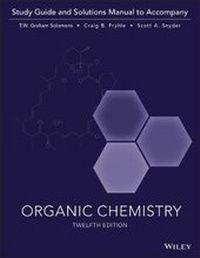
Organic Chemistry, Study Guide & Student Solutions Manual
12th Edition
Published on 11. April 2016
Book
Paperback/Softback
752 pages
978-1-119-07732-9 (ISBN)
Description
The Study Guide to accompany Organic Chemistry, 12th Edition contains review materials, practice problems and exercises to enhance mastery of the material in Organic Chemistry, 12th Edition.
In the Study Guide to accompany Organic Chemistry, 12th Edition, special attention is paid towards helping students learn how to put the various pieces of organic chemistry together in order to solve problems. The Study Guide helps clarify to students what organic chemistry is and how it works so that students can master the theory and practice of organic chemistry. The Study Guide emphasizes an understanding of how different molecules react together to create products and the relationship between structure and reactivity.
In the Study Guide to accompany Organic Chemistry, 12th Edition, special attention is paid towards helping students learn how to put the various pieces of organic chemistry together in order to solve problems. The Study Guide helps clarify to students what organic chemistry is and how it works so that students can master the theory and practice of organic chemistry. The Study Guide emphasizes an understanding of how different molecules react together to create products and the relationship between structure and reactivity.
More details
Edition
12th edition
Language
English
Place of publication
New York
United States
Target group
College/higher education
Dimensions
Height: 269 mm
Width: 213 mm
Thickness: 38 mm
Weight
1678 gr
ISBN-13
978-1-119-07732-9 (9781119077329)
Copyright in bibliographic data and cover images is held by Nielsen Book Services Limited or by the publishers or by their respective licensors: all rights reserved.
Schweitzer Classification
Other editions
Previous edition
T. W. Graham Solomons | Craig B. Fryhle | Scott A. Snyder
Student Study Guide and Student Solutions Manual to accompany Organic Chemistry 11e
Book
03/2013
Wiley
€219.00
Article exhausted; check for reprint
Persons
T.W. Graham Solomons did his undergraduate work at The Citadel and received his doctorate in organic chemistry in 1959 from Duke University where he worked with C.K. Bradsher. Following this he was a Sloan Foundation Postdoctoral Fellow at the University of Rachester where he worked with V. Boekelheide. in 1960 he became a charter member of the faculty of the University of South Florida and became Professor of Chemistry in 1973. In 1992 he was made Professor Emeritus. His research interests have been in areas of heterocyclic chemistry and unusual aromatic compounds. He has published papers in the Journal of the American Chemical Society, the Journal of Organic Chemistry, and the Journal of Heterocyclic Chemistry. He has received several awards for distinguished teaching.
Craig B. Fryhle is Chair and Professor of Chemistry at Pacific Lutheran University. He earned his B.A. degree from Gettysburg College and Ph.D. from Brown University. His experiences at these institutions shaped his dedication to mentoring undergraduate students in chemistry and the liberal arts, which is a passion that burns strongly for him. His research interests have been in areas relating to the shikimic acid pathway, including molecular modeling and NMR spectrometry of substrates and analogues, as well as structure and reactivity studies of shikimate pathways enzymes using isotopic labeling and mass spectrometry.
Craig B. Fryhle is Chair and Professor of Chemistry at Pacific Lutheran University. He earned his B.A. degree from Gettysburg College and Ph.D. from Brown University. His experiences at these institutions shaped his dedication to mentoring undergraduate students in chemistry and the liberal arts, which is a passion that burns strongly for him. His research interests have been in areas relating to the shikimic acid pathway, including molecular modeling and NMR spectrometry of substrates and analogues, as well as structure and reactivity studies of shikimate pathways enzymes using isotopic labeling and mass spectrometry.