

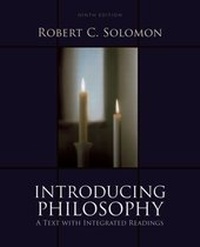
Introducing Philosophy
Text with Intergrated Readings
9th Edition
Published on 20. December 2007
Book
Paperback/Softback
684 pages
978-0-19-532952-0 (ISBN)
Description
Introducing Philosophy: A Text with integrated Readings , ninth edition, is an engaging introduction to the basic philosophical problems and their potential alternative solutions. It is a topically organized hybrid that includes Soloman's own discussion along with excerpts from prominent thinkers of the last 2500 years on topics such as the nature of reality, the existence and nature of God, the possibility of human knowledge, the mystery of the self, the nature of truth, and the essence of freedom.
More details
Edition
9th Revised edition
Language
English
Place of publication
New York
United States
Target group
College/higher education
Edition type
Revised edition
Dimensions
Height: 191 mm
Width: 234 mm
Thickness: 25 mm
Weight
1073 gr
ISBN-13
978-0-19-532952-0 (9780195329520)
Copyright in bibliographic data and cover images is held by Nielsen Book Services Limited or by the publishers or by their respective licensors: all rights reserved.
Schweitzer Classification
Other editions
Previous edition
Book
07/2004
8th Edition
Oxford University Press Inc
€34.65
Article exhausted; check for reprint
Person
Content
INTRODUCTION: PHILOSOPHY ; A. Socrate ; B. What is Philosophy ; C. Modern Approach to Philosophy ; D. A Brief Introduction to Logic ; PART 1: THE WORLD AND BEYOND ; Chapter 1. Reality ; A. "The Way the World Really Is" ; B. The First Greek Philosophers ; C. Ultimate Reality in the East; India, Persia, and China ; D. Two Kinds of Metaphysics: Plato and Aristotle ; E. Modern Metaphysics: Descartes, Spinoza, and Leibniz ; Chapter 2. Religion ; A. What is Religion? ; B. The Western Traditions ; C. God as Creator: Intellegence and Design ; D. Religion, Morality, and Evil ; E. Beyond Reason: Faith and Irrationality ; F. Doubts over Religion ; Chapter 3. Knowledge ; A. The Rationalist's Confidence: Descartes ; B. Innate Ideas Concerning Human Understanding: John Locke ; C. The Empiricist Theory of Knowledge ; D. Common Sense Undone: Bishop Berkeley ; E. The Congenial Skeptic: David Hume ; F. Kant's Revolution ; G. The Battle in Europe after Kant: Relativism and Absolutism ; H. Phenomenology ; I. Heremeneutics and Pragmatism: Relativism Reconsidered ; J. Feminist Epistemology ; Chapter 4. Self ; A. Consciousness and the Self: From Descartes to Kant ; B. Existentialism: Self-Identity and the Responsibility of Choice ; C. The Individual and the Community ; D. One Self? Any Self? Questioning the Concept of Personal "Essence" ; Chapter 5. Mind and Body ; A. What is Consciousness? ; B. The Problems of Dualism ; C. The Rejection of Dualism ; D. The Problem of Consciousness ; Chapter 6. Freedom ; A. Fatalism and Karma ; B. Predestination ; C. Determinism ; D. Compulsion and Ignorance ; E. Freedom in Practice ; F. Racial Freedom: Existentialism ; PART 3: THE GOOD AND THE RIGHT ; Chapter 7. Ethics ; A. Morality ; B. Is Morality Relative? ; C. Egotism and Altruism ; D. Morality as Virtue: Aristotle ; E. Morality and Sentiment: Hume and Rousseau ; F. Morality and Practical Reason: Kant ; G. Utilitarianism ; H. The Creation of Morality: Nietzsche and Existentialism ; I. Ethics and Gender ; Chapter 8. Justice ; A. The Problem of Justice ; B. Individual Rights and Freedom ; C. Obeying the Law: Civil Disobediance and Anarchism ; D. A Neglected Right: The Right to Eat