

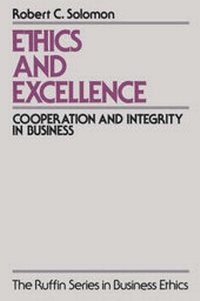
Ethics and Excellence
Cooperation and Integrity in Business
Published on 13. January 1994
Book
Paperback/Softback
304 pages
978-0-19-508711-6 (ISBN)
Description
The Greek philosopher Aristotle, writing over two thousand years before Wall Street, called people who engaged in activities which did not contribute to society "parasites." In his latest work, renowned scholar Robert C. Solomon asserts that though capitalism may require capital, it does not require, much less should it be defined by, the parasites it inevitably attracts. Capitalism has succeeded not with brute strength or because it has made people rich, but because it has produced responsible citizens and-however unevenly-prosperous communities. It cannot tolerate a conception of business that focuses solely on income and vulgarity while ignoring traditional virtues of responsibility, community, and integrity. Many feel that there is too much lip-service and not enough understanding of the importance of cooperation and integrity in corporate life. This book rejects the myths and metaphors of war-like competition that cloud business thinking and develops an "Aristotelean" theory of business.
The author's approach emphasizes several core concepts: the corporation as community, the search for excellence, the importance of integrity and sound judgment, as well as a more cooperative and humane vision of business. Solomon stresses the virtues of honesty, trust, fairness, and compassion in the competitive business world, and confronts the problem of "moral mazes" and what he posits as its solution-moral courage.
The author's approach emphasizes several core concepts: the corporation as community, the search for excellence, the importance of integrity and sound judgment, as well as a more cooperative and humane vision of business. Solomon stresses the virtues of honesty, trust, fairness, and compassion in the competitive business world, and confronts the problem of "moral mazes" and what he posits as its solution-moral courage.
Reviews / Votes
'Should be widely read by those involved in business.' Long Range Planning 'Solomon's style is lively, witty, and accessible to a broad readership, and the plan of the book is straightforward. He not only makes a major contribution to Business Ethics, but also provides a stimulus to the development of so-called virtue ethics in the heart of ethical theory.' Allen Buchanan, University of Wisconsin, Journal of Business Ethics, 13, 1994 'does a good job of bridging the ground between philosophy and business' S. Harrison, Leeds Metropolitan UniversityMore details
Language
English
Place of publication
New York
United States
Target group
Professional and scholarly
Illustrations
bibliography
Dimensions
Height: 234 mm
Width: 155 mm
Thickness: 23 mm
Weight
439 gr
ISBN-13
978-0-19-508711-6 (9780195087116)
Copyright in bibliographic data and cover images is held by Nielsen Book Services Limited or by the publishers or by their respective licensors: all rights reserved.
Schweitzer Classification
Content
Introduction: Can Ethics be Taught?
I. Business Myths and Metaphors: Vices Parading as Virtues
1: Macho Myths and Metaphors: Jungles, Battles, Games
2: Abstract Greed
3: The Myth of the Profit Motive
4: Game Theory as a Model for Business and Business Ethics
5: The End of Cowboy Capitalism
6: Atomic Myths and Metaphors: Individualism and "the Entrepreneur"
7: Beyond Selfishness: Adam Smith and Limits of the Market
8: Beyond Cost/Benefit Analysis: Utilitarinism Refined
II. An Aristotelian Approach to Business: Framework and Theory
9: Business Ethics: "The Third Wave" and the Problem of Theory
10: The Aristotelian Approach to Business Ethics
11: Business as an Unbounded Practice
12: Aristotelian Metaphors: Corporate Cultures and The Professional Manager
13: Business as a Profession: People imn Business as Professionals
14: The Six Parameters of Aristotelian Ethics
The Corporation as Community
In Search of Excellence
The Individual in the Organization
The Meaning of Integrity
Decision-making and Good Judgment
Holism: Beyond Stakeholder Analysis
III. The Heart of the Corporation: Business Virtues and Vices
The Nature of the Virtues
Aristotelian Virtues, Warrior, Moral and Business Virtues
The Basic Business Virtues: Honesty, Dependability, Trust and Fairness
The Virtues of the Corporate Self: Friendliness, Honor, Loyalty, Shame
Competition, Caring and Compassion
Justice: The Ultimate Virtue of Corporate Life
Resentment: Corporate Poison
The Charasmatic Virtues: Saints, Heroes, Clowns and Rogues (Nietzschian Management)
Theories in Practice: Ethics Styles
Moral Mazes and the Problem of Integrity
Epilogue: Philosophers in the Corporation: Apologists or Subversives?
I. Business Myths and Metaphors: Vices Parading as Virtues
1: Macho Myths and Metaphors: Jungles, Battles, Games
2: Abstract Greed
3: The Myth of the Profit Motive
4: Game Theory as a Model for Business and Business Ethics
5: The End of Cowboy Capitalism
6: Atomic Myths and Metaphors: Individualism and "the Entrepreneur"
7: Beyond Selfishness: Adam Smith and Limits of the Market
8: Beyond Cost/Benefit Analysis: Utilitarinism Refined
II. An Aristotelian Approach to Business: Framework and Theory
9: Business Ethics: "The Third Wave" and the Problem of Theory
10: The Aristotelian Approach to Business Ethics
11: Business as an Unbounded Practice
12: Aristotelian Metaphors: Corporate Cultures and The Professional Manager
13: Business as a Profession: People imn Business as Professionals
14: The Six Parameters of Aristotelian Ethics
The Corporation as Community
In Search of Excellence
The Individual in the Organization
The Meaning of Integrity
Decision-making and Good Judgment
Holism: Beyond Stakeholder Analysis
III. The Heart of the Corporation: Business Virtues and Vices
The Nature of the Virtues
Aristotelian Virtues, Warrior, Moral and Business Virtues
The Basic Business Virtues: Honesty, Dependability, Trust and Fairness
The Virtues of the Corporate Self: Friendliness, Honor, Loyalty, Shame
Competition, Caring and Compassion
Justice: The Ultimate Virtue of Corporate Life
Resentment: Corporate Poison
The Charasmatic Virtues: Saints, Heroes, Clowns and Rogues (Nietzschian Management)
Theories in Practice: Ethics Styles
Moral Mazes and the Problem of Integrity
Epilogue: Philosophers in the Corporation: Apologists or Subversives?