

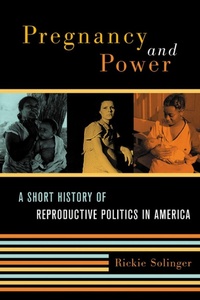
Pregnancy and Power
A Short History of Reproductive Politics in America
Published on 1. March 2007
Book
Paperback/Softback
312 pages
978-0-8147-9828-7 (ISBN)
Description
A sweeping chronicle of women's battles for reproductive freedom
A sweeping chronicle of women's battles for reproductive freedom throughout American history, Pregnancy and Power explores the many forces-social, racial, economic, and political-that have shaped women's reproductive lives in the United States.
Leading historian Rickie Solinger argues that a woman's control over her body involves much more than the right to choose an abortion. Reproductive politics were at play when slaveholders devised breeding schemes, when the U.S. government took Indian children from their families in the nineteenth century, and when doctors pressed Latina women to be sterilized in the 1970s. Tracing the diverse plot lines of women's reproductive lives throughout American history, Solinger redefines the idea of reproductive freedom, putting race and class at the center of the effort to control sex and pregnancy in America over time.
Solinger asks which women have how many children under what circumstances, and shows how reproductive experiences have been encouraged or coerced, rewarded or punished, honored or exploited over the last 250 years. Viewed in this way, the debate over reproductive rights raises questions about access to sex education and prenatal care, about housing laws, about access to citizenship, and about which women lose children to adoption and foster care.
Pregnancy and Power shows that a complete understanding of reproductive politics must take into account the many players shaping public policy-lawmakers, educators, employers, clergy, physicians-as well as the consequences for women who obey and resist these policies. Tracing the diverse plotlines of women's reproductive lives throughout American history, Solinger redefines the idea of reproductive freedom, putting race and class at the center of the struggle to control sex and pregnancy in America.
A sweeping chronicle of women's battles for reproductive freedom throughout American history, Pregnancy and Power explores the many forces-social, racial, economic, and political-that have shaped women's reproductive lives in the United States.
Leading historian Rickie Solinger argues that a woman's control over her body involves much more than the right to choose an abortion. Reproductive politics were at play when slaveholders devised breeding schemes, when the U.S. government took Indian children from their families in the nineteenth century, and when doctors pressed Latina women to be sterilized in the 1970s. Tracing the diverse plot lines of women's reproductive lives throughout American history, Solinger redefines the idea of reproductive freedom, putting race and class at the center of the effort to control sex and pregnancy in America over time.
Solinger asks which women have how many children under what circumstances, and shows how reproductive experiences have been encouraged or coerced, rewarded or punished, honored or exploited over the last 250 years. Viewed in this way, the debate over reproductive rights raises questions about access to sex education and prenatal care, about housing laws, about access to citizenship, and about which women lose children to adoption and foster care.
Pregnancy and Power shows that a complete understanding of reproductive politics must take into account the many players shaping public policy-lawmakers, educators, employers, clergy, physicians-as well as the consequences for women who obey and resist these policies. Tracing the diverse plotlines of women's reproductive lives throughout American history, Solinger redefines the idea of reproductive freedom, putting race and class at the center of the struggle to control sex and pregnancy in America.
Reviews / Votes
A concise historical overview. . . . Based primarily on a vast array of well-documented secondary sources, this book is a well-written and useful overview of the politics behind pregnancy in the U.S. . . . Highly recommended. (Choice) Solinger is impressively optimistic about America's potential not only to evolve into 'a country of reproductive justice,' but also to overcome centuries of the sex, race, and class prejudice that have literally built our society. (Bitch) The book is well documented and well written... I expect this book to find a place in many classrooms. (The Journal of American History) Readers will find within this book a deeply researched and fine analysis of reproductive politics spanning 250 years. It definitely should be of interest to legal scholars and law students and also to political and social historians. (The American Journal of Legal History) This succinct, highly readable political and cultural history of a wide range of reproductive issues is a near-perfect primer on the topic. (Publishers Weekly)More details
Language
English
Place of publication
New York
United States
Target group
Professional and scholarly
Product notice
Paperback (trade)
Dimensions
Height: 227 mm
Width: 153 mm
Thickness: 19 mm
Weight
422 gr
ISBN-13
978-0-8147-9828-7 (9780814798287)
Copyright in bibliographic data and cover images is held by Nielsen Book Services Limited or by the publishers or by their respective licensors: all rights reserved.
Schweitzer Classification
Other editions
Additional editions
E-Book
11/2005
New York University Press
€24.49
Available for download
Person
Rickie Solinger is a historian, the editor of a book series on reproductive justice, and a curator who organizes exhibitions associated with the themes of her books. Her books include Wake Up Little Susie: Single Pregnancy and Race Before Roe v. Wade, The Abortionist: A Woman Against the Law, and Beggars and Choosers: How the Politics of Choice Shapes Adoption, Abortion, and Welfare in the United States.
Content
Introduction: What Is Reproductive Politics? 1 Racializing the Nation: From the Declaration of Independence to the Emancipation Proclamation, 1776-1865 2 Sex in the City: From Secrecy to Anonymity to Privacy, 1870s to 1920s 3 No Extras: Curbing Fertility during the Great Depression 4 Central Planning: Managing Fertility, Race, and Rights in Postwar America, 1940s to 1960 5 The Human Rights Era: The Rise of Choice, the Contours of Backlash, 1960-1980 6 Revitalizing Hierarchies: How the Aftermath of Roe v. Wade Affected Fetuses, Teenage Girls, Prisoners, and Ordinary Women, 1980 to the Present Notes Acknowledgments Index About the Author