

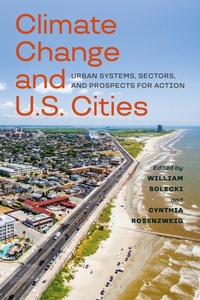
Climate Change and U.S. Cities
Urban Systems, Sectors, and Prospects for Action
Published on 28. April 2022
Book
Paperback/Softback
384 pages
978-1-61091-978-4 (ISBN)
Description
Approximately 80% of the U.S. population now lives in urban metropolitan areas, and this number is expected to grow
significantly in the coming years. At the same time, the built infrastructure sustaining these populations has become
increasingly vulnerable to climate change. Stresses to existing systems, such as buildings, energy, transportation, water,
and sanitation are growing. If the status quo continues, these systems will be unable to support a high quality of life for
urban residents over the next decades, a vulnerability exacerbated by climate change impacts. Understanding this
dilemma and identifying a path forward is particularly important as cities are becoming leading agents of climate action.
Prepared as a follow-up to the Fourth National Climate Assessment (NCA), Climate Change and U.S. Cities documents the
current understanding of existing and future climate risk for U.S. cities, urban systems, and the residents that depend on
them. Beginning with an examination of the existing science since 2012, chapters develop connections between existing
and emerging climate risk, adaptation planning, and the role of networks and organizations in facilitating climate action
in cities. From studies revealing disaster vulnerability among low-income populations to the development of key
indicators for tracking climate change, this is an essential, foundational analysis. Importantly, the assessment puts a
critical emphasis on the cross-cutting factors of economics, equity, and governance.
Urban stakeholders and decision makers will come away with a full picture of existing climate risks and a set of conclusions and recommendations for action. Many cities in the United States still have not yet planned for climate
change and the costs of inaction are great. With bold analysis, Climate Change and U.S. Cities reveals the need for action
and the tools that cities must harness to effect decisive, meaningful change.
significantly in the coming years. At the same time, the built infrastructure sustaining these populations has become
increasingly vulnerable to climate change. Stresses to existing systems, such as buildings, energy, transportation, water,
and sanitation are growing. If the status quo continues, these systems will be unable to support a high quality of life for
urban residents over the next decades, a vulnerability exacerbated by climate change impacts. Understanding this
dilemma and identifying a path forward is particularly important as cities are becoming leading agents of climate action.
Prepared as a follow-up to the Fourth National Climate Assessment (NCA), Climate Change and U.S. Cities documents the
current understanding of existing and future climate risk for U.S. cities, urban systems, and the residents that depend on
them. Beginning with an examination of the existing science since 2012, chapters develop connections between existing
and emerging climate risk, adaptation planning, and the role of networks and organizations in facilitating climate action
in cities. From studies revealing disaster vulnerability among low-income populations to the development of key
indicators for tracking climate change, this is an essential, foundational analysis. Importantly, the assessment puts a
critical emphasis on the cross-cutting factors of economics, equity, and governance.
Urban stakeholders and decision makers will come away with a full picture of existing climate risks and a set of conclusions and recommendations for action. Many cities in the United States still have not yet planned for climate
change and the costs of inaction are great. With bold analysis, Climate Change and U.S. Cities reveals the need for action
and the tools that cities must harness to effect decisive, meaningful change.
More details
Series
Language
English
Place of publication
Washington
United States
Product notice
Paperback (trade)
Unsewn / adhesive bound
Dimensions
Height: 226 mm
Width: 152 mm
Thickness: 15 mm
Weight
431 gr
ISBN-13
978-1-61091-978-4 (9781610919784)
Copyright in bibliographic data and cover images is held by Nielsen Book Services Limited or by the publishers or by their respective licensors: all rights reserved.
Schweitzer Classification
Other editions
Additional editions
Cynthia Rosenzweig | William D. Solecki
Climate Change and U.S. Cities
Urban Systems, Sectors, and Prospects for Action
E-Book
02/2022
Princeton University Press
€51.99
Available for download
Persons
William Solecki is a Professor of Geography at Hunter College, CUNY, and a founding member of both the Urban Climate Change Research Network and the International Human Dimensions Programme's Urbanization and Global Environmental Change Project. Dr. Solecki is currently a lead author of the IPCC Sixth Assessment. Cynthia Rosenzweig is a Senior Research Scientist at the NASA Goddard Institute for Space Studies, where she heads the Climate Impacts Group. She is a Professor at Barnard College and a Senior Research Scientist at The Earth Institute at Columbia University.
Content
Chapter 1. Introduction: Cities and Climate Change Connections
William Solecki and Cynthia Rosenzweig
Chapter 2. Urban Systems and Climate Change in Context
Nancy B. Grimm, Dale Quattrochi, and Christopher Clark
Chapter 3. Urban Infrastructure Systems and Services: Vulnerabilities and Impacts
Rae Zimmerman and Adam Freed
Chapter 4. Urban Climate Adaptation Planning, Governance, and Economics
Susan Julius, Ira Feldman, and JoAnn Carmin
Chapter 5. Sustained Urban Climate Assessment
Cynthia Rosenzweig, Danielle Peters, and Reginald Blake
Chapter 6. Conclusions and Recommendations: Prospects for Action
Cynthia Rosenzweig and William Solecki
William Solecki and Cynthia Rosenzweig
Chapter 2. Urban Systems and Climate Change in Context
Nancy B. Grimm, Dale Quattrochi, and Christopher Clark
Chapter 3. Urban Infrastructure Systems and Services: Vulnerabilities and Impacts
Rae Zimmerman and Adam Freed
Chapter 4. Urban Climate Adaptation Planning, Governance, and Economics
Susan Julius, Ira Feldman, and JoAnn Carmin
Chapter 5. Sustained Urban Climate Assessment
Cynthia Rosenzweig, Danielle Peters, and Reginald Blake
Chapter 6. Conclusions and Recommendations: Prospects for Action
Cynthia Rosenzweig and William Solecki