

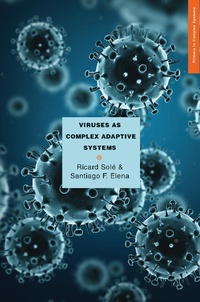
Viruses as Complex Adaptive Systems
Published on 11. December 2018
Book
Paperback/Softback
240 pages
978-0-691-15884-6 (ISBN)
Description
How complex systems theory sheds new light on the adaptive dynamics of viral populations
Viruses are everywhere, infecting all sorts of living organisms, from the tiniest bacteria to the largest mammals. Many are harmful parasites, but viruses also play a major role as drivers of our evolution as a species and are essential regulators of the composition and complexity of ecosystems on a global scale. This concise book draws on complex systems theory to provide a fresh look at viral origins, populations, and evolution, and the coevolutionary dynamics of viruses and their hosts.
New viruses continue to emerge that threaten people, crops, and farm animals. Viruses constantly evade our immune systems, and antiviral therapies and vaccination campaigns can be powerless against them. These unique characteristics of virus biology are a consequence of their tremendous evolutionary potential, which enables viruses to quickly adapt to any environmental challenge. Ricard Sole and Santiago Elena present a unified framework for understanding viruses as complex adaptive systems. They show how the application of complex systems theory to viral dynamics has provided new insights into the development of AIDS in patients infected with HIV-1, the emergence of new antigenic variants of the influenza A virus, and other cutting-edge advances.
Essential reading for biologists, physicists, and mathematicians interested in complexity, Viruses as Complex Adaptive Systems also extends the analogy of viruses to the evolution of other replicators such as computer viruses, cancer, and languages.
Viruses are everywhere, infecting all sorts of living organisms, from the tiniest bacteria to the largest mammals. Many are harmful parasites, but viruses also play a major role as drivers of our evolution as a species and are essential regulators of the composition and complexity of ecosystems on a global scale. This concise book draws on complex systems theory to provide a fresh look at viral origins, populations, and evolution, and the coevolutionary dynamics of viruses and their hosts.
New viruses continue to emerge that threaten people, crops, and farm animals. Viruses constantly evade our immune systems, and antiviral therapies and vaccination campaigns can be powerless against them. These unique characteristics of virus biology are a consequence of their tremendous evolutionary potential, which enables viruses to quickly adapt to any environmental challenge. Ricard Sole and Santiago Elena present a unified framework for understanding viruses as complex adaptive systems. They show how the application of complex systems theory to viral dynamics has provided new insights into the development of AIDS in patients infected with HIV-1, the emergence of new antigenic variants of the influenza A virus, and other cutting-edge advances.
Essential reading for biologists, physicists, and mathematicians interested in complexity, Viruses as Complex Adaptive Systems also extends the analogy of viruses to the evolution of other replicators such as computer viruses, cancer, and languages.
Reviews / Votes
"This book demonstrates how viruses, besides being fascinating organisms, can provide experimental tests and case studies for many of the evolutionary processes that are important to biologists."-Lin Chao, University of California, San Diego "This stimulating and timely book addresses questions central to virus population dynamics from the conceptual framework of complex systems theory. Clearly structured and easy to read, it fills a gap and will appeal to scientists in a diversity of fields, from virology to mathematical biology."-Fernando Garcia-Arenal, Universidad Politecnica de Madrid "Viruses as Complex Adaptive Systems covers the evolution, diversity, and behavior of viruses from a mathematical perspective, providing a broad range of vignettes on the subject that are clear and engagingly written. The book also serves as a useful introduction to some aspects of theoretical biology."-Oliver Pybus, University of Oxford "Sole and Elena bring together in one place a variety of different concepts and approaches that are normally treated separately, offering detailed discussions of the rapid contemporary variation of some viruses along with the medium and long-term evolution of others. I know of no other book like this one."-Colin R. Parrish, Cornell UniversityMore details
Series
Language
English
Place of publication
New Jersey
United States
Target group
College/higher education
Professional and scholarly
Product notice
Paperback (trade)
Illustrations
69 b/w illus.
Dimensions
Height: 213 mm
Width: 141 mm
Thickness: 20 mm
Weight
331 gr
ISBN-13
978-0-691-15884-6 (9780691158846)
Copyright in bibliographic data and cover images is held by Nielsen Book Services Limited or by the publishers or by their respective licensors: all rights reserved.
Schweitzer Classification
Other editions
Additional editions
Ricard Solé | Santiago F. Elena
Viruses as Complex Adaptive Systems
E-Book
11/2018
1st Edition
Princeton University Press
€39.99
Available for download
Persons
Ricard Sole is research professor and head of the Complex Systems Lab at Pompeu Fabra University in Barcelona. His books include Phase Transitions and Self-Organization in Complex Ecosystems (both Princeton). Santiago F. Elena is professor and head of the Evolutionary Systems Virology Lab at the Spanish National Research Council (CSIC) in Valencia.