

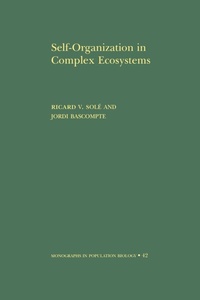
Self-Organization in Complex Ecosystems
Published on 26. March 2006
Book
Paperback/Softback
384 pages
978-0-691-07040-7 (ISBN)
Description
Can physics be an appropriate framework for the understanding of ecological science? Most ecologists would probably agree that there is little relation between the complexity of natural ecosystems and the simplicity of any example derived from Newtonian physics. Though ecologists have long been interested in concepts originally developed by statistical physicists and later applied to explain everything from why stock markets crash to why rivers develop particular branching patterns, applying such concepts to ecosystems has remained a challenge. Self-Organization in Complex Ecosystems is the first book to clearly synthesize what we have learned about the usefulness of tools from statistical physics in ecology. Ricard Sole and Jordi Bascompte provide a comprehensive introduction to complex systems theory, and ask: do universal laws shape the structure of ecosystems, at least at some scales? They offer the most compelling array of theoretical evidence to date of the potential of nonlinear ecological interactions to generate nonrandom, self-organized patterns at all levels.
Tackling classic ecological questions--from population dynamics to biodiversity to macroevolution--the book's novel presentation of theories and data shows the power of statistical physics and complexity in ecology. Self-Organization in Complex Ecosystems will be a staple resource for years to come for ecologists interested in complex systems theory as well as mathematicians and physicists interested in ecology.
Tackling classic ecological questions--from population dynamics to biodiversity to macroevolution--the book's novel presentation of theories and data shows the power of statistical physics and complexity in ecology. Self-Organization in Complex Ecosystems will be a staple resource for years to come for ecologists interested in complex systems theory as well as mathematicians and physicists interested in ecology.
Reviews / Votes
"Self-Organization in Complex Ecosystems is an excellent book, and could very well be the very best of its type."--Timothy F. H. Allen. BioScience "There is no book like this in the canonical line of textbooks on theoretical ecology: Self-Organization in Complex Ecosystems views ecosystems from the perspective of self-organization and the emergence of their large-scale complex features. It does this from a largely mathematical perspective and, surprisingly, draws on several methods from theoretical physics."--Stefan Bornholdt, TRENDS "Throughout the volume, the authors provide examples of rigorous mathematical treatment and ecological problems of local and global significance using concepts and tools of statistical physics. These examples, as well as a solid background on the applicability of fundamental laws of physics in ecology, could provide excellent supplemental formation for theoretical ecology courses."--Igor Linkov, Quarterly Review of BiologyMore details
Series
Language
English
Place of publication
New Jersey
United States
Target group
Professional and scholarly
College/higher education
Product notice
Paperback (trade)
Illustrations
112 line illus. 6 tables.
Dimensions
Height: 234 mm
Width: 156 mm
Thickness: 22 mm
Weight
594 gr
ISBN-13
978-0-691-07040-7 (9780691070407)
Copyright in bibliographic data and cover images is held by Nielsen Book Services Limited or by the publishers or by their respective licensors: all rights reserved.
Schweitzer Classification
Other editions
Additional editions
Ricard Solé | Jordi Bascompte
Self-Organization in Complex Ecosystems
E-Book
06/2015
1st Edition
Princeton University Press
€90.99
Available for download
Ricard Sole | Jordi Bascompte
Self-Organization in Complex Ecosystems
Book
03/2006
Princeton University Press
€117.61
Article exhausted; check different version
Persons
Ricard V. Sole is Professor of Research at the Catalan Institute for Research and Advanced Studies in Spain, head of the Complex Systems Lab at Universitat Pompeu Fabra in Barcelona, external professor at the Santa Fe Institute, and Senior Member of the NASA-Associate Center of Astrobiology. His recent books include "Signs of Life: How Complexity Pervades Biology". Jordi Bascompte is Associate Professor of Research at the Spanish Research Council, and a Visiting Scientist at the National Center for Ecological Analysis and Synthesis at the University of California, Santa Barbara. He was awarded a European Young Investigator Award, and is coeditor of "Modeling Spatiotemporal Dynamics in Ecology".
Content
List of Figures and Tables xi Acknowledgments xv Chapter 1: Complexity in Ecological Systems 1 The Newtonian Paradigm in Physics 2 Dynamics and Thermodynamics 6 Emergent Properties 10 Ecosystems as Complex Adaptive Systems 13 Chapter 2: Nonlinear Dynamics 17 The Balance of Nature?17 Population Cycles 19 Catastrophes and Breakpoints 27 Deterministic Chaos 31 Evidence of Bifurcations in Nature 34 Unpredictability and Forecasting 42 The Ecology of Universality 48 Evidence of Chaos in Nature 50 Criticisms of Chaos 58 Complex Dynamics:The Interplay between Noise and Nonlinearities 61 Chapter 3: Spatial Self-Organization:From Pattern to Process 65 Space:The Missing Ingredient 65 Turing Instabilities 68 Coupled Map Lattice Models 84 Looking for Self-Organizing Spatial Patterns in Nature 95 Dispersal and Complex Dynamics 98 Spatial Synchrony in Population Cycles 108 When Is Space Relevant?A Trade-Off between Simplicity and Realism 117 Coevolution and Diffusion in Phenotype Space 123 Chapter 4: Scaling and Fractals in Ecology 127 Scaling and Fractals 127 Fractal Time Series 137 Percolation 139 Nonequilibrium Phase Transitions 144 The Branching Process 146 The Contact Process:Complexity Made Simple 149 Random Walks and Levy Flights in Population Dynamics 151 Percolation and Scaling in Random Graphs 156 Ecological Multifractals 162 Self-Organized Critical Phenomena 165 Complexity from Simplicity 168 Chapter 5: Habitat Loss and Extinction Thresholds 171 Habitat Loss and Fragmentation 171 Extinction Thresholds in Metapopulation Models 173 Extinction Thresholds in Metacommunity Models 178 Food Web Structure and Habitat Loss 186 Percolation in Spatially Explicit Landscapes 191 Extinction Thresholds in Spatially Explicit Models 195 Analytical Models of Correlated Landscapes 199 More Realistic Models of Extinction Thresholds 206 Chapter 6: Complex Ecosystems:From Species to Networks 215 Stability and Complexity 215 N-Species Lotka-Volterra Models 218 Topological and Dynamic Constraints 223 Indirect Effects 226 Keystone Species and Evolutionary Dynamics 231 Complexity and Fragility in Food Webs 237 Community Assembly:The Importance of History 251 Scaling in Ecosystems:A Stochastic Quasi-Neutral Model 254 Chapter 7: Complexity in Macroevolution 263 Extinction and Diversification 263 Internal and External Factors 264 Scaling in the Fossil Recor 270 Competition and the Fossil Recor 276 Red Queen Dynamics 279 Evolution on Fitness Landscapes 282 Extinctions and Coherent Noise 292 NetworkModels of Macroevolution 295 Ecology as It Would Be: Artificial Life 304 Recovery after Mass Extinction 308 Implications for Current Ecologies 313 Appendix 1.Lyapunov Exponents for ID Maps 317 Appendix 2.Renormalization Group Analysis 319 Appendix 3.Stochastic Multispecies Model 321 References 325 Index 359