

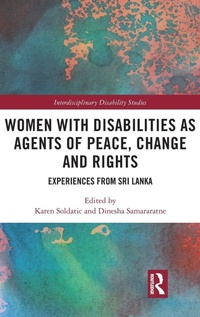
Women with Disabilities as Agents of Peace, Change and Rights
Experiences from Sri Lanka
1st Edition
Published on 30. October 2020
Book
Hardback
122 pages
978-1-138-08524-4 (ISBN)
Description
Drawing on rich empirical work emerging from core conflict regions within the island nation of Sri Lanka, this book illustrates the critical role that women with disabilities play in post-armed conflict rebuilding and development.
This pathbreaking book shows the critical role that women with disabilities play in post-armed conflict rebuilding and development. Through offering a rare yet important insight into the processes of gendered-disability advocacy activation within the post-conflict environment, it provides a unique counter narrative to the powerful images, symbols and discourses that too frequently perpetuate disabled women's so-called need for paternalistic forms of care. Rather than being the mere recipients of aid and help, the narratives of women with disabilities reveal the generative praxis of social solidarity and cohesion, progressed via their nascent collective practices of gendered-disability advocacy.
It will be of interest to academics and students working in the fields of disability studies, gender studies, post-conflict studies, peace studies and social work.
This pathbreaking book shows the critical role that women with disabilities play in post-armed conflict rebuilding and development. Through offering a rare yet important insight into the processes of gendered-disability advocacy activation within the post-conflict environment, it provides a unique counter narrative to the powerful images, symbols and discourses that too frequently perpetuate disabled women's so-called need for paternalistic forms of care. Rather than being the mere recipients of aid and help, the narratives of women with disabilities reveal the generative praxis of social solidarity and cohesion, progressed via their nascent collective practices of gendered-disability advocacy.
It will be of interest to academics and students working in the fields of disability studies, gender studies, post-conflict studies, peace studies and social work.
Reviews / Votes
"This book upends common portrayals of disabled women - from passive recipients or victims to agents of change in post-conflict settings. Using the stories of diverse Sri Lankan women and foregrounding gendered and disability injustices, the compelling narratives demonstrate how disabled women's activism has changed the peace-building context in Sri Lanka. In building networks and coalitions to address their needs and aspirations, Sri Lankan disabled women remind us of the importance of 'nothing without us'."Deborah Stienstra, Jarislowsky Chair in Families and Work, Director, Live Work Well Research Centre, Professor of Political Science, University of Guelph, Canada.
"A critical and timely intervention in the literature on both peacebuilding and disability studies, this book builds a comprehensive argument against locating women peacebuilders as a generic category by examining the specific role of disabled women in peacebuilding in Sri Lanka. In doing so it offers evidence and provocative insights from across scholarship, activism, life narratives and ethnic boundaries into the relationship of disability justice and postwar peace, collective mobilization and women's agency. A compelling case study thereby emerges not only of the specific Sri Lankan context in relation to its war, the law, disability rights and challenges of post-war recovery, but also what peacebuilding means from a non-ableist perspective."
Neloufer de Mel, Chair Professor of English, Department of English, University of Colombo, Sri Lanka.
"Using intersectional and agency perspectives in Post war Sri Lankan context, this book contributes significantly to the growing gender and disability literature in the global south. Empirically underlining the challenges of individual and collective activism of women with disabilities in peace making, it provides useful recommendations for public policy. A must read."Nilika Mehrotra, Professor, School of Social Sciences, Jawaharlal Nehru University, New Delhi, India. "This book upends common portrayals of disabled women - from passive recipients or victims to agents of change in post-conflict settings. Using the stories of diverse Sri Lankan women and foregrounding gendered and disability injustices, the compelling narratives demonstrate how disabled women's activism has changed the peace-building context in Sri Lanka. In building networks and coalitions to address their needs and aspirations, Sri Lankan disabled women remind us of the importance of 'nothing without us'."
Deborah Stienstra, Jarislowsky Chair in Families and Work, Director, Live Work Well Research Centre, Professor of Political Science, University of Guelph, Canada.
"A critical and timely intervention in the literature on both peacebuilding and disability studies, this book builds a comprehensive argument against locating women peacebuilders as a generic category by examining the specific role of disabled women in peacebuilding in Sri Lanka. In doing so it offers evidence and provocative insights from across scholarship, activism, life narratives and ethnic boundaries into the relationship of disability justice and postwar peace, collective mobilization and women's agency. A compelling case study thereby emerges not only of the specific Sri Lankan context in relation to its war, the law, disability rights and challenges of post-war recovery, but also what peacebuilding means from a non-ableist perspective."
Neloufer de Mel, Chair Professor of English, Department of English, University of Colombo, Sri Lanka.
"Using intersectional and agency perspectives in Post war Sri Lankan context, this book contributes significantly to the growing gender and disability literature in the global south. Empirically underlining the challenges of individual and collective activism of women with disabilities in peace making, it provides useful recommendations for public policy. A must read."Nilika Mehrotra, Professor, School of Social Sciences, Jawaharlal Nehru University, New Delhi, India.
More details
Series
Language
English
Place of publication
London
United Kingdom
Publishing group
Taylor & Francis Ltd
Target group
College/higher education
Dimensions
Height: 240 mm
Width: 161 mm
Thickness: 12 mm
Weight
358 gr
ISBN-13
978-1-138-08524-4 (9781138085244)
Copyright in bibliographic data and cover images is held by Nielsen Book Services Limited or by the publishers or by their respective licensors: all rights reserved.
Schweitzer Classification
Other editions
Additional editions
Karen Soldatic | Dinesha Samararatne
Women with Disabilities as Agents of Peace, Change and Rights
Experiences from Sri Lanka
Book
04/2022
1st Edition
Routledge
€62.20
Shipment within 15-20 days
Karen Soldatic | Dinesha Samararatne
Women with Disabilities as Agents of Peace, Change and Rights
Experiences from Sri Lanka
E-Book
10/2020
1st Edition
Routledge
€55.49
Available for download
Karen Soldatic | Dinesha Samararatne
Women with Disabilities as Agents of Peace, Change and Rights
Experiences from Sri Lanka
E-Book
10/2020
1st Edition
Routledge
€55.49
Available for download
Persons
Karen Soldatic is an Associate Professor, School of Social Sciences, and Institute Fellow, Institute for Culture and Society, at Western Sydney University. She was awarded a Fogarty Foundation Excellence in Education Fellowship for 2006-09, a British Academy International Fellowship in 2012, a fellowship at The Centre for Human Rights Education at Curtin University (2011-12), where she remains an Adjunct Fellow, and an Australian Research Council DECRA Fellowship (2016-19). Her research on global welfare regimes builds on her 20 years of experience as an international, national and state-based senior policy analyst, researcher and practitioner. She obtained her PhD (Distinction) in 2010 from the University of Western Australia.
Dinesha Samararatne is a Senior Lecturer at the Department of Public & International Law at the Faculty of Law at the University of Colombo, Sri Lanka. She is also a Postdoctoral Fellow in the ARC Laureate Program in Comparative Constitutional Law (2019-20), a Co-Convenor of Constitution Transformation Network (CTN) of the Melbourne Law School and co-editor of the Blog of the International Association for Constitutional Law (IACL). Her recent research has been in relation to constitution-making, methodology of comparative constitutional law, women's rights and rights of persons with disabilities.
Dinesha Samararatne is a Senior Lecturer at the Department of Public & International Law at the Faculty of Law at the University of Colombo, Sri Lanka. She is also a Postdoctoral Fellow in the ARC Laureate Program in Comparative Constitutional Law (2019-20), a Co-Convenor of Constitution Transformation Network (CTN) of the Melbourne Law School and co-editor of the Blog of the International Association for Constitutional Law (IACL). Her recent research has been in relation to constitution-making, methodology of comparative constitutional law, women's rights and rights of persons with disabilities.
Content
1. Introduction: Out of the shadows: Women with disabilities as agents of peace, justice and reparations in Sri Lanka. 2. Going beyond disability identity and creating communities of belonging: Perception management and gendered disability advocacy. 3. Music, resistance and change: The gendered-disability performativity of a Tamil woman with multiple disabilities. 4. Raging (e)motions. 5. Women with disabilities, advocacy and the law. 6. Learning about rights, claiming a gendered-disability identity: The role of reparations and gendered-disability justice. 7. Conclusion and recommendations: Enabling women with disabilities' advocacy and activism in the peace-building landscape