

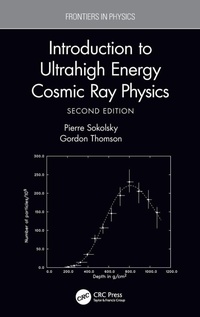
Introduction To Ultrahigh Energy Cosmic Ray Physics
2nd Edition
Published on 27. October 2020
Book
Hardback
158 pages
978-0-367-17384-5 (ISBN)
Description
This revised edition provides an up-to-date summary of the field of ultra-high energy cosmic rays, dealing with their origin, propagation, and composition,. The authors reflect the enormous strides made since the first edition in the realm of experimental work, in particular the use of vastly improved, more sensitive and precise detectors. The level remains introductory and pedagogical, suitable for students and researchers interested in moving into this exciting field. Throughout the text, the authors focus on giving an introductory overview of the key physics issues, followed by a clear and concise description of experimental approaches and current results.
Key Features:
Updates the most coherent summary of the field available, with new text that provides the reader with clear historical context.
Brand new discussion of contemporary space-based experiments and ideas for extending ground-based detectors.
Completely new discussion of radio detection methods.
Includes a new chapter on small to intermediate-scale anisotropy.
Offers new sections on modern hadronic models and software packages to simulate showers.
Key Features:
Updates the most coherent summary of the field available, with new text that provides the reader with clear historical context.
Brand new discussion of contemporary space-based experiments and ideas for extending ground-based detectors.
Completely new discussion of radio detection methods.
Includes a new chapter on small to intermediate-scale anisotropy.
Offers new sections on modern hadronic models and software packages to simulate showers.
More details
Series
Edition
2nd edition
Language
English
Place of publication
London
United Kingdom
Publishing group
Taylor & Francis Ltd
Target group
Professional and scholarly
Academic and Professional Practice & Development
Illustrations
44 s/w Abbildungen, 17 farbige Abbildungen, 1 s/w Tabelle
1 Tables, black and white; 17 Illustrations, color; 44 Illustrations, black and white
Dimensions
Height: 240 mm
Width: 161 mm
Thickness: 14 mm
Weight
435 gr
ISBN-13
978-0-367-17384-5 (9780367173845)
Copyright in bibliographic data and cover images is held by Nielsen Book Services Limited or by the publishers or by their respective licensors: all rights reserved.
Schweitzer Classification
Other editions
Additional editions
Pierre Sokolsky | Gordon Thomson
Introduction To Ultrahigh Energy Cosmic Ray Physics
Book
10/2020
2nd Edition
CRC Press
€91.75
Shipment within 15-20 days
Pierre Sokolsky | Gordon Thomson
Introduction To Ultrahigh Energy Cosmic Ray Physics
E-Book
10/2020
2nd Edition
CRC Press
€97.49
Available for download
Pierre Sokolsky | Gordon Thomson
Introduction To Ultrahigh Energy Cosmic Ray Physics
E-Book
10/2020
2nd Edition
CRC Press
€97.49
Available for download
Persons
Pierre Sokolsky and Gordon Thomson are both emeritus at the Department of Physics and Astronomy of the University of Utah, where Sokolsky was a Distinguished Professor and Thomson held the Jack W. Keuffel Chair in Experimental Astrophysics. Both were co-spokespersons of the High Resolution Fly's Eye (HiRes) and the Telescope Array experiments. Sokolsky played an important role in the pioneering Fly's Eye experiment and is the recipient of the American Physical Society's Panofsky Prize for the development of the air-fluorescence technique for the study of ultra-high energy cosmic rays.
Content
Introduction to the Second Edition. Survey of Ultrahigh Energy Cosmic Rays. Extensive Air Showers. Monte Carlo Simulation Techniques. Experimental Techniques: Surface Detectors. Experimental Techniques: Air Fluorescence. Experimental Techniques: Hybrid Detectors. Experimental Techniques: Radio Detection of Cosmic Ray Cascades. The Cosmic Ray Spectrum. Searches for Anisotropy. Composition: Direct Methods . Composition: Muon and Electron Detectors. Ultrahigh Energy Cosmic Ray Composition. The Inelastic Total Cross Section. The Atmosphere