

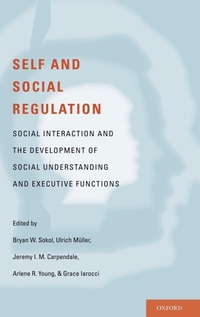
Self- and Social-Regulation
Social Interaction and the Development of Social Understanding and Executive Functions
Published on 4. February 2010
Book
Hardback
472 pages
978-0-19-532769-4 (ISBN)
Description
New research on children's executive functioning and self-regulation has begun to reveal important connections to their developing social understanding (or "theories of mind") and emotional competence. The exact nature of the relations between these aspects of children's social and emotional development is, however, far from being fully understood. Considerable disagreement has emerged, for instance, over the question of whether executive functioning facilitates social-emotional understanding, or vice versa. Recent studies linking the development of children's social understanding with aspects of their interpersonal relationships also raise concerns about the particular role that social interaction plays in the development of executive function. Three key questions currently drive this debate: Does social interaction play a role in the development of executive function or, more generally, self-regulation? If it does play a role, what forms of social interaction facilitate the development of executive function? Do different patterns of interpersonal experience differentially affect the development of self-regulation and social understanding? In this book, the contributors address these questions and explore other emerging theoretical and empirical links between self-regulation, social interaction, and children's psycho-social competence. It will be a valuable resource for student and professional researchers interested in executive function, emotion, and social development.
Reviews / Votes
This excellent book is unique in bringing together a very diverse group of authors who have something interesting to say about self-regulation or executive functioning and its relation to social understanding and social interaction. The authors vary in their perspectives, their approaches, and their foci, but together provide a stimulating, nuanced, and multifaceted review of theory and findings on self-regulation and executive functioning. Even an expert on the topic is likely to learn much about new approaches and empirical findings. This book will be very useful to researchers, students, and practitioners interested in the development of self-regulation and executive functioning. - Nancy Eisenberg, Regents' Professor, Department of Psychology, Arizona State University What an extraordinary collection! This carefully edited volume not only showcases some of the most exciting work in developmental psychology, but it also shows us the future of the field, in which the many facets of children's lives (cognitive, social, emotional, neurological, phenomenological, etc.) are understood in relation to one another. This is an important piece of scholarship, and it will make a lasting contribution. - Philip David Zelazo, Nancy M. and John E. Lindahl Professor, Institute of Child Development, University of MinnesotaMore details
Language
English
Place of publication
New York
United States
Target group
College/higher education
Professional and scholarly
Illustrations
1 halftone, 19 line illus.
Dimensions
Height: 240 mm
Width: 161 mm
Thickness: 30 mm
Weight
869 gr
ISBN-13
978-0-19-532769-4 (9780195327694)
Copyright in bibliographic data and cover images is held by Nielsen Book Services Limited or by the publishers or by their respective licensors: all rights reserved.
Schweitzer Classification
Other editions
Additional editions
Bryan Sokol | Ulrich Muller | Jeremy Carpendale
Self- and Social-Regulation
Social Interaction and the Development of Social Understanding and Executive Functions
E-Book
01/2010
1st Edition
OUP eBook
€65.99
Available for download
Persons
Bryan Sokol is an Assistant Professor in the Department of Psychology at St. Louis University. His research interests include the development of children's social understanding and socio-emotional competence, moral agency, and conceptions of selfhood. He is on the board of directors of the Jean Piaget Society.
Jeremy I. M. Carpendale is Professor of Developmental Psychology at Simon Fraser University. His areas of research include social cognitive and moral development. He is author with Charlie Lewis of "How Children Develop Social Understanding" (2006, Blackwell), co-editor of several books including the Cambridge Companion to Piaget and associate editor for New Ideas in Psychology.
Grace Iarocci is Associate Professor of Psychology and Michael Smith Foundation for Health Research scholar at Simon Fraser University. Her research focuses on the study of attention and cognition and the relation to social development in typical children and in individuals with developmental disorders. She is also interested in the effects of the child's mal/adaptation on parental and family health and well-being.
Arlene Young is an Associate Professor of psychology at Simon Fraser University and a clinical child psychologist. Her research interests focus on child individual differences, such as, temperament and cognitive biases and parent-child relationships in the development of anxiety disorders. She also publishes in the area of language and learning disorders including individual difference predictors of long-term outcomes and best practice for intervention.
Ulrich Mueller is Associate Professor of Developmental Psychology at the University of Victoria. His research focuses on the development of problem solving and social understanding in infants and preschoolers. He is an editor of the Cambridge Companion to Piaget (with Jeremy Carpendale and Les Smith) and associate editor for New Ideas in Psychology.
Jeremy I. M. Carpendale is Professor of Developmental Psychology at Simon Fraser University. His areas of research include social cognitive and moral development. He is author with Charlie Lewis of "How Children Develop Social Understanding" (2006, Blackwell), co-editor of several books including the Cambridge Companion to Piaget and associate editor for New Ideas in Psychology.
Grace Iarocci is Associate Professor of Psychology and Michael Smith Foundation for Health Research scholar at Simon Fraser University. Her research focuses on the study of attention and cognition and the relation to social development in typical children and in individuals with developmental disorders. She is also interested in the effects of the child's mal/adaptation on parental and family health and well-being.
Arlene Young is an Associate Professor of psychology at Simon Fraser University and a clinical child psychologist. Her research interests focus on child individual differences, such as, temperament and cognitive biases and parent-child relationships in the development of anxiety disorders. She also publishes in the area of language and learning disorders including individual difference predictors of long-term outcomes and best practice for intervention.
Ulrich Mueller is Associate Professor of Developmental Psychology at the University of Victoria. His research focuses on the development of problem solving and social understanding in infants and preschoolers. He is an editor of the Cambridge Companion to Piaget (with Jeremy Carpendale and Les Smith) and associate editor for New Ideas in Psychology.
Content
Preface
SECTION 1
Theoretical Perspectives on Self- and Social-Regulation
Stuart I. Hammond, Maximilian B. Bibok, and Jeremy I. M. Carpendale
Chapter 1
Executive Function: Description and Explanation
Anthony Steven Dick and Willis F. Overton
Chapter 2
Executive Function: Theoretical Concerns
Jack Martin and Laura Failows
Chapter 3
Vygotsky, Luria, and the Social Brain
Charles Fernyhough
Chapter 4
Epistemic Flow and the Social Making of Minds
Charlie Lewis, Jeremy Carpendale, John Towse, and Katerina Maridaki-Kassotaki
Chapter 5
Developments and Regressions in Rule Use: The Case of Zenadine Zidane
Jacob A. Burack, Natalie Russo, Tammy Dawkins, and Mariette Huizinga
Chapter 6
The Development of Self-Regulation: A Neuropsychological Perspective
Marianne Hrabok and Kimberly A. Kerns
Chapter 7
Working Memory in Infancy and Early Childhood: What Develops?
Maureen Hoskyn
SECTION 2
Social Understanding and Self-Regulation: From Perspective-Taking to Theory-of-Mind and Back
Bryan W. Sokol, James Allen, Snjezana Huerta, and Ulrich Mueller
Chapter 8
Object-Based Set-Shifting in Preschoolers: Relations to Theory of Mind
Daniela Kloo, Josef Perner, and Thomas Giritzer
Chapter 9
Clarifying the Relation between Executive Function and Children's Theories of Mind
Louis J. Moses and Deniz Tahiroglu
Chapter 10
The Developmental Relations between Perspective Taking and Prosocial Behaviors: A Meta-Analytic Examination of the Task-Specificity Hypothesis
Gustavo Carlo, George P. Knight, Meredith McGinley, Rebecca Goodvin, and Scott C. Roesch
Chapter 11
The Development of Future Oriented Decision-Making
Chris Moore
SECTION 3
Self-regulation in Social Contexts: Parents, Peers, and Individual Differences
Arlene R. Young, Dagmar Bernstein, and Grace Iarocci
Chapter 12
A Bidirectional View of Executive Function and Social Interaction
Suzanne Hala, Penny Pexman, Emma Climie, Kristin Rostad and Melanie Glenwright
Chapter 13
Underpinning Collaborative Learning
Emma Flynn
Chapter 14
Psychological Distancing in the Development of Executive Function and Emotion Regulation
Gerald F. Giesbrecht, Ulrich Mueller, and Michael R. Miller
Chapter 15
Emotional Contributions to the Development of Executive Functions in the Family Context
Susan M. Perez and Mary Gauvain
Chapter 16
Early Social and Cognitive Precursors and Parental Support For Self-Regulation and Executive Function: Relations from Early Childhood into Adolescence
Susan H. Landry and Karen E. Smith
Chapter 17
Do Early Social Cognition and Executive Function Predict Individual Differences in Preschoolers' Prosocial and Antisocial Behavior?
Claire Hughes and Rosie Ensor
SECTION 1
Theoretical Perspectives on Self- and Social-Regulation
Stuart I. Hammond, Maximilian B. Bibok, and Jeremy I. M. Carpendale
Chapter 1
Executive Function: Description and Explanation
Anthony Steven Dick and Willis F. Overton
Chapter 2
Executive Function: Theoretical Concerns
Jack Martin and Laura Failows
Chapter 3
Vygotsky, Luria, and the Social Brain
Charles Fernyhough
Chapter 4
Epistemic Flow and the Social Making of Minds
Charlie Lewis, Jeremy Carpendale, John Towse, and Katerina Maridaki-Kassotaki
Chapter 5
Developments and Regressions in Rule Use: The Case of Zenadine Zidane
Jacob A. Burack, Natalie Russo, Tammy Dawkins, and Mariette Huizinga
Chapter 6
The Development of Self-Regulation: A Neuropsychological Perspective
Marianne Hrabok and Kimberly A. Kerns
Chapter 7
Working Memory in Infancy and Early Childhood: What Develops?
Maureen Hoskyn
SECTION 2
Social Understanding and Self-Regulation: From Perspective-Taking to Theory-of-Mind and Back
Bryan W. Sokol, James Allen, Snjezana Huerta, and Ulrich Mueller
Chapter 8
Object-Based Set-Shifting in Preschoolers: Relations to Theory of Mind
Daniela Kloo, Josef Perner, and Thomas Giritzer
Chapter 9
Clarifying the Relation between Executive Function and Children's Theories of Mind
Louis J. Moses and Deniz Tahiroglu
Chapter 10
The Developmental Relations between Perspective Taking and Prosocial Behaviors: A Meta-Analytic Examination of the Task-Specificity Hypothesis
Gustavo Carlo, George P. Knight, Meredith McGinley, Rebecca Goodvin, and Scott C. Roesch
Chapter 11
The Development of Future Oriented Decision-Making
Chris Moore
SECTION 3
Self-regulation in Social Contexts: Parents, Peers, and Individual Differences
Arlene R. Young, Dagmar Bernstein, and Grace Iarocci
Chapter 12
A Bidirectional View of Executive Function and Social Interaction
Suzanne Hala, Penny Pexman, Emma Climie, Kristin Rostad and Melanie Glenwright
Chapter 13
Underpinning Collaborative Learning
Emma Flynn
Chapter 14
Psychological Distancing in the Development of Executive Function and Emotion Regulation
Gerald F. Giesbrecht, Ulrich Mueller, and Michael R. Miller
Chapter 15
Emotional Contributions to the Development of Executive Functions in the Family Context
Susan M. Perez and Mary Gauvain
Chapter 16
Early Social and Cognitive Precursors and Parental Support For Self-Regulation and Executive Function: Relations from Early Childhood into Adolescence
Susan H. Landry and Karen E. Smith
Chapter 17
Do Early Social Cognition and Executive Function Predict Individual Differences in Preschoolers' Prosocial and Antisocial Behavior?
Claire Hughes and Rosie Ensor