

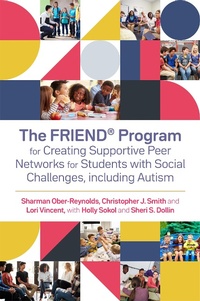
The FRIEND (R) Program for Creating Supportive Peer Networks for Students with Social Challenges, including Autism
Published on 21. October 2019
Book
Paperback/Softback
224 pages
978-1-78592-627-3 (ISBN)
Description
FRIEND is a social, communication and play-based program to help school-aged children with social challenges. All students deserve a positive school experience where they can reach their social and academic potential. However, this can prove difficult for students with challenges such as attention deficit, anxiety, or autism spectrum disorders, who may struggle daily with social situations. This manual provides everything educators need to support these students with their social skills in everyday situations, throughout their school years.
This program is designed to help any student with social challenges, no matter how subtle. For students without social challenges, it teaches tolerance, acceptance and understanding. The characteristics of successful social skills programs are described, with an emphasis on how FRIEND implements them through three key components: the Peer Sensitivity Curriculum, the FRIEND Lunch Program and the FRIEND Playground Program. These can be implemented individually or in any combination as a comprehensive program. Parents and family are offered information on working together with schools and implementing FRIEND strategies at home and in the community.
Emphasizing peer sensitivity, education and a supportive environment, FRIEND is for any educator wanting to create an inclusive and safe atmosphere for students to learn social skill-building strategies.
This program is designed to help any student with social challenges, no matter how subtle. For students without social challenges, it teaches tolerance, acceptance and understanding. The characteristics of successful social skills programs are described, with an emphasis on how FRIEND implements them through three key components: the Peer Sensitivity Curriculum, the FRIEND Lunch Program and the FRIEND Playground Program. These can be implemented individually or in any combination as a comprehensive program. Parents and family are offered information on working together with schools and implementing FRIEND strategies at home and in the community.
Emphasizing peer sensitivity, education and a supportive environment, FRIEND is for any educator wanting to create an inclusive and safe atmosphere for students to learn social skill-building strategies.
Reviews / Votes
FRIEND (R) strategies can make a world of difference for the isolated child. This book will be of great help to parents, teachers, and others who would like to help children socialize and support one another. A great asset to anyone who works with children with social challenges. -- Lynn Kern Koegel, PhD, CCC-SLP, Clinical Professor, Stanford School of Medicine, Pivotal Response Treatment (PRT) for AutismMore details
Language
English
Place of publication
London
United Kingdom
Target group
Primary & secondary/elementary & high school
College/higher education
Professional and scholarly
Product notice
Paperback (UK-trade)
Dimensions
Height: 226 mm
Width: 152 mm
Thickness: 10 mm
Weight
272 gr
ISBN-13
978-1-78592-627-3 (9781785926273)
Copyright in bibliographic data and cover images is held by Nielsen Book Services Limited or by the publishers or by their respective licensors: all rights reserved.
Schweitzer Classification
Other editions
Additional editions
Holly Sokol | Sheri S. Dollin | Sharman Ober-Reynolds
The FRIEND (R) Program for Creating Supportive Peer Networks for Students with Social Challenges, including Autism
E-Book
10/2019
Jessica Kingsley Publishers
€28.99
Available for download
Persons
Sharman Ober-Reynolds, MSN, FNP is Senior Research Coordinator at Southwest Autism Research & Resource Center in Phoenix, AZ. She is also the founder of the FRIEND program, which she has been using and refining for over 18 years.
Christopher J. Smith, Ph.D. is the Vice President and Director of Research at Southwest Autism Research & Resource Center. He has a wealth of professional experience in psychiatric disorders, and ASD in particular.
Lori Vincent, Ph.D., BCBA-D is a licensed psychologist in the Division of Developmental and Behavioral Pediatrics at Cincinnati Children's Hospital Medical Center. Her work focuses on evidence-based interventions for children with ASD and other developmental disabilities.
Holly Sokol, M. ED has worked for the last nine years as a special education teacher in settings ranging from self-contained classrooms to her current resource room setting at Legacy Traditional Schools.
Sheri S. Dollin, M.Ed. is an Early Childhood Educator with decades of experience supporting individuals with autism. Sheri played a key role at Southwest Autism Research & Resource Center in building programs, leading innovative projects and growing the organization's footprint.
Christopher J. Smith, Ph.D. is the Vice President and Director of Research at Southwest Autism Research & Resource Center. He has a wealth of professional experience in psychiatric disorders, and ASD in particular.
Lori Vincent, Ph.D., BCBA-D is a licensed psychologist in the Division of Developmental and Behavioral Pediatrics at Cincinnati Children's Hospital Medical Center. Her work focuses on evidence-based interventions for children with ASD and other developmental disabilities.
Holly Sokol, M. ED has worked for the last nine years as a special education teacher in settings ranging from self-contained classrooms to her current resource room setting at Legacy Traditional Schools.
Sheri S. Dollin, M.Ed. is an Early Childhood Educator with decades of experience supporting individuals with autism. Sheri played a key role at Southwest Autism Research & Resource Center in building programs, leading innovative projects and growing the organization's footprint.
Content
1. Introduction
2. The Benefits of FRIENDS
3. Implementation Strategies
4. Data Drives FRIEND
5. Peer Sensitivity Program
6. FRIEND Lunch Program
7. FRIEND Playground Program
8. Strategies for Parents
9. Conclusion
Appendix I: Introductory Documents
Appendix II: Planning Tools
Appendix III: Social Functioning Interviews
Appendix IV: Super Skills Profile of Social Difficulty
Appendix V: Observation Recording Form
Appendix VI: Tip Sheets
Appendix VII: Implementation Checklists
Appendix VIII:FRIEND Activity Guide
2. The Benefits of FRIENDS
3. Implementation Strategies
4. Data Drives FRIEND
5. Peer Sensitivity Program
6. FRIEND Lunch Program
7. FRIEND Playground Program
8. Strategies for Parents
9. Conclusion
Appendix I: Introductory Documents
Appendix II: Planning Tools
Appendix III: Social Functioning Interviews
Appendix IV: Super Skills Profile of Social Difficulty
Appendix V: Observation Recording Form
Appendix VI: Tip Sheets
Appendix VII: Implementation Checklists
Appendix VIII:FRIEND Activity Guide