

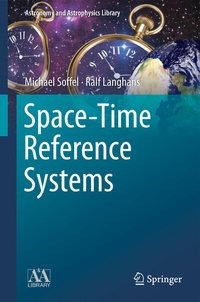
Space-Time Reference Systems
Published on 9. November 2014
Book
Paperback/Softback
XIV, 314 pages
978-3-642-44313-8 (ISBN)
Description
The high accuracy of modern astronomical spatial-temporal reference systems has made them considerably complex. This book offers a comprehensive overview of such systems. It begins with a discussion of 'The Problem of Time', including recent developments in the art of clock making (e.g., optical clocks) and various time scales. The authors address the definitions and realization of spatial coordinates by reference to remote celestial objects such as quasars. After an extensive treatment of classical equinox-based coordinates, new paradigms for setting up a celestial reference system are introduced that no longer refer to the translational and rotational motion of the Earth. The role of relativity in the definition and realization of such systems is clarified.The topics presented in this book are complemented by exercises (with solutions). The authors offer a series of files, written in Maple, a standard computer algebra system, to help readers get a feel for the various models and orders of magnitude. Beyond astrometry, the main fields of application of high-precision astronomical spatial-temporal reference systems and frames are navigation (GPS, interplanetary spacecraft navigation) and global geodynamics, which provide a high-precision Celestial Reference System and its link to any terrestrial spatial-temporal reference system. Mankind's urgent environmental questions can only be answered in the context of appropriate reference systems in which both aspects, space and time, are realized with a sufficiently high level of accuracy. This book addresses all those interested in high-precision reference systems and the various techniques (GPS, Very Long Baseline Interferometry, Satellite Laser Ranging, Lunar Laser Ranging) necessary for their realization, including the production and dissemination of time signals.
More details
Series
Edition
2013 ed.
Language
English
Place of publication
Berlin
Germany
Publishing group
Springer Berlin
Target group
Primary & secondary/elementary & high school
Graduate
Illustrations
XIV, 314 p.
Dimensions
Height: 235 mm
Width: 155 mm
Thickness: 18 mm
Weight
499 gr
ISBN-13
978-3-642-44313-8 (9783642443138)
DOI
10.1007/978-3-642-30226-8
Schweitzer Classification
Other editions
Additional editions
Michael Soffel | Ralf Langhans
Space-Time Reference Systems
E-Book
10/2012
1st Edition
Springer
€53.49
Available for download
Michael Soffel | Ralf Langhans
Space-Time Reference Systems
Book
10/2012
Springer
€53.49
Shipment within 7-9 days
Persons
Prof. Dr. phil. nat. Michael Soffel is the director of the Lohrmann Observatory of the Technical University Dresden. He is an internationally known expert in relativistic celestial mechanics, relativistic astronomy and geodesy and experimental gravity research. He is the author of the book "Relativity in Astrometry, Celestial Mechanics and Geodesy", Springer-Verlag (1989).
Dr. Ing. Ralf Langhans is working in the field of planetary geodesy and has been teaching astronomical geodesy and various courses in engineering geodesy.
Dr. Ing. Ralf Langhans is working in the field of planetary geodesy and has been teaching astronomical geodesy and various courses in engineering geodesy.
Content
List of Symbols.- Preface.- 1 Introduction.- 2 Time.- 3 Space-Time.- 4 Barycentric Dynamical Reference System.- 5 Classical Astronomical Coordinates.- 6 Astrometry.- 7 Celestial Reference System.- 8 Terrestrial Reference System.- 9 From the GCRS to the ITRS.- 10 Astronomical Software - Yearbooks.- 11 Astronomical constants.- References.- List of acronyms.- Appendix A: Solutions to Exercises.- Appendix B: Description of the AstroRef Package.- Index 304.