

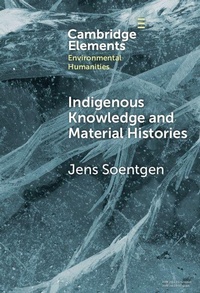
Indigenous Knowledge and Material Histories
The Example of Rubber
Published on 13. June 2024
Book
Hardback
76 pages
978-1-009-51708-9 (ISBN)
Description
This Element deals with stories told about substances and ways to analyse them through an Environmental Humanitie's perspective. It then takes up rubber as an example and its many stories. It is shown that the common notions of rubber history, which assume that rubber only became a useful material through a miraculous operation called vulcanization, that is attributed to the US-American Charles Goodyear, are false. In contrast, it is shown that rubber and many important rubber products are inventions of Indigenous peoples of South America, made durable by a process that can be called organic vulcanization. It is with that invention, that the story of rubber starts. Without it, rubber would not exist, neither in the Americas nor elsewhere. Finally, it is shown that Indigenous rubber products also offer some ecological advantages over industrially manufactured ones.
More details
Series
Language
English
Place of publication
Cambridge
United Kingdom
Product notice
sewn/stitched
Cloth over boards
Illustrations
Worked examples or Exercises
Dimensions
Height: 229 mm
Width: 152 mm
Thickness: 6 mm
Weight
272 gr
ISBN-13
978-1-009-51708-9 (9781009517089)
Copyright in bibliographic data and cover images is held by Nielsen Book Services Limited or by the publishers or by their respective licensors: all rights reserved.
Schweitzer Classification
Other editions
Additional editions
E-Book
06/2024
Cambridge University Press
€20.99
Available for download
Book
06/2024
Cambridge University Press
€24.00
Shipment within 15-20 days
Person
Content
1. Introduction; 2. The rhetorical and literary tradition of stories of stuff; 3. Research on the history of individual materials; 4. Substances and materials; 5. Histories; 6. Rubber; 7. Rubber histories and the representation of Indigenous peoples of South and Central America; 8. Indigenous knowledge; 9. Indigenous rubber products; 10. Problems of untreated rubber; 11. The place of Indigenous knowledge in the history of rubber; 12. Rubber and Rubbish: tire dumps and microrubber.