

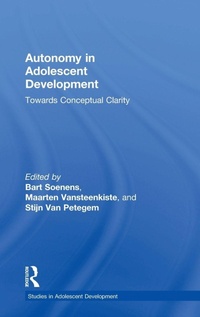
Autonomy in Adolescent Development
Towards Conceptual Clarity
1st Edition
Published on 30. August 2017
Book
Hardback
224 pages
978-1-138-64061-0 (ISBN)
Description
Autonomy is a central feature of adolescent development, playing a key role in adolescents' psychosocial adjustment. However, opinions differ about the nature and definition of autonomy and so important questions regarding the role of autonomy in adolescents' development have remained unanswered. This book helps to address these questions while bringing clarity to the literature on adolescent autonomy.
Autonomy in Adolescent Development: Towards Conceptual Clarity highlights a distinction between two notions of autonomy: autonomy-as-independence and autonomy-as-volition. The chapters in this volume illustrate how this distinction sheds new light on controversial questions regarding autonomy, such as: Is more autonomy always beneficial for adolescents' psychosocial adjustment? Or are there limits to the amount of autonomy ideal for well-being and social adjustment? Is autonomy a universally critical ingredient of optimal development? Or do effects of autonomy differ by cultural context and socioeconomic status? How can parents, siblings, and peers promote the development of autonomy?
Bringing together scholars from varied theoretical backgrounds studying autonomy in different contexts, this book provides an overview of recent conceptual and empirical work from diverse perspectives, yielding refreshing and thought-provoking insights into the nature of adolescent autonomy. Autonomy in Adolescent Development is invaluable for advanced students and researchers in adolescent development, acting both as a guide and as a source of inspiration for new research in the area.
Autonomy in Adolescent Development: Towards Conceptual Clarity highlights a distinction between two notions of autonomy: autonomy-as-independence and autonomy-as-volition. The chapters in this volume illustrate how this distinction sheds new light on controversial questions regarding autonomy, such as: Is more autonomy always beneficial for adolescents' psychosocial adjustment? Or are there limits to the amount of autonomy ideal for well-being and social adjustment? Is autonomy a universally critical ingredient of optimal development? Or do effects of autonomy differ by cultural context and socioeconomic status? How can parents, siblings, and peers promote the development of autonomy?
Bringing together scholars from varied theoretical backgrounds studying autonomy in different contexts, this book provides an overview of recent conceptual and empirical work from diverse perspectives, yielding refreshing and thought-provoking insights into the nature of adolescent autonomy. Autonomy in Adolescent Development is invaluable for advanced students and researchers in adolescent development, acting both as a guide and as a source of inspiration for new research in the area.
More details
Series
Language
English
Place of publication
Hove
United Kingdom
Publishing group
Taylor & Francis Ltd
Target group
College/higher education
Illustrations
8 s/w Zeichnungen, 4 s/w Tabellen
4 Tables, black and white; 8 Line drawings, black and white
Dimensions
Height: 240 mm
Width: 161 mm
Thickness: 18 mm
Weight
531 gr
ISBN-13
978-1-138-64061-0 (9781138640610)
Copyright in bibliographic data and cover images is held by Nielsen Book Services Limited or by the publishers or by their respective licensors: all rights reserved.
Schweitzer Classification
Other editions
Additional editions

Bart Soenens | Maarten Vansteenkiste | Stijn Van Petegem
Autonomy in Adolescent Development
Towards Conceptual Clarity
Book
08/2017
1st Edition
Psychology Press Ltd
€69.30
Shipment within 10-20 days
Bart Soenens | Maarten Vansteenkiste | Stijn Van Petegem
Autonomy in Adolescent Development
Towards Conceptual Clarity
E-Book
08/2017
Psychology Press Ltd
€63.49
Available for download
Bart Soenens | Maarten Vansteenkiste | Stijn Van Petegem
Autonomy in Adolescent Development
Towards Conceptual Clarity
E-Book
08/2017
Psychology Press Ltd
€63.49
Available for download
Persons
Bart Soenens is professor at Ghent University, Belgium, where he teaches undergraduate courses on developmental psychology. His research is mainly about parent-child relationships and about the role of parenting in child and adolescent development.
Maarten Vansteenkiste is professor at Ghent University, Belgium. His major research interests include the study of motivation and autonomy in diverse life domains.
Stijn Van Petegem is a postdoctoral researcher at the Institute of Psychology and member of the Family and Development Research Center (FADO) at the University of Lausanne, Switzerland. His major research interests include autonomy, defiance, parenting, and identity development.
Maarten Vansteenkiste is professor at Ghent University, Belgium. His major research interests include the study of motivation and autonomy in diverse life domains.
Stijn Van Petegem is a postdoctoral researcher at the Institute of Psychology and member of the Family and Development Research Center (FADO) at the University of Lausanne, Switzerland. His major research interests include autonomy, defiance, parenting, and identity development.
Content
Preface. 1: How to solve the conundrum of adolescent autonomy? On the importance of distinguishing between independence and volitional functioning, Bart Soenens, Maarten Vansteenkiste, Stijn Van Petegem, Wim Beyers, and Richard Ryan. 2: Observing adolescent relationships: Autonomy processes in parent, peer, and romantic partner interactions, Jessica Kansky, Erik Ruzek, and Joseph Allen. 3: The development of autonomy during adolescence: A social-cognitive domain theory view, Judith G. Smetana. 4: Governance transfer: A dynamic perspective on adolescent behavioral autonomy and parent regulation, Lauree Tilton-Weaver and Sheila K. Marshall. 5: Adolescent autonomy in context: Facilitative parenting in different cultures, domains, and settings, Wendy S. Grolnick, Madeline Levitt, and Alessandra Caruso. 6: The striving to develop an authentic inner-compass as a key component of adolescents' need for autonomy: Parental antecedents and effects on identity, well-being, and resilience, Avi Assor. 7: The role of choice in understanding adolescent autonomy and academic functioning, Erika A. Patall and Sophia Yang Hooper. 8: Parent-adolescent relationships and romantic development: A review and argument for research on autonomy supportive parenting, Melanie J. Zimmer-Gembeck, Stijn Van Petegem, Wendy Ducat, Sarah Clear, and Shawna Mastro. 9: Psychology and culture construct "autonomy", Cigdem Kagitcibasi