

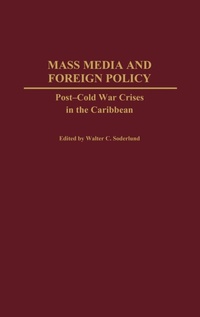
Mass Media and Foreign Policy
Post-Cold War Crises in the Caribbean
Published on 30. May 2003
Book
Hardback
200 pages
978-0-275-97785-6 (ISBN)
Description
The terrorist attacks on the United States that occurred on September 11 marked the end of an historical era known as the post-Cold War period. During this time, the U.S. government produced no clear media guidelines for dealing with world crises, and media coverage increasingly came to be focused on domestic conflicts rather than international ones. In the absence of a clearly defined threat, no dominant media frame replaced the time-worn Cold War in media reporting. Mass media has been recognized as an important intermediary between the government and the population. In this context, this study examines network coverage of seven post-Cold War crises, ranging from Cuba to Mexico, occurring in the Caribbean Basin between 1990 and 1996 to evaluate the framing of these events by the various media covering them.
In providing context for understanding these crises, this examination reviews U.S. policy in each case and discovers a strong correlation between the level of U.S. involvement in the crisis and the amount of media attention generated. By appearing on the news or not, the president along with key Cabinet members were able to define whether an event constituted a crisis for the United States. In instances where the media received little guidance from Washington officials on the implications for the United States, the media did attempt to provide explanations of events, however, coverage tended to be minimal. Case studies include the recording and coding of language used as positive, negative, and neutral/ambiguous.
In providing context for understanding these crises, this examination reviews U.S. policy in each case and discovers a strong correlation between the level of U.S. involvement in the crisis and the amount of media attention generated. By appearing on the news or not, the president along with key Cabinet members were able to define whether an event constituted a crisis for the United States. In instances where the media received little guidance from Washington officials on the implications for the United States, the media did attempt to provide explanations of events, however, coverage tended to be minimal. Case studies include the recording and coding of language used as positive, negative, and neutral/ambiguous.
More details
Language
English
Place of publication
United States
Publishing group
Bloomsbury Publishing Plc
Target group
College/higher education
Professional and scholarly
Dimensions
Height: 240 mm
Width: 161 mm
Thickness: 15 mm
Weight
470 gr
ISBN-13
978-0-275-97785-6 (9780275977856)
Copyright in bibliographic data and cover images is held by Nielsen Book Services Limited or by the publishers or by their respective licensors: all rights reserved.
Schweitzer Classification
Other editions
Additional editions
E-Book
05/2003
1st Edition
Praeger Publishers Inc
€65.99
Available for download
Person
WALTER C. SODERLUND is Professor Emeritus of Political Science at the University of Windsor.
Content
Introduction by Walter C. Soderlund The Jamaat-al-Muslimeen Coup in Trinidad and Tobago, 1990 by Walter C. Soderlund The Military Coup in Haiti, 1991 by Ralph C. Nelson and Walter C. Soderlund The Attempted Restoration of Jean-Bertrand Aristide to the Presidency of Haiti, 1993 by Walter C. Soderlund and Ralph C. Nelson The Restoration of Democracy to Haiti, 1994 by Walter C. Soderlund and Ralph C. Nelson The Zapatista Rebellion in Chiapas, 1994 by Walter C. Soderlund and E. Donald Briggs The Cuban Rafter Crisis, 1944 by Walter C. Soderlund The Cuban Shoot-down of "Brothers to the Rescue" Aircraft, 1996 by Walter C. Soderlund Conclusion by Walter C. Soderlund References Index