

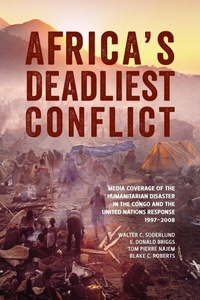
Africa's Deadliest Conflict
Media Coverage of the Humanitarian Disaster in the Congo and the United Nations Response, 1997-2008
Published on 30. August 2012
Book
Paperback/Softback
275 pages
978-1-55458-835-0 (ISBN)
Description
Africa's Deadliest Conflict deals with the complex intersection of the legacy of post-colonial history - a humanitarian crisis of epic proportions - and changing norms of international intervention associated with the idea of human security and the responsibility to protect (R2P). It attempts to explain why, despite a softening of norms related to the sanctity of state sovereignty, the international community dealt so ineffectively with a brutal conflict in the Democratic Republic of the Congo, which between 1997 and 2011 claimed an estimated 5.5 million. In particular, the book focuses on the role of mass media in creating a will to intervene, a role considered by many to be the key to prodding a reluctant international community to action.
Included in the book are a primer on Congolese history, a review of United Nations peacekeeping missions in the Congo, and a detailed examination of both US television news and New York Times coverage of the Congo from 1997 through 2008. Separate conclusions are offered with respect to peacekeeping in the Age of R2P and on the role of mass media in both promoting and inhibiting robust international responses to large-scale humanitarian crises.
Included in the book are a primer on Congolese history, a review of United Nations peacekeeping missions in the Congo, and a detailed examination of both US television news and New York Times coverage of the Congo from 1997 through 2008. Separate conclusions are offered with respect to peacekeeping in the Age of R2P and on the role of mass media in both promoting and inhibiting robust international responses to large-scale humanitarian crises.
Reviews / Votes
"Scholars and faculty as well as peace practitioners in the fields of international security, international organizations, international social work, and social welfare policy will find Africa's Deadliest Conflict a vital addition to the literature on collective violence prevention and intervention research." -- Kingsley Chigbu, University of Texas -- ACUNS, 201309 "Africa's Deadliest Conflict is an impressive book that attempts to document the amount of US media coverage of wars in the Democratic Republic of Congo (DRC), from May 1997 to late 2008, using the concepts of agenda setting (media's evaluative function). If agenda setting can alert citizens and their leaders about faraway international events, framing makes them think about these events in a certain way. The authors use quantitative data to document the media's alerting function and qualitative data to address the evaluative function of both television and print news.... A thoughtful and insightful analysis of Congo's recent wars, making the book an excellent resource for students of mass media. Moreover, this book is a rich analysis and a worthwhile read for anyone interested in gaining a deeper understanding of not only Congo but the mass media's role in the political process." -- Emizet Kisangani, Kansas State University -- Modern African Studies, Volume 51/4, 201312More details
Language
English
Place of publication
Waterloo, Ontario
Canada
Product notice
Paperback (trade)
Unsewn / adhesive bound
Illustrations
16 tables, and 2 maps
Dimensions
Height: 226 mm
Width: 152 mm
Thickness: 18 mm
Weight
408 gr
ISBN-13
978-1-55458-835-0 (9781554588350)
Copyright in bibliographic data and cover images is held by Nielsen Book Services Limited or by the publishers or by their respective licensors: all rights reserved.
Schweitzer Classification
Persons
Walter C. Soderlund is a professor emeritus in the Department of Political Science at the University of Windsor. His books include Africa's Deadliest Conflict, The Independence of South Sudan, and The Responsibility to Protect in Darfur.
E. Donald Briggs is a professor emeritus in the Department of Political Science at the University of Windsor, where he taught full-time for nearly forty years.
Tom Pierre Najem researches in the areas of international relations and comparative politics, with a regional specialization in the Middle East. He has lived and worked in the Middle East and North Africa and has held academic posts in Morocco and England.
Blake C. Roberts is the interim academic advisor of the University of Windsor's Digital-Journalism program and a sessional instructor and research associate in the Department of Political Science at the University of Windsor.
E. Donald Briggs is a professor emeritus in the Department of Political Science at the University of Windsor, where he taught full-time for nearly forty years.
Tom Pierre Najem researches in the areas of international relations and comparative politics, with a regional specialization in the Middle East. He has lived and worked in the Middle East and North Africa and has held academic posts in Morocco and England.
Blake C. Roberts is the interim academic advisor of the University of Windsor's Digital-Journalism program and a sessional instructor and research associate in the Department of Political Science at the University of Windsor.
Content
Africa's Deadliest Conflict: Media Coverage of the Humanitarian Disaster in the Congo and the United Nations Response, 1997-2008 by Walter C. Soderlund, E. Donald Briggs, Tom Pierre Najem, and Blake C. Roberts
List of Tables and Maps
Acknowledgements
The Authors
Introduction
1 The Congo: Understanding the Conflict
2 The UN Response: From ONUC to MONUSCO
3 Mass Media, Public Awareness and Television News Coverage of the Congo
4 New York Times Framing of the Second Congo War
5 New York Times Framing of the Third Congo War
6 Media Coverage of the Congo Wars: An Overall Assessment
7 Peacekeeping in the Age of R2P
Conclusion: The Impact of Mass Media on ""The Will to Intervene""
Postscript: An Update on Events
Appendix: Descriptive Language
Notes
References
Index
List of Tables and Maps
Acknowledgements
The Authors
Introduction
1 The Congo: Understanding the Conflict
2 The UN Response: From ONUC to MONUSCO
3 Mass Media, Public Awareness and Television News Coverage of the Congo
4 New York Times Framing of the Second Congo War
5 New York Times Framing of the Third Congo War
6 Media Coverage of the Congo Wars: An Overall Assessment
7 Peacekeeping in the Age of R2P
Conclusion: The Impact of Mass Media on ""The Will to Intervene""
Postscript: An Update on Events
Appendix: Descriptive Language
Notes
References
Index