

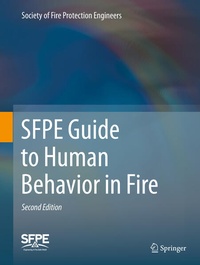
SFPE Guide to Human Behavior in Fire
2nd Edition
Published on 27. November 2018
Book
Hardback
XIV, 159 pages
978-3-319-94696-2 (ISBN)
Description
This single resource for the fire safety community distills the most relevant and useful science and research into a consensus-based guide whose key factors and considerations impact the response and behavior of occupants of a building during a fire event.The Second Edition of SFPE's Engineering Guide: Human Behavior in Fire provides a common introduction to this field for the broad fire safety community: fire protection engineers/fire safety engineers, human behavior scientists/researchers, design professionals, and code authorities. The public benefits from consistent understanding of the factors that influence the responses and behaviors of people when threatened by fire and the application of reliable methodologies to evaluate and estimate human response in buildings and structures.This Guide also aims to lessen the uncertainties in the "people components" of fire safety and allow for more refined analysis with less reliance on arbitrary safety factors. As with fire science in general, our knowledge of human behavior in fire is growing, but is still characterized by uncertainties that are traceable to both limitation in the science and unfamiliarity by the user communities. The concepts for development of evacuation scenarios for performance-based designs and the technical methods to estimate evacuation response are reviewed with consideration to the limitation and uncertainty of the methods. This Guide identifies both quantitative and qualitative information that constitutes important consideration prior to developing safety factors, exercising engineering judgment, and using evacuation models in the practical design of buildings and evacuation procedures. Besides updating material in the First Edition, this revision includes new information on:Incapacitating Effects of Fire Effluent & Toxicity Analysis MethodsOccupant Behavior ScneariosMovement Models and Behavioral ModelsEgress Model Selection, Verification, and ValidationEstimation of Uncertainty and Use of Safety FactorsEnhancing Human Response to Emergencies & Notification of MessagingThe prediction of human behavior during a fire emergency is one of the most challenging areas of fire protection engineering. Yet, understanding and considering human factors is essential to designing effective evacuation systems, ensuring safety during a fire and related emergency events, and accurately reconstructing a fire.
More details
Edition
Second Edition 2019
Language
English
Place of publication
Cham
Switzerland
Publishing group
Springer International Publishing
Target group
Professional and scholarly
Edition type
Revised edition
Illustrations
24 s/w Abbildungen
XIV, 159 p. 24 illus.
Dimensions
Height: 285 mm
Width: 215 mm
Thickness: 16 mm
Weight
698 gr
ISBN-13
978-3-319-94696-2 (9783319946962)
DOI
10.1007/978-3-319-94697-9
Schweitzer Classification
Other editions
Additional editions
Society of Fire Protection Engineers
SFPE Guide to Human Behavior in Fire
E-Book
11/2018
2nd Edition
Springer
€139.09
Available for download
Person
The SFPE Task Group on Human Behavior in Fire consists of the leading researchers on the topic, from academia, industry, and government.
The Society of Fire Protection Engineers (SFPE) is the professional society representing those practicing the field of fire protection engineering. The Society has over 4,600 members and 92 chapters, including 17 student chapters worldwide.
The Society of Fire Protection Engineers (SFPE) is the professional society representing those practicing the field of fire protection engineering. The Society has over 4,600 members and 92 chapters, including 17 student chapters worldwide.
The purpose of SFPE is to advance the science and practice of fire protection engineering and its allied fields, to maintain a high ethical standard among its members and to foster fire protection engineering education.
Content
1 Introduction.- 2 Integrating Human Behavior Factors into Design.- 3 Population Characteristics.- 4 Occupant Behavior Concepts - Cues, Decisions & Actions.- 5 Effects of Fire Effluent.- 6 Development and Selection of Occupant Behavioral Scenarios.- 7 Calculation of Effects of Fire Effluent.- 8 Physical Movement Concepts.- 9 Egress Model Selection.- 10 Egress Model Testing.- 11 Estimation of Uncertainty and Safety Factors.- 12 Enhancing Human Response to Emergency Notification and Messaging.- 13 Managing the Movement of Building Occupants.