

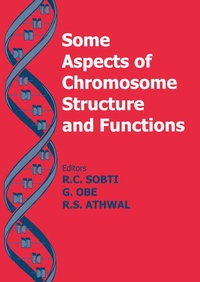
Some Aspects of Chromosome Structure and Function
Chromosome Structure and Function
Published on 31. July 2002
Book
Hardback
X, 238 pages
978-0-7923-7057-4 (ISBN)
Description
It was at the end of the 19th century that a Swiss biologist, Karl Nageli first proposed the existence of hereditary organelles that carried information from parent to offspring. Ensuing decades experienced vigorous studies that led to the development of discovery that chromosomes are indeed the carriers of genetic information. Subsequent studies, especially by Morgan and Bridges, established unequivocally the chromosome theory of inheritance. Today, the structure of chromosome is well established. At the physical level, eukaryotic chromosomes are composed of a single, linear, double helix of DNA. The elementary helical structure involves nucleosomes, comprised of histones around which the DNA is wrapped. A hierarchy of higher order of chromosomal architecture may possibly be responsible for the regulation of gene helical structures expression. The localized condensations of DNA constitute chromomeres. Uncoiled structures sometimes extending from chromomeres, which form loops, is the result of discontinuities in the regular coiling of the DNA in the chromosome.
More details
Edition
2002 ed.
Language
English
Place of publication
Dordrecht
Netherlands
Target group
Professional and scholarly
Research
Illustrations
20 s/w Abbildungen
X, 238 p.
Dimensions
Height: 276 mm
Width: 198 mm
Thickness: 19 mm
Weight
781 gr
ISBN-13
978-0-7923-7057-4 (9780792370574)
DOI
10.1007/978-94-010-0334-6
Schweitzer Classification
Other editions
Additional editions
R.C. Sobti | G. Obe
Some Aspects of Chromosome Structure and Function
Chromosome Structure and Function
E-Book
12/2012
Springer
€149.79
Available for download
Content
1. Aspects of Tandemly Organized, Repetitive Sequences in Chromosomal DNA.- 2. Mapping and Organization of Highly-Repeated Sequences by Means of Fluorescence in situ Hybridization Against Synaptonemal Complex-Associated Chromatin of Rye.- 3. Some Insights on the Mechanism of in situ DNA Digestion by Restriction Enzymes and on Fluorochrome Banding: Case of the Argentata group.- 4. Structural Differences of Chromosomes in Plants Detected by Fluorescence in situ Hybridization Using Probes of rDNA, Arabidopsis-type Telomere Sequence Repeats and pCrT7-4.- 5. Planococcus citri (Homoptera, Coccoidea): A Paradigmatic Case of Chromosome Structure as an Epigenetic Way to Control Gene Expression.- 6. Cytogenetic and Molecular Analysis of Heterochromatic Areas in the Holocentric Chromosomes of Different Aphid Species.- 7. Translocation Frequencies for X and Y Chromosomes Predicted by Computer Simulations of Nuclear Structure.- 8. Evolution of DNA Repair Mechanisms.- 9. Cytogenetics of Lepidopteran Insects.- 10. Chromosome Structure in Fishes.- 11. A Review of Chromosome Banding in Fishes.- 12. Chromosomes in Birds.- 13. Chromosomal Analysis in Human Population Monitoring.- 14. Genotoxic Investigations on Occupationally Exposed Cattle Yard Workers.- 15. Telomeres, Telomerase and Cancer.- 16. Chromosomal Radiosensitivity as an Indicator of Genetic Predisposition to Breast Cancer.- 17. Molecular Genetics of Gastrointestinal Tract Cancers.- 18. Molecular Pathogenesis of Lung Cancer.- 19. Bladder Cancer: Genetic and Epidemiological Factors Involved in its Genesis.- 20. Molecular Genetics of Prostate Cancer.