

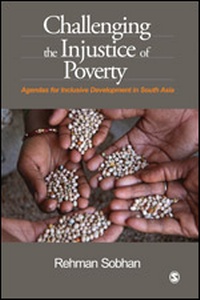
Challenging the Injustice of Poverty
Agendas for Inclusive Development in South Asia
1st Edition
Published on 31. October 2010
Book
Hardback
516 pages
978-81-321-0468-1 (ISBN)
Description
This book explores issues related to poverty in South Asia in a two-pronged manner-by focusing on injustice created and perpetuated by the unjust nature of a social order as its source and then providing concrete suggestions about how policymakers may move to challenge these injustices.
Drawing research inputs from studies across various South Asian countries, the book redefines poverty as a process where certain sections of the society are excluded from equal participation in development opportunities as well as decision-making. It further identifies a variety of operational ideas for policymakers, political activists and civil society advocacy groups committed to build a more just and poverty free society in South Asia
Drawing research inputs from studies across various South Asian countries, the book redefines poverty as a process where certain sections of the society are excluded from equal participation in development opportunities as well as decision-making. It further identifies a variety of operational ideas for policymakers, political activists and civil society advocacy groups committed to build a more just and poverty free society in South Asia
Reviews / Votes
One can learn a lot from reading this book. It will open a debate on poverty alleviation once again in South Asia. It is certainly a significant piece of work on mainstreaming the poor via corporate assets and working out innovative collective arrangements. The book is a distillation of Sobhan's thoughts over his lifetime of reading, thinking, pondering and acting. He has combined great analytical skills with deep research, and brought home some key issues that determine poverty in the South Asian region. It is a must read for all those who are interested in the subject. -- Social Action Challenging the Injustice of Poverty is a significant contribution to literature on poverty eradication strategies in South Asia. This work makes for fruitful reading for all those interested in developing such strategies and will enhance their knowledge of structural change as a mean of inclusive development. The most admirable feature of the book is that the work is based on conceptual as well as empirical analysis. -- Dawn It would be pity if Rehman Sobhan's book Challenging the injustice of poverty is left unread for being considered too dull and too heavy a read. It is indeed heavy, with imprints of a researcher all over the place... [The book] has over 70 pages of annexures and bibliography.... Challenging the injustice of poverty is like a ready document for South Asian government to tap and do the needful. There seems to be no other meaningful way to challenge poverty. -- Outlook Business Sobhan's thesis is a well-conceptualised, well-executed document that puts forth some concrete proposals that are capable of taking forward the global fight against poverty and social exclusion on a specific trajectory. It can serve as a blueprint which the policy leaders can rely on. But the need of the hour is the political will to shake up the policy agenda of the governments of the developing world with a view to promoting and sustaining inclusive development and growth. -- The New Indian Express The author has combined great analytical skills with deep scholarship and brought home some key factors that determine poverty in the South Asian region. It is a must read for all those who are interested in poverty eradication through various tools enunciated by the author. -- The Tribune The book is an outcome of six years of untiring work specifically on the subject, conducted jointly by the Centre for Policy Dialogue (CPD), Bangladesh and South Asia Centre for Policy Studies (SACEPS), Nepal.... The arguments developed in this book are an outcome of comprehensive research and extensive dialogue.... Once can learn a great deal from reading this book. It will open a debate on poverty alleviation once again in South Asia.... It is indeed a remarkable piece of work on mainstreaming the poor via corporate assets and working out innovative collective arrangements. The book is a distillation of Prof. Sobhan's thoughts over a lifetime of reading, thinking, contemplating and acting. He has combined great analytical skills with deep scholarship, and brought home some key factors that determine poverty in the South Asian region. It is a must read for all those who are interested in the subject. -- Saman Kelegama Prof. Rehman Sobhan...has challenged policymakers, the hordes of the excluded and their advocates in the region to address the biggest threat to democracy, economic stability and human rights in South Asia - Poverty.... This is an excellent summary of the schemes for reducing poverty devised by the World Bank, IMF and the International Development Community from Washington Consensus to Millennium Development Goals, proposals for promoting equity, some success stories from Asia, SAARC initiatives on poverty, the PRSPs in South Asia and India's recent experiments in poverty reduction.... In order to promote the vitally needed agrarian reforms, Prof. Sobhan pleads for a national commission in each South Asian country and lays down its agenda.... Prof. Sobhan finds a great deal of potential for mitigating the problems of the small producers among the excluded through their collective action. Several successful models in India (ITC, Amul, Sewa) and Bangladesh (Pran, Brac) and dairy cooperatives in Nepal and Sri Lanka and women's collective action, are analysed.... After a fairly detailed discussion on budgetary and financial policies for poverty eradication and some stimulating arguments for broadening of assets through collective action that address the problems faced by the most vulnerable groups.., the author takes up the question of institutions that can promote collective action by the excluded.... Professor Sobhan's monumental study must generate an intensive debate on South Asian people's poverty. -- The Daily Star This book will open a debate on poverty alleviation once again in South Asia where there are already two Independent South Asian Commission on Poverty Alleviation reports and as per the 13th SAARC Summit declaration, SAARC countries have geared themselves to achieve SDGs (SAARC Development Goals) by 2015 (in addition to the MDGs). It is indeed a remarkable piece of work on mainstreaming the poor via corporate assets and working out innovative collective arrangements. -- The Book ReviewMore details
Edition
First Edition
Language
English
Place of publication
New Delhi
India
Target group
College/higher education
Professional and scholarly
Dimensions
Height: 216 mm
Width: 140 mm
Weight
714 gr
ISBN-13
978-81-321-0468-1 (9788132104681)
Copyright in bibliographic data and cover images is held by Nielsen Book Services Limited or by the publishers or by their respective licensors: all rights reserved.
Schweitzer Classification
Person
Rehman Sobhan is a noted Bangladeshi economist and freedom fighter who played an active role in the Bangali national movement. He is currently the Chairman, Centre for Policy Dialogue, Dhaka, Bangladesh. He was educated at St. Paul's School, Darjeeling; Aitchison College, Lahore; and the University of Cambridge. He was one of the several economists whose ideas influenced the 6-point programme of Sheikh Mujibur Rahman, which became the basis for the struggle for self-rule for Bangladesh. A former Professor of Economics at Dhaka University, he has authored numerous books and articles on various developmental issues. The most recent of these, Challenging the Injustice of Poverty: Agendas for Inclusive Development in South Asia, was published by SAGE in 2010.
He served the first Government of Bangladesh as Envoy Extraordinaire with special responsibility for Economic Affairs, during the Liberation War in 1971. He was a member of the first Bangladesh Planning Commission, and in the 1980s headed the premier development research facility, BIDS. In 1990-91, he became a Member of the Advisory Council of the President of Bangladesh in charge of the Ministry of Planning and the Economic Relations Division. In 1993, he founded and became the Chairman of the Centre for Policy Dialogue (CPD), one of Bangladesh's most prestigious think tanks. He also headed the South Asia Centre for Policy Studies (SACEPS) from 2000 to 2005, one of the leading think tanks for promoting regional cooperation in South Asia.
He served the first Government of Bangladesh as Envoy Extraordinaire with special responsibility for Economic Affairs, during the Liberation War in 1971. He was a member of the first Bangladesh Planning Commission, and in the 1980s headed the premier development research facility, BIDS. In 1990-91, he became a Member of the Advisory Council of the President of Bangladesh in charge of the Ministry of Planning and the Economic Relations Division. In 1993, he founded and became the Chairman of the Centre for Policy Dialogue (CPD), one of Bangladesh's most prestigious think tanks. He also headed the South Asia Centre for Policy Studies (SACEPS) from 2000 to 2005, one of the leading think tanks for promoting regional cooperation in South Asia.
Content
Preface
Poverty as Structural Injustice
Prevailing Poverty Alleviation Strategies: A Review
Promoting Agrarian Reform
Enhancing the Market Power of the Excluded: Sharing in value addition
Democratising Educational Opportunities
Budgetary Policies for Poverty Eradication
Financial Policies for Poverty Eradication
Broadening Ownership of Assets through Collective Action
Institutions for Promoting Collective Action by the Excluded
The Political Economy of Structural Change
Annexures
Bibliography
Index
Poverty as Structural Injustice
Prevailing Poverty Alleviation Strategies: A Review
Promoting Agrarian Reform
Enhancing the Market Power of the Excluded: Sharing in value addition
Democratising Educational Opportunities
Budgetary Policies for Poverty Eradication
Financial Policies for Poverty Eradication
Broadening Ownership of Assets through Collective Action
Institutions for Promoting Collective Action by the Excluded
The Political Economy of Structural Change
Annexures
Bibliography
Index