

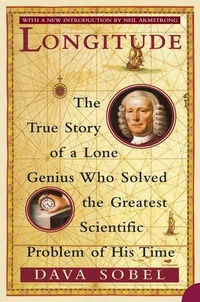
Longitude
The True Story of a Lone Genius Who Solved the Greatest Scientific Problem of His Time
Published on 5. September 2005
Book
Paperback/Softback
208 pages
978-0-00-721422-8 (ISBN)
Description
The tenth anniversary edition of the dramatic human story of an epic scientific quest: the search for the solution of how to calculate longitude and the unlikely triumph of an English genius. With a new Foreword by the celebrated astronaut Neil Armstrong.
'Sobel has done the impossible and made horology sexy - no mean feat' New Scientist
Anyone alive in the 18th century would have known that 'the longitude problem' was the thorniest scientific dilemma of the day - and had been for centuries. Lacking the ability to measure their longitude, sailors throughout the great ages of exploration had been literally lost at sea as soon as they lost sight of land. Thousands of lives, and the increasing fortunes of nations, hung on a resolution.
The quest for a solution had occupied scientists and their patrons for the better part of two centuries when, in 1714, Parliament upped the ante by offering a king's ransom (GBP20,000) to anyone whose method or device proved successful. Countless quacks weighed in with preposterous suggestions. The scientific establishment throughout Europe - from Galileo to Sir Isaac Newton - had mapped the heavens in both hemispheres in its certain pursuit of a celestial answer. In stark contrast, one man, John Harrison, dared to imagine a mechanical solution.
Full of heroism and chicanery, brilliance and the absurd, LONGITUDE is also a fascinating brief history of astronomy, navigation and clockmaking.
'Sobel has done the impossible and made horology sexy - no mean feat' New Scientist
Anyone alive in the 18th century would have known that 'the longitude problem' was the thorniest scientific dilemma of the day - and had been for centuries. Lacking the ability to measure their longitude, sailors throughout the great ages of exploration had been literally lost at sea as soon as they lost sight of land. Thousands of lives, and the increasing fortunes of nations, hung on a resolution.
The quest for a solution had occupied scientists and their patrons for the better part of two centuries when, in 1714, Parliament upped the ante by offering a king's ransom (GBP20,000) to anyone whose method or device proved successful. Countless quacks weighed in with preposterous suggestions. The scientific establishment throughout Europe - from Galileo to Sir Isaac Newton - had mapped the heavens in both hemispheres in its certain pursuit of a celestial answer. In stark contrast, one man, John Harrison, dared to imagine a mechanical solution.
Full of heroism and chicanery, brilliance and the absurd, LONGITUDE is also a fascinating brief history of astronomy, navigation and clockmaking.
Reviews / Votes
Dava Sobel has written a gem of a book...one of the best reads for the non-scientific writing to come along for many a moon." Financial Times "A true life thriller, jam-packed with political intrigue, international warfare, personal feuds and financial skullduggery." Daily Mail "Rarely have I enjoyed a book as much as Dava Sobel's Longitude. She has an extraordinary gift of making difficult ideas clear." Daily TelegraphMore details
Language
English
Place of publication
London
United Kingdom
Publishing group
HarperCollins Publishers
Product notice
Unsewn / adhesive bound
Paperback (UK-B)
Dimensions
Height: 198 mm
Width: 128 mm
Thickness: 17 mm
Weight
170 gr
ISBN-13
978-0-00-721422-8 (9780007214228)
Copyright in bibliographic data and cover images is held by Nielsen Book Services Limited or by the publishers or by their respective licensors: all rights reserved.
Schweitzer Classification
Other editions
Additional editions
Previous edition

Dava Sobel
Longitude:the True Story of a Lone Genius Who Solved the Greatest Scientific Problem of His Time
Book
12/2005
Penguin Putnam Inc
€28.65
Article exhausted; check for reprint
Person
Dava Sobel is an award-winning former science reporter for the New York Times and writes frequently about science for several magazines, including Audubon, Discover, Life and Omni.