

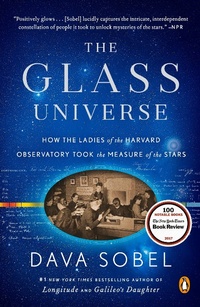
The Glass Universe
How the Ladies of the Harvard Observatory Took the Measure of the Stars
Published on 31. October 2017
Book
Paperback/Softback
352 pages
978-0-14-311134-4 (ISBN)
Description
From #1 New York Times bestselling author Dava Sobel, the "inspiring" (People), little-known true story of women's landmark contributions to astronomy
A New York Times Book Review Notable Book
Named one of the best books of the year by NPR, The Economist, Smithsonian, Nature, and NPR's Science Friday
Nominated for the PEN/E.O. Wilson Literary Science Writing Award
"A joy to read." -The Wall Street Journal
In the mid-nineteenth century, the Harvard College Observatory began employing women as calculators, or "human computers," to interpret the observations their male counterparts made via telescope each night. At the outset this group included the wives, sisters, and daughters of the resident astronomers, but soon the female corps included graduates of the new women's colleges-Vassar, Wellesley, and Smith. As photography transformed the practice of astronomy, the ladies turned from computation to studying the stars captured nightly on glass photographic plates.
The "glass universe" of half a million plates that Harvard amassed over the ensuing decades-through the generous support of Mrs. Anna Palmer Draper, the widow of a pioneer in stellar photography-enabled the women to make extraordinary discoveries that attracted worldwide acclaim. They helped discern what stars were made of, divided the stars into meaningful categories for further research, and found a way to measure distances across space by starlight. Their ranks included Williamina Fleming, a Scottish woman originally hired as a maid who went on to identify ten novae and more than three hundred variable stars; Annie Jump Cannon, who designed a stellar classification system that was adopted by astronomers the world over and is still in use; and Dr. Cecilia Helena Payne, who in 1956 became the first ever woman professor of astronomy at Harvard-and Harvard's first female department chair.
Elegantly written and enriched by excerpts from letters, diaries, and memoirs, The Glass Universe is the hidden history of the women whose contributions to the burgeoning field of astronomy forever changed our understanding of the stars and our place in the universe.
A New York Times Book Review Notable Book
Named one of the best books of the year by NPR, The Economist, Smithsonian, Nature, and NPR's Science Friday
Nominated for the PEN/E.O. Wilson Literary Science Writing Award
"A joy to read." -The Wall Street Journal
In the mid-nineteenth century, the Harvard College Observatory began employing women as calculators, or "human computers," to interpret the observations their male counterparts made via telescope each night. At the outset this group included the wives, sisters, and daughters of the resident astronomers, but soon the female corps included graduates of the new women's colleges-Vassar, Wellesley, and Smith. As photography transformed the practice of astronomy, the ladies turned from computation to studying the stars captured nightly on glass photographic plates.
The "glass universe" of half a million plates that Harvard amassed over the ensuing decades-through the generous support of Mrs. Anna Palmer Draper, the widow of a pioneer in stellar photography-enabled the women to make extraordinary discoveries that attracted worldwide acclaim. They helped discern what stars were made of, divided the stars into meaningful categories for further research, and found a way to measure distances across space by starlight. Their ranks included Williamina Fleming, a Scottish woman originally hired as a maid who went on to identify ten novae and more than three hundred variable stars; Annie Jump Cannon, who designed a stellar classification system that was adopted by astronomers the world over and is still in use; and Dr. Cecilia Helena Payne, who in 1956 became the first ever woman professor of astronomy at Harvard-and Harvard's first female department chair.
Elegantly written and enriched by excerpts from letters, diaries, and memoirs, The Glass Universe is the hidden history of the women whose contributions to the burgeoning field of astronomy forever changed our understanding of the stars and our place in the universe.
More details
Language
English
Place of publication
United States
Publishing group
Penguin Putnam Inc
Product notice
Paperback (trade)
Illustrations
16-PAGE COLOR INSERT (ON INSERT STOCK)
Dimensions
Height: 213 mm
Width: 139 mm
Thickness: 22 mm
Weight
337 gr
ISBN-13
978-0-14-311134-4 (9780143111344)
Copyright in bibliographic data and cover images is held by Nielsen Book Services Limited or by the publishers or by their respective licensors: all rights reserved.
Schweitzer Classification
Other editions
Additional editions

Dava Sobel | Cassandra Campbell
The Glass Universe
How the Ladies of the Harvard Observatory Took the Measure of the Stars
Audio
05/2017
Books on Tape
€46.37
Withdrawn from sale
Dava Sobel | Cassandra Campbell
The Glass Universe
How the Ladies of the Harvard Observatory Took the Measure of the Stars
Audio
12/2016
Penguin Audiobooks
€46.37
Article exhausted; check different version
Dava Sobel
The Glass Universe
How the Ladies of the Harvard Observatory Took the Measure of the Stars
Book
12/2016
Viking
€47.80
Article exhausted; check different version
Dava Sobel
The Glass Universe
How the Ladies of the Harvard Observatory Took the Measure of the Stars
E-Book
12/2016
Penguin Books
€12.49
Available for download
Person
DAVA SOBEL is the author of five books, including the New York Times bestsellers Longitude, Galileo’s Daughter, The Planets, and The Glass Universe. A former New York Times science reporter and longtime contributor to The New Yorker, Audubon, Discover, and Harvard Magazine, she is the recipient of the National Science Board’s Individual Public Service Award and the Boston Museum of Science’s Bradford Washburn Award, among others.