

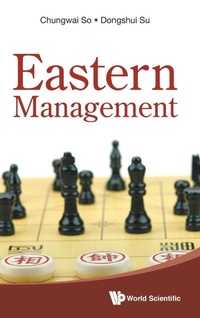
Eastern Management
Published on 8. April 2021
Book
Hardback
608 pages
978-981-4412-99-5 (ISBN)
Description
History has proven that the most dynamic and creative management theories often arise in fast-growing economies. With the rapid development of China's economy, Chinese management styles have attracted more and more attention from management scholars and practitioners around the world. Derived from 40 years of theoretical research, Eastern Management is the crystallisation of 2,000 years of Chinese thought, theory and experience. It integrates Western and Eastern management styles and highlights the role of human nature in management. Above all, it holds that the guiding principles of Chinese management are putting people first, regarding morality as priority and conducting oneself to serve others.This book views management as a system with multiple micro, meso and macro levels, namely personal management, family governance, business governance and state governance. Through adopting multiple perspectives, multi-level analysis and syncretic theoretical approaches, this book aims to help people gain a deeper understanding of the commitment of Eastern and Chinese management communities to the harmony between humans and nature, individuals and society, and to people in general, as a means to gradually improve the conditions of human existence.
More details
Language
English
Place of publication
Singapore
Singapore
Target group
College/higher education
Dimensions
Height: 235 mm
Width: 157 mm
Thickness: 37 mm
Weight
1019 gr
ISBN-13
978-981-4412-99-5 (9789814412995)
Copyright in bibliographic data and cover images is held by Nielsen Book Services Limited or by the publishers or by their respective licensors: all rights reserved.
Schweitzer Classification
Persons
Content
Theoretical Construction of Oriental Management; Origination and Development of Oriental Management; Chinese Management; Western Management; Overseas Chinese Businessmen Management; People First; Morality Priority; Conduct and Serve; State Governance; Business Governance; Family Governance; Self Governance; Conduct of People-Oriented Philosophy; Conduct of Management Psychology; Conduct of Social Connections; Conduct of Strategic Thinking and Planning; Conduct of Talents Management; Harmony; Peace; Cooperation.