

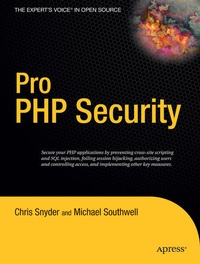
Pro PHP Security
Published on 8. September 2005
Book
Paperback/Softback
XXVIII, 528 pages
978-1-59059-508-4 (ISBN)
Description
Pro PHP Security is one of the first books devoted solely to PHP security. It will serve as your complete guide for taking defensive and proactive security measures within your PHP applications. The methods discussed are compatible with PHP versions 3, 4, and 5.
The knowledge you'll gain from this comprehensive guide will help you prevent attackers from potentially disrupting site operation or destroying data. And you'll learn about various security measures, for example, creating and deploying "captchas," validating e-mail, fending off SQL injection attacks, and preventing cross-site scripting attempts.
More details
Edition
1st ed.
Language
English
Place of publication
Berkeley
United States
Target group
Popular/general
Product notice
Paperback (trade)
Unsewn / adhesive bound
Illustrations
XXVIII, 528 p.
Dimensions
Height: 234 mm
Width: 179 mm
Thickness: 27 mm
Weight
812 gr
ISBN-13
978-1-59059-508-4 (9781590595084)
DOI
10.1007/978-1-4302-0057-4
Schweitzer Classification
Other editions
Additional editions
Persons
Chris Snyder is a software engineer at the Fund for the City of New York, where he helps develop next-generation websites and services for nonprofit organizations. He is a member of the executive board of New York PHP, and has been looking for new ways to build scriptable, linked, multimedia content since he saw his first Hypercard stack in 1988.
Content
The Importance of Security.- Why Is Secure Programming a Concern?.- Maintaining a Secure Environment.- Dealing with Shared Hosts.- Maintaining Separate Development and Production Environments.- Keeping Software Up to Date.- Using Encryption I: Theory.- Using Encryption II: Practice.- Securing Network Connections I: SSL.- Securing Network Connections II: SSH.- Controlling Access I: Authentication.- Controlling Access II: Permissions and Restrictions.- Practicing Secure PHP Programming.- Validating User Input.- Preventing SQL Injection.- Preventing Cross-Site Scripting.- Preventing Remote Execution.- Enforcing Security for Temporary Files.- Preventing Session Hijacking.- Practicing Secure Operations.- Allowing Only Human Users.- Verifying Your Users' Identities.- Using Roles to Authorize Actions.- Adding Accountability to Track Your Users.- Preventing Data Loss.- Safely Executing System Commands.- Handling Remote Procedure Calls Safely.- Taking Advantage of Peer Review.