

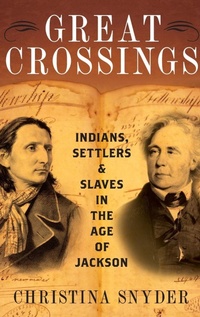
Great Crossings
Indians, Settlers, and Slaves in the Age of Jackson
Published on 30. March 2017
Book
Hardback
416 pages
978-0-19-939906-2 (ISBN)
Description
In this beautifully written book, prize-winning historian Christina Snyder reinterprets the history of Jacksonian America. Usually, this drama focuses on whites who turned west to conquer a continent, extending liberty as they went. Great Crossings features Indians from across the continent seeking new ways to assert anciently-held rights, and people of African descent who challenged the United States to live up to its ideals. These diverse groups met in an experimental community in central Kentucky called Great Crossings, home to the first federal Indian school and a famous interracial family.
Great Crossings embodied monumental changes then transforming North America. The United States, within the span of a few decades, grew from an East Coast nation to a continental empire. The territorial growth of the United States forged a multicultural, multiracial society, but that diversity also sparked fierce debates over race, citizenship, and America's destiny. Great Crossings, a place of race-mixing and cultural exchange, emerged as a battleground. Its history allows an intimate view of the ambitions and struggles of Indians, settlers, and slaves who were trying to secure their place in a changing world. Through deep research and compelling prose, Snyder introduces us to a diverse range of historical actors: Richard Mentor Johnson, the politician who reportedly killed Tecumseh and then became schoolmaster to the sons of his former foes; Julia Chinn, Johnson's enslaved lover, who fought for her children's freedom; Peter Pitchlynn, a Choctaw intellectual who, even in the darkest days of Indian removal, argued for the future of Indian nations. Together, their stories demonstrate how that era transformed colonizers and the colonized alike, sowing the seeds of modern America.
Great Crossings embodied monumental changes then transforming North America. The United States, within the span of a few decades, grew from an East Coast nation to a continental empire. The territorial growth of the United States forged a multicultural, multiracial society, but that diversity also sparked fierce debates over race, citizenship, and America's destiny. Great Crossings, a place of race-mixing and cultural exchange, emerged as a battleground. Its history allows an intimate view of the ambitions and struggles of Indians, settlers, and slaves who were trying to secure their place in a changing world. Through deep research and compelling prose, Snyder introduces us to a diverse range of historical actors: Richard Mentor Johnson, the politician who reportedly killed Tecumseh and then became schoolmaster to the sons of his former foes; Julia Chinn, Johnson's enslaved lover, who fought for her children's freedom; Peter Pitchlynn, a Choctaw intellectual who, even in the darkest days of Indian removal, argued for the future of Indian nations. Together, their stories demonstrate how that era transformed colonizers and the colonized alike, sowing the seeds of modern America.
Reviews / Votes
In drawing our attention to these protagonists and to their complicated histories, Snyder has produced a work of importance to scholars of American history as well as of comparative Indigenous histories more generally. Great Crossings is a nuanced text ... This compelling work is, at its heart, a story about the conditions of liberty and citizenship that prevail over and through diversity within an imperial state. * Ben Silverstein, Australasian Journal of American History * Great Crossings warrants attention from a wide multidisciplinary readership. From the short-lived experiment at Choctaw Academy, Snyder o?ers new insight into race, class, slavery, education, and other aspects of antebellum American society. She even shares a foreshadowing glimpse into what would become the United States' Indian boarding-school system later in the century. This book, moreover, contributes plenty to our understanding of how integral and intricate Indigenous experiences have been throughout American history. * Daniel Usner, Native American and Indigenous Studies *More details
Language
English
Place of publication
New York
United States
Target group
College/higher education
Illustrations
20 hts
Dimensions
Height: 240 mm
Width: 161 mm
Thickness: 27 mm
Weight
790 gr
ISBN-13
978-0-19-939906-2 (9780199399062)
Copyright in bibliographic data and cover images is held by Nielsen Book Services Limited or by the publishers or by their respective licensors: all rights reserved.
Schweitzer Classification
Other editions
Additional editions
Book
09/2019
Oxford University Press Inc
€43.90
Shipment within 15-20 days
E-Book
02/2017
1st Edition
OUP eBook
€9.99
Available for download
E-Book
02/2017
1st Edition
OUP eBook
€9.99
Available for download
Person
Christina Snyder is McCabe Greer Professor of History at Pennsylvania State University, specializing in US history and Native American history. She is the author of the award-winning Slavery in Indian Country: The Changing Face of Captivity in Early America.
Content
Acknowledgments
Introduction: The Great Path?
1. Warriors 2. A Family at the Crossing 3. Scholars 4. Indian Gentlemen and Black Ladies 5. Rise of the Leviathan 6. The Land of Death 7. Rebirth of the Spartans 8. The Vice President and the Runaway Lovers 9. Dr. Nail's Rebellion 10. The New Superintendent 11. Orphans among Strangers 12. Indian Schools for Indian Territory Conclusion: Paths to the Future
Notes
Index
Introduction: The Great Path?
1. Warriors 2. A Family at the Crossing 3. Scholars 4. Indian Gentlemen and Black Ladies 5. Rise of the Leviathan 6. The Land of Death 7. Rebirth of the Spartans 8. The Vice President and the Runaway Lovers 9. Dr. Nail's Rebellion 10. The New Superintendent 11. Orphans among Strangers 12. Indian Schools for Indian Territory Conclusion: Paths to the Future
Notes
Index