

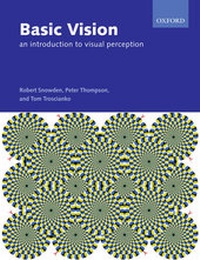
Basic Vision
An Introduction to Visual Perception
Published on 11. May 2006
Book
Paperback/Softback
408 pages
978-0-19-928670-6 (ISBN)
Description
How do we spot a familiar face from across a crowded room, and know that we're not waving to a complete stranger? How can we judge that the oncoming car is approaching too fast for us to cross the road safely, and we're better off waiting at the kerb? Basic Vision: An Introduction to Visual Perception demystifies the processes through which the brain 'sees'. It leads us through the various elements that come together as our perception of the world around us: the perception of size, colour, motion, and three-dimensional space. It illustrates the intricacy of the visual system, discussing its development during infancy, and revealing how the brain can get it wrong, either as a result of brain damage, through which the network of processes become compromised, or through illusion, where the brain compensates for mixed messages by seeing what it thinks should be there, rather than conveying the reality. The book also demonstrates the importance of contemporary techniques and methodology, and neuroscience-based techniques in particular, in driving forward our understanding of the visual system.
With a sense of enthusiasm for the subject that pervades the book, Basic Vision will motivate and engage even the most reluctant learner, opening up to an undergraduate audience this stimulating yet challenging subject for the first time. Online Resource Centre: For Lecturers: Figures from the book available to download, to facilitate lecture preparation Customizable course outlines and student handouts, to facilitate lecture delivery Test bank of multiple choice questions - a readily available tool for either formative or summative assessment For the student: Annotated web links, giving students ready access to these additional learning resources Update section, giving links to web sites and journal articles to illustrate to the student developments in the field since the book published
With a sense of enthusiasm for the subject that pervades the book, Basic Vision will motivate and engage even the most reluctant learner, opening up to an undergraduate audience this stimulating yet challenging subject for the first time. Online Resource Centre: For Lecturers: Figures from the book available to download, to facilitate lecture preparation Customizable course outlines and student handouts, to facilitate lecture delivery Test bank of multiple choice questions - a readily available tool for either formative or summative assessment For the student: Annotated web links, giving students ready access to these additional learning resources Update section, giving links to web sites and journal articles to illustrate to the student developments in the field since the book published
Reviews / Votes
...an impressive range of topics makes this textbook an ideal choice for teaching either a course on vision, or for selecting this book together with others to teach a course on cognitive processes. Psychology Teaching Review The book is very clear and easy to read. I could not help contrasting it with the work of many other authors, who seem to think that difficulty in reading their books or articles is evidence of their superior intellect. Its target audience of undergraduates will find it very easy to follow and it would not even be out of place in a public library. This is certainly a book which would enhance your university's library. If you like its approach, it would make a good set book for a vision course. Mike Griffiths, Goldsmiths College in Psychology Learning and Teaching, March 2007. I cannot but write how much I enjoy the book, which since then became my favourite while lecturing in General Psychology (perception). I really appreciate its up-to-date contents; also, no other book on psychology brought so much fun. Dr G Paramei, Interim Professor of Psychology, Darmstadt University of Technology Congratulations to you and your colleagues for having written a truly outstanding beginner's textbook on vision and visual consciousness. I am a newcomer to this scientific field but your book was the perfect introductory material for me-I consider myself very lucky indeed that I chanced across it! I do hope that your undergraduate readers will find Basic Vision as interesting, and hilariously witty, as I did. Dr L. A. Flippin, Director of Medicinal Chemistry, Fibrogen Inc, USA The quality of this book reflects the fact that, between them, the three authors boast over 80 years experience of teaching visual perception. I plan to adopt this text in my final year undergraduate teaching and I would certainly recommend others to do the same. Good science can be fun, and this book exemplifies that. Colin WG Clifford, University of Sydney, THES November 2006More details
Language
English
Place of publication
Oxford
United Kingdom
Target group
College/higher education
Intermediate and advanced level undergraduates of psychology and neuroscience. Also of interest to postgraduate students who require an accessible introduction to the field.
Illustrations
220 colour line
Dimensions
Height: 246 mm
Width: 189 mm
Thickness: 19 mm
Weight
887 gr
ISBN-13
978-0-19-928670-6 (9780199286706)
Copyright in bibliographic data and cover images is held by Nielsen Book Services Limited or by the publishers or by their respective licensors: all rights reserved.
Schweitzer Classification
Other editions
New editions
Book
02/2012
Oxford University Press
€260.60
Shipment within 15-20 days
Persons
Content
0. A trailer to the book; 1. The first steps in seeing; 2. Signalling changes; 3. To the cortex; 4. Spatial vision; 5. Colour vision; 6. The perception of motion; 7. The third dimension; 8. The development of vision; 9. Attention and neglect; 10. The perception of faces; 11. Vision and action; 12. How we know it might be so..