

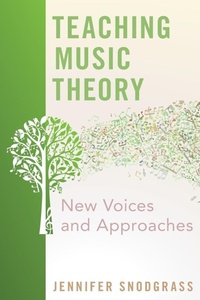
Teaching Music Theory
New Voices and Approaches
Published on 29. June 2020
Book
Paperback/Softback
336 pages
978-0-19-087995-2 (ISBN)
Description
In recent years, music theory educators around the country have developed new and innovative teaching approaches, reintroducing a sense of purpose into their classrooms. In this book, author and veteran music theory educator Jennifer Snodgrass visits several of these teachers, observing them in their music theory classrooms and providing lesson plans that build upon their approaches. Based on three years of field study spanning seventeen states, coupled with reflections on her own teaching strategies,Teaching Music Theory: New Voices and Approaches highlights real-life teaching approaches from effective (and sometimes award-winning) instructors from a wide range of institutions: high schools, community colleges, liberal arts colleges, and conservatories.
Throughout the book, Snodgrass focuses on topics like classroom environment, collaborative learning, undergraduate research and professional development, and curriculum reform. She also emphasizes the importance of a diverse, progressive, and inclusive teaching environment throughout, from encouraging student involvement in curriculum planning to designing lesson plans and assessments so that pedagogical concepts can easily be transferred to the applied studio, performance ensemble, and other courses outside of music. An accessible and valuable text designed with the needs of both students and faculty in mind,Teaching MusicTheoryprovides teachers with a vital set of tools to rejuvenate the classroom and produce confident, empowered students.
Throughout the book, Snodgrass focuses on topics like classroom environment, collaborative learning, undergraduate research and professional development, and curriculum reform. She also emphasizes the importance of a diverse, progressive, and inclusive teaching environment throughout, from encouraging student involvement in curriculum planning to designing lesson plans and assessments so that pedagogical concepts can easily be transferred to the applied studio, performance ensemble, and other courses outside of music. An accessible and valuable text designed with the needs of both students and faculty in mind,Teaching MusicTheoryprovides teachers with a vital set of tools to rejuvenate the classroom and produce confident, empowered students.
Reviews / Votes
Jennifer Snodgrass presents a truly significant contribution to the field, one that every music theory pedagogy class, both graduate and undergraduate, should seriously consider as a primary textbook. * Anthony J. Kosar, Journal of Music Theory Pedagogy * This book is an excellent resource for any music teacher and a valuable addition to the libraries of all classroom music theory teachers. * American Music Teacher * Although there are numerous books about music theory fundamentals-clefs, key signatures, scales, harmony, and so on-there are far fewer about how to teach music theory. In this thought-provoking book, Snodgrass (Appalachian State Univ.) presents the fruits of her in-depth research on this topic. ... Today's students are collaborative learners who want to know why what an instructor teaches is relevant to their particular musical objectives, and who want to influence the content of their curricula. Thus, one-size-fits-all curricula no longer suffice. Since the book treats both high school and university teaching, it is suitable for academic and public use. * D. Arnold, CHOICE * This ambitious, relevant, and practical book is indispensable for music theory and aural skills instructors at all levels. It draws together best practices in contemporary pedagogy from dozens of instructors and offers something for everyone. * Leigh VanHandel, Michigan State University * An invaluable resource for music theory teachers and music educators at any level, this book provides a window into some of the most engaging and effective theory classrooms and shares the creative teaching strategies used within them. Snodgrass's zeal for teaching is felt on every page! * Daniel Stevens, University of Delaware *More details
Language
English
Place of publication
New York
United States
Target group
Professional and scholarly
Illustrations
85 figures
Dimensions
Height: 234 mm
Width: 156 mm
Thickness: 18 mm
Weight
503 gr
ISBN-13
978-0-19-087995-2 (9780190879952)
Copyright in bibliographic data and cover images is held by Nielsen Book Services Limited or by the publishers or by their respective licensors: all rights reserved.
Schweitzer Classification
Other editions
Additional editions
Jennifer Snodgrass
Teaching Music Theory
Book
06/2020
Oxford University Press Inc
€190.80
Shipment within 15-20 days
E-Book
04/2020
OUP eBook
€18.49
Available for download
E-Book
04/2020
OUP eBook
€18.49
Available for download
Person
Jennifer Snodgrass is Professor of Music Theory at Appalachian State University where she teaches courses in music theory, aural skills, analysis, songwriting, and pedagogy. A Grammy-nominated educator, Snodgrass has published in a multitude of theory and education journals and is an active presenter around the country. Most recently she was named a co-editor to the Journal of Music Theory Pedagogy and is the assistant director of the Gail Boyd de Stwolinski Center for Theory Pedagogy at the University of Oklahoma.
Content
Preface
1. The Golden Circle: "Why," "How," and "What"
2. Why and How: Curriculum and Content
3. The Classroom Environment
4. Teaching Theory on the High School Level
5. The Content: Written Theory (Fundamentals-Diatonic Harmony)
6. Chromatic Harmony and Form
7. Pedagogy of Aural Skills
8. Assessment
9. Empower the Undergraduate
10. Taking the First Steps into Academia
11. What the Best Music Theory Instructors Do
Epilogue
Appendix
Bibliography
1. The Golden Circle: "Why," "How," and "What"
2. Why and How: Curriculum and Content
3. The Classroom Environment
4. Teaching Theory on the High School Level
5. The Content: Written Theory (Fundamentals-Diatonic Harmony)
6. Chromatic Harmony and Form
7. Pedagogy of Aural Skills
8. Assessment
9. Empower the Undergraduate
10. Taking the First Steps into Academia
11. What the Best Music Theory Instructors Do
Epilogue
Appendix
Bibliography