

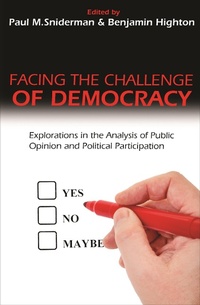
Facing the Challenge of Democracy
Explorations in the Analysis of Public Opinion and Political Participation
Published on 30. October 2011
Book
Paperback/Softback
416 pages
978-0-691-15111-3 (ISBN)
Description
Citizens are political simpletons--that is only a modest exaggeration of a common characterization of voters. Certainly, there is no shortage of evidence of citizens' limited political knowledge, even about matters of the highest importance, along with inconsistencies in their thinking, some glaring by any standard. But this picture of citizens all too often approaches caricature. Paul Sniderman and Benjamin Highton bring together leading political scientists who offer new insights into the political thinking of the public, the causes of party polarization, the motivations for political participation, and the paradoxical relationship between turnout and democratic representation. These studies propel a foundational argument about democracy. Voters can only do as well as the alternatives on offer. These alternatives are constrained by third players, in particular activists, interest groups, and financial contributors. The result: voters often appear to be shortsighted, extreme, and inconsistent because the alternatives they must choose between are shortsighted, extreme, and inconsistent.
Facing the Challenge of Democracy features contributions by John Aldrich, Stephen Ansolabehere, Edward Carmines, Jack Citrin, Susanna Dilliplane, Christopher Ellis, Michael Ensley, Melanie Freeze, Donald Green, Eitan Hersh, Simon Jackman, Gary Jacobson, Matthew Knee, Jonathan Krasno, Arthur Lupia, David Magleby, Eric McGhee, Diana Mutz, Candice Nelson, Benjamin Page, Kathryn Pearson, Eric Schickler, John Sides, James Stimson, Lynn Vavreck, Michael Wagner, Mark Westlye, and Tao Xie.
Facing the Challenge of Democracy features contributions by John Aldrich, Stephen Ansolabehere, Edward Carmines, Jack Citrin, Susanna Dilliplane, Christopher Ellis, Michael Ensley, Melanie Freeze, Donald Green, Eitan Hersh, Simon Jackman, Gary Jacobson, Matthew Knee, Jonathan Krasno, Arthur Lupia, David Magleby, Eric McGhee, Diana Mutz, Candice Nelson, Benjamin Page, Kathryn Pearson, Eric Schickler, John Sides, James Stimson, Lynn Vavreck, Michael Wagner, Mark Westlye, and Tao Xie.
Reviews / Votes
"Raymond Wolfinger taught me two things: be guided by common sense, even (and above all) when doing theory. And that, to understand how democracy works, we need first of all to pay attention to ordinary people and how they think and act. This volume exemplifies both these ideas and advances them further than I would have thought possible. This book greatly enlarges our understanding of American democracy."-John A. Ferejohn, New York University School of Law "These remarkable essays by the profession's leading political scientists not only honor one of the great social scientists, teachers, and mentors of the twentieth century, but advance the long-standing debate about the quality of democracy in America. They are vintage Wolfinger in their approach-confronting sage theories and everyday notions of politics with hard facts."-Steven J. Rosenstone, chancellor, Minnesota State Colleges and Universities "This lucid collection should give pause to skeptics about democracy. It offers a strong argument that the public is more engaged, consistent in its opinions, and rational in its voting than conventional wisdom holds."-Scott Keeter, Pew Research CenterMore details
Language
English
Place of publication
New Jersey
United States
Target group
College/higher education
Professional and scholarly
Product notice
Paperback (trade)
Illustrations
28 line illus. 53 tables.
Dimensions
Height: 234 mm
Width: 155 mm
Thickness: 25 mm
Weight
567 gr
ISBN-13
978-0-691-15111-3 (9780691151113)
Copyright in bibliographic data and cover images is held by Nielsen Book Services Limited or by the publishers or by their respective licensors: all rights reserved.
Schweitzer Classification
Other editions
Additional editions
Paul M. Sniderman | Benjamin Highton
Facing the Challenge of Democracy
Explorations in the Analysis of Public Opinion and Political Participation
E-Book
06/2015
1st Edition
Princeton University Press
from
€188.95
Available for download
Paul M. Sniderman | Benjamin Highton
Facing the Challenge of Democracy
Explorations in the Analysis of Public Opinion and Political Participation
Book
10/2011
Princeton University Press
€76.75
Article exhausted; check different version
Persons
Paul M. Sniderman is the Fairleigh S. Dickinson, Jr., Professor of Public Policy at Stanford University. Benjamin Highton is associate professor of political science at the University of California, Davis.
Content
Preface ix Acknowledgments xi List of Contributors xiii Introduction: Facing the Challenge of Democracy by Paul M. Sniderman and Benjamin Highton 1 Part I: The Political Logic of Preference Consistency Chapter I. How Do Political Scientists Know What Citizens Want? An Essay on Theory and Measurement by Arthur Lupia 23 Chapter II. Purposive Mass Belief Systems concerning Foreign Policy Benjamin I. Page and Tao Xie 47 Chapter III. Cosmopolitanism by Simon Jackman and Lynn Vavreck 70 Chapter IV. Running to the Right: Effects of Campaign Strategy on Mass Opinion and Behavior by Diana Mutz and Susanna Dilliplane 97 Chapter V. Pathways to Conservative Identification: The Politics of Ideological Contradiction in the United States by Christopher Ellis and James A. Stimson 120 Part II: Polarization and the Party System Chapter VI. Partisan Differences in Job Approval Ratings of George W. Bush and U.S. Senators in the States: An Exploration by Gary C. Jacobson 153 Chapter VII. Political Participation, Polarization, and Public Opinion: Activism and the Merging of Partisan and Ideological Polarization by John H. Aldrich and Melanie Freeze 185 Chapter VIII. Political Parties in the Capital Economy of Modern Campaigns by Jonathan Krasno 207 Chapter IX. Candidates and Parties in Congressional Elections: Revisiting Candidate-Centered Conclusions in a Partisan Era by Eric McGhee and Kathryn Pearson 224 Chapter X. The Myth of the Independent Voter Revisited by David B. Magleby, Candice J. Nelson, and Mark C. Westlye 238 Part III: Participation and Representation Chapter XI. Who Really Votes? By Stephen Ansolabehere and Eitan Hersh 267 Chapter XII. Who Governs if Everyone Votes? By John Sides, Eric Schickler, and Jack Citrin 292 Chapter XIII. T he Effects of Registration Laws on Voter Turnout: An Updated Assessment by Matthew R. Knee and Donald P. Green 312 Chapter XIV. I ssue Preferences, Civic Engagement, and the Transformation of American Politics by Edward G. Carmines, Michael J. Ensley, and Michael W. Wagner 329 References 355 Index 379