

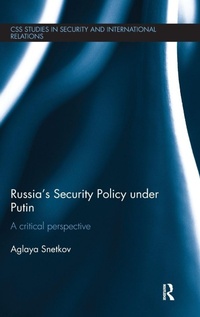
Russia's Security Policy under Putin
A critical perspective
1st Edition
Published on 3. December 2014
Book
Hardback
264 pages
978-0-415-82143-8 (ISBN)
Description
This book examines the evolution of Russia's security policy under Putin in the 21st century, using a critical security studies approach.
Drawing on critical approaches to security the book investigates the interrelationship between the internal-external nexus and the politics of (in)security and regime-building in Putin's Russia. In so doing, it evaluates the way that this evolving relationship between state identities and security discourses framed the construction of individual security policies, and how, in turn, individual issues can impact on the meta-discourses of state and security agendas. To this end, the (de)securitisation discourses and practices towards the issue of Chechnya are examined as a case study.
In so doing, this study has wider implications for how we read Russia as a security actor through an approach that emphasises the importance of taking into account its security culture, the interconnection between internal/external security priorities and the dramatic changes that have taken place in Russia's conceptions of itself, national and security priorities and conceptualisation of key security issues, in this case Chechnya. These aspects of Russia's security agenda remain somewhat of a neglected area of research, but, as argued in this book, offer structuring and framing implications for how we understand Russia's position towards security issues, and perhaps those of rising powers more broadly.
This book will be of much interest to students of Russian security, critical security studies and IR.
Drawing on critical approaches to security the book investigates the interrelationship between the internal-external nexus and the politics of (in)security and regime-building in Putin's Russia. In so doing, it evaluates the way that this evolving relationship between state identities and security discourses framed the construction of individual security policies, and how, in turn, individual issues can impact on the meta-discourses of state and security agendas. To this end, the (de)securitisation discourses and practices towards the issue of Chechnya are examined as a case study.
In so doing, this study has wider implications for how we read Russia as a security actor through an approach that emphasises the importance of taking into account its security culture, the interconnection between internal/external security priorities and the dramatic changes that have taken place in Russia's conceptions of itself, national and security priorities and conceptualisation of key security issues, in this case Chechnya. These aspects of Russia's security agenda remain somewhat of a neglected area of research, but, as argued in this book, offer structuring and framing implications for how we understand Russia's position towards security issues, and perhaps those of rising powers more broadly.
This book will be of much interest to students of Russian security, critical security studies and IR.
Reviews / Votes
Snetkov's monograph, based on a PhD dissertation at the University of Birmingham, provides a close reading of Russian security discourse from 1999-2014 through the prism of Chechnya. The author carefully documents how the Russian leadership switched from a frame of a "weak state" to a "strong state" before edging back toward a discourse of an embattled state threatened by external enemies-and their domestic collaborators-a theme that emerged by 2004.--P. Rutland, Wesleyan University, CHOICE 'Snetkov's monograph ... provides a close reading of Russian security discourse from 1999-2014 through the prism of Chechnya. The author carefully documents how the Russian leadership switched from a frame of a "weak state" to a "strong state" before edging back toward a discourse of an embattled state threatened by external enemies-and their domestic collaborators-a theme that emerged by 2004.'--P. Rutland, Wesleyan University, CHOICE
'Snetkov's volume provides a rich investigative agenda for the Russian security specialist. ... [her] research unambiguously signals how valuable it can be to study Russia's security challenges using multiple analytical lenses'--Raymond Taras, Tulane University, Europe-Asia Studies
More details
Series
Language
English
Place of publication
London
United Kingdom
Publishing group
Taylor & Francis Ltd
Target group
College/higher education
Professional and scholarly
Dimensions
Height: 240 mm
Width: 161 mm
Thickness: 19 mm
Weight
567 gr
ISBN-13
978-0-415-82143-8 (9780415821438)
Copyright in bibliographic data and cover images is held by Nielsen Book Services Limited or by the publishers or by their respective licensors: all rights reserved.
Schweitzer Classification
Other editions
Additional editions
Book
06/2016
1st Edition
Routledge
€68.50
Shipment within 10-20 days
E-Book
11/2014
1st Edition
Routledge
€61.99
Available for download
E-Book
11/2014
1st Edition
Routledge
€61.99
Available for download
Person
Aglaya Snetov is Senior Researcher, Center for Security Studies, ETH Zurich, Switzerland, and has a PhD in Russian and East European studies from the University of Birmingham.
Content
1. Introduction 2. Analysing security in a non-Western context Part I: 1999-2000 3. Russia in crisis 1999/2000 4. Russia's number one threat: the securitisation of Chechnya Part II: 2000-2004 5. The Rebuilding of Russia 6. The 'normalisation' of Chechnya Part III: 2004-2008 7. Russia as a strong state and a great power? 8. A 'rebuilt' Chechnya in a securitised North Caucasus? Part IV: 2008-2014 9. Modernisation, resecuritisation and patriotic fervour: Medvedev and Putin 10. Russia's policy towards the North Caucasus and Chechnya 11. Conclusion