

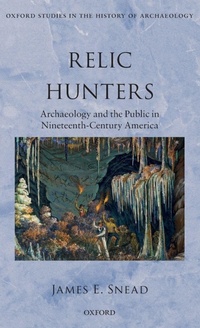
Relic Hunters
Archaeology and the Public in Nineteenth- Century America
Published on 20. September 2018
Book
Hardback
320 pages
978-0-19-873627-1 (ISBN)
Description
Relic Hunters is a study of the complex relationship between the people of 19th century America with the material antiquities of North America's indigenous past. As scholars struggled to explain their existence, farmers in Ohio were plowing up arrowheads, building their houses atop burial mounds, and developing their own ideas about antiquity. They experienced the new country as a "place with history" reflected in material traces that became important touch points for scientific knowledge, but for American cultural identity as well.
Relic Hunters traces the encounter with American antiquities from 1812 to 1879. This encompasses the period when archaeology took root in the United States: it also spans the "deep settlement" of the Midwest and sectional strife both before and after the Civil War. At the center of the story is the first iconic find of American archaeology, known as "the Kentucky Mummy." Discovered deep in a cavern, this dessicated burial became the subject of scholarly competition, traveling exhibitions, and even poetry. The book uses the theme of the Kentucky Mummy to structure the broader story of the public and American antiquities, a tour that leads through rural museums, mound excavations, lecture tours, shady deals, and ultimately into the famous attic of the Smithsonian Institution.
Ultimately, Relic Hunters is a story of the American landscape, and of the role of archaeology in shaping that place. Derived from letters, memoranda, and reports found in more than a dozen archives, this is a unique account of a critical encounter that shaped local and national identity in ways that are only now being explored.
Relic Hunters traces the encounter with American antiquities from 1812 to 1879. This encompasses the period when archaeology took root in the United States: it also spans the "deep settlement" of the Midwest and sectional strife both before and after the Civil War. At the center of the story is the first iconic find of American archaeology, known as "the Kentucky Mummy." Discovered deep in a cavern, this dessicated burial became the subject of scholarly competition, traveling exhibitions, and even poetry. The book uses the theme of the Kentucky Mummy to structure the broader story of the public and American antiquities, a tour that leads through rural museums, mound excavations, lecture tours, shady deals, and ultimately into the famous attic of the Smithsonian Institution.
Ultimately, Relic Hunters is a story of the American landscape, and of the role of archaeology in shaping that place. Derived from letters, memoranda, and reports found in more than a dozen archives, this is a unique account of a critical encounter that shaped local and national identity in ways that are only now being explored.
More details
Series
Language
English
Place of publication
Oxford
United Kingdom
Target group
Professional and scholarly
Dimensions
Height: 222 mm
Width: 145 mm
Thickness: 21 mm
Weight
536 gr
ISBN-13
978-0-19-873627-1 (9780198736271)
Copyright in bibliographic data and cover images is held by Nielsen Book Services Limited or by the publishers or by their respective licensors: all rights reserved.
Schweitzer Classification
Other editions
Additional editions
E-Book
08/2018
1st Edition
OUP eBook
€56.99
Available for download
E-Book
08/2018
1st Edition
OUP eBook
€56.99
Available for download
Person
James E. Snead is Professor at California State University, Northridge. He completed his Ph.D. at UCLA in 1995: subsequent writing and research has been supported by numerous institutions and agencies, including the American Museum of Natural History, the Wenner-Gren Foundation, the American Antiquarian Society, and the National Science Foundation.
Content
1: The Kentucky Mummy: Encountering the American Past
2: Antiquarian Dreams: Collections and Competition in the Early Republic
3: "Too Poetical a Theory": Antiquarian Ambition, East and West
4: Antiquarian Entrepreneurs: Mounds and Meaning in the Jacksonian Era
5: "These Places Know him no more": Surveys, Panoramas, and the Ancient American Landscape
6: Idol Pursuits: Artifacts and Authority after the Civil War
7: Mementos of the Prehistoric Races: Antiquarians and Archaeologists in the Centennial Decade
8: "Lost by Being Found": The Public and the Material Past in the 19th Century United States
2: Antiquarian Dreams: Collections and Competition in the Early Republic
3: "Too Poetical a Theory": Antiquarian Ambition, East and West
4: Antiquarian Entrepreneurs: Mounds and Meaning in the Jacksonian Era
5: "These Places Know him no more": Surveys, Panoramas, and the Ancient American Landscape
6: Idol Pursuits: Artifacts and Authority after the Civil War
7: Mementos of the Prehistoric Races: Antiquarians and Archaeologists in the Centennial Decade
8: "Lost by Being Found": The Public and the Material Past in the 19th Century United States