

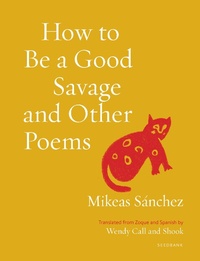
How to Be a Good Savage and Other Poems
Published on 22. February 2024
Book
Paperback/Softback
224 pages
978-1-63955-020-3 (ISBN)
Description
The latest in the Seedbank series, the debut in English of a groundbreaking Indigenous poet of the Americas.
In a fiercely personal yet authoritative voice, prolific contemporary poet Mikeas Sanchez explores the worldview of the Zoque people of southern Mexico. Her paced, steely lyrics fuse cosmology, lineage, feminism, and environmental activism into a singular body of work that stands for the self and the collective in the same instant. "I am woman and I celebrate every vein," she writes, "where I guard my ancestors' secrets / every Zoque man's word in my mouth / every Zoque woman's wisdom in my spit."
How to Be a Good Savage and Other Poems examines the intersection of Zoque struggles against colonialism and empire, and those of North African immigrants and refugees. Sanchez encountered the latter in Barcelona as a revelation, "spreading their white blankets on the ground / as if they'll soon return to sea / flying the sail of the promised land / the land that became a mirage." Other works bring us just as close to similarly imperiled relatives, ancestors, gods, and archetypal Zoque men and women that Sanchez addresses with both deeply prophetic and childlike love.
Coming from the only woman to ever publish a book of poetry in Zoque and Spanish, this timely, powerful collection pairs the bilingual originals with an English translation for the first time. This book is for anyone interested in poetry as knowledge, proclaimed with both feet squarely set on ancient ground.
The How to Be a Good Savage and Other Poems audiobook read by Mikeas Sanchez, Wendy Call, and Shook is available everywhere you listen to audiobooks.
In a fiercely personal yet authoritative voice, prolific contemporary poet Mikeas Sanchez explores the worldview of the Zoque people of southern Mexico. Her paced, steely lyrics fuse cosmology, lineage, feminism, and environmental activism into a singular body of work that stands for the self and the collective in the same instant. "I am woman and I celebrate every vein," she writes, "where I guard my ancestors' secrets / every Zoque man's word in my mouth / every Zoque woman's wisdom in my spit."
How to Be a Good Savage and Other Poems examines the intersection of Zoque struggles against colonialism and empire, and those of North African immigrants and refugees. Sanchez encountered the latter in Barcelona as a revelation, "spreading their white blankets on the ground / as if they'll soon return to sea / flying the sail of the promised land / the land that became a mirage." Other works bring us just as close to similarly imperiled relatives, ancestors, gods, and archetypal Zoque men and women that Sanchez addresses with both deeply prophetic and childlike love.
Coming from the only woman to ever publish a book of poetry in Zoque and Spanish, this timely, powerful collection pairs the bilingual originals with an English translation for the first time. This book is for anyone interested in poetry as knowledge, proclaimed with both feet squarely set on ancient ground.
The How to Be a Good Savage and Other Poems audiobook read by Mikeas Sanchez, Wendy Call, and Shook is available everywhere you listen to audiobooks.
Reviews / Votes
Praise for How the Be a Good Savage and Other Poems"In How to Be a Good Savage and Other Poems, Macy's store windows and buildings like "dark, silent tombs" share space with sacred mountains and flowers that teach newborns to speak. [. . .] [Sanchez's] writing is compelling in part because she manages to simultaneously honor and challenge traditions - her own and those of others - presenting a Zoque worldview in dialogue with global ecology, feminism and modernity writ large."-Benjamin Samuels, New York Times Book Review
"As the first woman to ever publish a book of poetry in Zoque, a language spoken in Southern Mexico, and Spanish, this poetry collection encompasses colonialism, lineage, and the balance to embrace ancestral roots and the present. Powerful and lyrical, this collection is unlike anything other collection of poems I've read before."-Lupita Aquino, The Today Show
"In a fiercely personal yet authoritative voice...Mikeas Sanchez explores the worldview of the Zoque people of southern Mexico[...] How to Be a Good Savage and Other Poems examines the intersection of Zoque struggles against colonialism and empire, and those of North African immigrants and refugees. [. . .] Coming from the only woman to ever publish a book of poetry in Zoque and Spanish, this timely, powerful collection pairs the bilingual originals with an English translation for the first time."-Latin American Literature Today
"How to Be a Good Savage and Other Poems is not simply another poetry collection. Its pages are, notably, a means of cultural and linguistic preservation, and each and every poem is call for attention to and awareness of the cultures, beliefs, and peoples colonialism has long displaced and overshadowed."-Nicole Yurcaba, Tupelo Quarterly
"In a fiercely personal yet authoritative voice, prolific contemporary poet Mikeas Sanchez explores the worldview of the Zoque people of southern Mexico. Her paced, steely lyrics fuse cosmology, lineage, feminism, and environmental activism into a singular body of work that stands for the self and the collective in the same instant."-Philly Chapbook Review
Praise for the Seedbank Series
"Milkweed's Seedbank series is one of the most exciting and visionary projects in contemporary publishing. Taking the long view, these volumes run parallel to the much-hyped books of the moment to demonstrate the possibility and hope inherent in all great literature."-Stephen Sparks, Point Reyes Books
"Through its cultural-linguistic contribution to narrative diversity, Milkweed's Seedbank series is a vital tool in imagining the futures possible for humanity beyond the anthropocene. Bringing works from Greek, K'iche', German, Russian (and more!) whose authors are deeply rooted in their homelands, each voice encountered has resonated with me on a seemingly cellular level-shifting and changing both who I am and can be. I will continue to press these books into the hands of compassionate readers and cannot wait to share the forthcoming titles in the project!"-Erin Pineda from 27th Letter Books
"Milkweed as a publishing house has long been championing literary works both fictitious and true to life centered around culture, nature, and environmentalism. The Seedbank series serves as both a marvelous introduction to the books Milkweed provides and as a collection of essential stories that ought to be on everyone's radar. The words behind these front covers highlight life-changing experiences, knowledge, and ways of life from communities that are seldom otherwise heard from in the publishing world through an authentic cultural lens. What I've read from the Seedbank line is phenomenal, and I look forward to spending time with future works in the series."-Andrew King from Secret Garden Books
More details
Series
Language
English
Place of publication
Minneapolis
United States
Product notice
Paperback (trade)
Illustrations
Illustrations
Dimensions
Height: 213 mm
Width: 160 mm
Thickness: 15 mm
Weight
295 gr
ISBN-13
978-1-63955-020-3 (9781639550203)
Copyright in bibliographic data and cover images is held by Nielsen Book Services Limited or by the publishers or by their respective licensors: all rights reserved.
Schweitzer Classification
Other editions
Additional editions
Mikeas Sánchez
How to Be a Good Savage and Other Poems
E-Book
01/2024
Milkweed Editions
€9.49
Available for download
Persons
Mikeas Sanchez is the author of How to Be a Good Savage and Other Poems. She is one of the most important poets of the Indigenous Americas, working in Zoque, a language spoken in southern Mexico. She is the only woman to have ever published a book of poetry in that language. Her six volumes of poetry-including Mokaya / Mojk'Jaeyae and Mumure' tae' yaejktambae / Todos somos cimarrones-are all bilingual Spanish-Zoque. Sanchez's work has been translated into Bangla, Catalan, English, German, Italian, Maya, Mixe, and Portuguese. In Chiapas, Mexico, she was awarded first place in the "Y el Bolom dice . . ." Prize for Fiction as well as the Pat O'tan Prize for Indigenous Poetry. Sanchez is a radio producer, translator, community health promoter, and defender of Zoque lands. She lives in Ajway, Chiapas.
Wendy Call is co-editor of Telling True Stories: A Nonfiction Writers' Guide and Best Literary Translations, author of the award-winning No Word for Welcome, and translator of two collections of poetry by Mexican-Zapotec poet Irma Pineda: In the Belly of Night and Other Poems and Nostalgia Doesn't Flow Away Like Riverwater. Her literary projects have been supported by Artist Trust, the Fulbright Commission, and the National Endowment for the Arts. Call serves on the faculty of the Rainier Writing Workshop MFA program and lives in Seattle, on Duwamish land, and in Oaxaca, Mexico, on Mixtec and Zapotec land.
Shook is a poet, translator, and editor whose work has spanned a wide range of languages and places. Their writing has appeared in Poetry, World Literature Today, the Guardian, and many other publications, as well as being translated into more than a dozen languages, including Isthmus Zapotec, Kurdish, and Uyghur. Since founding Phoneme Media in 2013, Shook has edited and published translations from over thirty-five languages. Today they direct Kashkul Books, a publishing project based in the Kurdistan Region of Iraq, as well as the translation-focused imprint avion at Gato Negro Ediciones in Mexico City. They reside at Newt Beach in Northern California.
Wendy Call is co-editor of Telling True Stories: A Nonfiction Writers' Guide and Best Literary Translations, author of the award-winning No Word for Welcome, and translator of two collections of poetry by Mexican-Zapotec poet Irma Pineda: In the Belly of Night and Other Poems and Nostalgia Doesn't Flow Away Like Riverwater. Her literary projects have been supported by Artist Trust, the Fulbright Commission, and the National Endowment for the Arts. Call serves on the faculty of the Rainier Writing Workshop MFA program and lives in Seattle, on Duwamish land, and in Oaxaca, Mexico, on Mixtec and Zapotec land.
Shook is a poet, translator, and editor whose work has spanned a wide range of languages and places. Their writing has appeared in Poetry, World Literature Today, the Guardian, and many other publications, as well as being translated into more than a dozen languages, including Isthmus Zapotec, Kurdish, and Uyghur. Since founding Phoneme Media in 2013, Shook has edited and published translations from over thirty-five languages. Today they direct Kashkul Books, a publishing project based in the Kurdistan Region of Iraq, as well as the translation-focused imprint avion at Gato Negro Ediciones in Mexico City. They reside at Newt Beach in Northern California.
Content
Introduction by Jake Skeets
Note on the Translations
Ore'yomo
Ore'yomo
Ore'yomo
Wejpaej'ki'uy
Nombrar las cosas
To Name Things
Mojk'jaeyae
Mokaya
Mokaya
Tumjama maka mujsi'
Y sabras un dia
And One Day You Will Know
Te' kojama wi'rupa jurae nitiyae ji' nhtae manemae'
El alma retorna al grito del silencio
The Soul Returns to Silence's Cry
Aisha'
Aisha
Aisha
Rama
Rama
Rama
Mumure' nhtae' yaejktampae
Todos somos cimarrones
We're All Maroons
Nereyda'is myapasyi'aeyu nhwyt New'York
Nereyda se sono en New York
Nereyda Dreamed in New York
[!Jae! te' kakuy myojna'pyapae'is mij' nhkojso]
[!Ay! de la muerte que te cubre los pies]
[Ay! From the death that covers your feet]
[Maka' mini' te' kakuy / tese' maka 'mpyi'are' mij' aenhkuy'omo]
[Llegara la muerte / y te encontrara en tu cama]
[Death will arrive / and find you in your bed]
[Maka mini te' kaku'y / te' wiyunh'sepae]
[Llegara la muerte / la verdadera]
[Death will arrive / the true one]
[Waekae nhtae' jampae'ae te' toya']
[Que para olvidar el dolor]
[May just one prayer]
[AEkyaj'papae temaejk kaetpamae te' jama teserike te' tzu']
[Los que duermen mas alla del dia y la noche]
[Those who sleep beyond day and night]
[Mujspatzi nyitzaejk'pak teserike yajpak' te' jama]
[En el inicio y la culminacion del dia se]
[At beginning and end of each day I know]
[Tumae jama tumae paenis]
[Un dia un hombre]
[One day a man]
Jesukristo'is ja' nyiaejk'tyiaejya aej' tzumama'is Kyonukskuy
Jesucristo no entendio jamas los ruegos de mi abuela
Jesus Never Understood My Grandmother's Prayers
Wanhjampatzi yom'nhkomi nyiaeyi'paeis Soledad
Mi Virgen se llama soledad
My Virgin's Named for Solitude
Nhtae' nhtzamae ore' sasyapyae tire'
Ser zoque es un privilegio
To Be Zoque Is a Privilege
Paejkinh'tzyoki'uy' mokaya'paetkoroya
Recibimiento del hombre mokaya
Reception for a Mokaya Man
Paejkinh'tzyi'okyuy mokaya'yomo'koroya
Recibimiento de la mujer mokaya
Reception for a Mokaya Woman
Aj' jara'is tzi'upae'
Mi padre me dio un regalo
My Father Gave Me a Gift
We'we'
Wewe
Wewe
Tzoko'tzyame
Pensar con el corazon
Thinking with Our Hearts
Waekae' jana tyi'ujanaemae' nijp'pyajpak
Para que no llueva el dia de tu entierro
So It Won't Rain on Your Burial Day
Wenhti'
Ofrenda
Gift
Tumae une' mapasyiaepya
Un nino suena
A Child Dreams
Jujtzyi'e nhtae waepae tzamapaenh'ajae
Como ser un buen salvaje
How to Be a Good Savage
Te' meke
El festin
Feast
Mapasyiaepyatzi yaejkpae'wakas
Sonando con un toro negro
Dreaming of a Black Bull
Pistinh
Ceiba
Ceiba
Maeja kupkuy'omo Saspalankis'yuneram jaetyi'ampatzi
Los hijos de Saspalanki lloramos en la gran ciudad
Saspalanki's Children Cry in the Big City
Sonerampaete
Somos Millones
We Are Millions
Nae'pyajpa, Mokayaram maka' yajpae'ya'e
Dicen que los Mokayas nos extinguiremos
They Say the Mokayas Will Go Extinct
Jujtzyi'ere'
?Cuanto vale?
What Is It Worth?
Tae' mokaya'ramte
Somos mokayas
We Are Mokayas
Mokaya, kaemanae'
Escucha, mokaya
Listen, Mokaya
Maka' tae' wyrurame nhtae' 'tunh'omo
Volveremos al camino
Returning to the Path
Notes on the Poems
Acknowledgments
Note on the Translations
Ore'yomo
Ore'yomo
Ore'yomo
Wejpaej'ki'uy
Nombrar las cosas
To Name Things
Mojk'jaeyae
Mokaya
Mokaya
Tumjama maka mujsi'
Y sabras un dia
And One Day You Will Know
Te' kojama wi'rupa jurae nitiyae ji' nhtae manemae'
El alma retorna al grito del silencio
The Soul Returns to Silence's Cry
Aisha'
Aisha
Aisha
Rama
Rama
Rama
Mumure' nhtae' yaejktampae
Todos somos cimarrones
We're All Maroons
Nereyda'is myapasyi'aeyu nhwyt New'York
Nereyda se sono en New York
Nereyda Dreamed in New York
[!Jae! te' kakuy myojna'pyapae'is mij' nhkojso]
[!Ay! de la muerte que te cubre los pies]
[Ay! From the death that covers your feet]
[Maka' mini' te' kakuy / tese' maka 'mpyi'are' mij' aenhkuy'omo]
[Llegara la muerte / y te encontrara en tu cama]
[Death will arrive / and find you in your bed]
[Maka mini te' kaku'y / te' wiyunh'sepae]
[Llegara la muerte / la verdadera]
[Death will arrive / the true one]
[Waekae nhtae' jampae'ae te' toya']
[Que para olvidar el dolor]
[May just one prayer]
[AEkyaj'papae temaejk kaetpamae te' jama teserike te' tzu']
[Los que duermen mas alla del dia y la noche]
[Those who sleep beyond day and night]
[Mujspatzi nyitzaejk'pak teserike yajpak' te' jama]
[En el inicio y la culminacion del dia se]
[At beginning and end of each day I know]
[Tumae jama tumae paenis]
[Un dia un hombre]
[One day a man]
Jesukristo'is ja' nyiaejk'tyiaejya aej' tzumama'is Kyonukskuy
Jesucristo no entendio jamas los ruegos de mi abuela
Jesus Never Understood My Grandmother's Prayers
Wanhjampatzi yom'nhkomi nyiaeyi'paeis Soledad
Mi Virgen se llama soledad
My Virgin's Named for Solitude
Nhtae' nhtzamae ore' sasyapyae tire'
Ser zoque es un privilegio
To Be Zoque Is a Privilege
Paejkinh'tzyoki'uy' mokaya'paetkoroya
Recibimiento del hombre mokaya
Reception for a Mokaya Man
Paejkinh'tzyi'okyuy mokaya'yomo'koroya
Recibimiento de la mujer mokaya
Reception for a Mokaya Woman
Aj' jara'is tzi'upae'
Mi padre me dio un regalo
My Father Gave Me a Gift
We'we'
Wewe
Wewe
Tzoko'tzyame
Pensar con el corazon
Thinking with Our Hearts
Waekae' jana tyi'ujanaemae' nijp'pyajpak
Para que no llueva el dia de tu entierro
So It Won't Rain on Your Burial Day
Wenhti'
Ofrenda
Gift
Tumae une' mapasyiaepya
Un nino suena
A Child Dreams
Jujtzyi'e nhtae waepae tzamapaenh'ajae
Como ser un buen salvaje
How to Be a Good Savage
Te' meke
El festin
Feast
Mapasyiaepyatzi yaejkpae'wakas
Sonando con un toro negro
Dreaming of a Black Bull
Pistinh
Ceiba
Ceiba
Maeja kupkuy'omo Saspalankis'yuneram jaetyi'ampatzi
Los hijos de Saspalanki lloramos en la gran ciudad
Saspalanki's Children Cry in the Big City
Sonerampaete
Somos Millones
We Are Millions
Nae'pyajpa, Mokayaram maka' yajpae'ya'e
Dicen que los Mokayas nos extinguiremos
They Say the Mokayas Will Go Extinct
Jujtzyi'ere'
?Cuanto vale?
What Is It Worth?
Tae' mokaya'ramte
Somos mokayas
We Are Mokayas
Mokaya, kaemanae'
Escucha, mokaya
Listen, Mokaya
Maka' tae' wyrurame nhtae' 'tunh'omo
Volveremos al camino
Returning to the Path
Notes on the Poems
Acknowledgments