

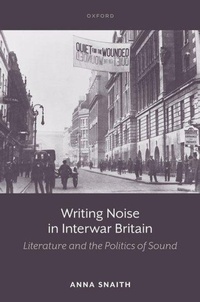
Writing Noise in Interwar Britain
Literature and the Politics of Sound
Will be published approx. on 27. November 2025
Book
Hardback
336 pages
978-0-19-895147-6 (ISBN)
Description
Interwar Britain--called the 'age of noise'--witnessed a pervasive preoccupation with 'unwanted' sound. With the rising hum of air and road traffic, the roar of industry, and the reverberations of newly popular sound technologies, everyday urban din became an increasingly urgent subject of interrogation. Practitioners across the arts and sciences sought to listen in to, represent, and regulate the causes and effects of excess or disruptive sound. Noise was one of the pre-eminent frameworks for conceptualizing modernity and its effects. Writing Noise in Interwar Britain explores this multi-disciplinary preoccupation and argues for its connection to the sonic legacy of the First World War.
The extreme decibel levels of the conflict brought about not only a concern with the effects of noise on minds and bodies, but a reconceptualization of the material effects of everyday sound. Modernist writers were at the forefront of this sonic-mindedness and derived creative fuel from tuning in to the noisescapes found in war zones, cities, factories, domestic spaces, and the countryside. In this way, literary fiction is not only a key source of auditory history but a site in which definitions of unwanted or resistant sound were rehearsed. Sound became noise and vice versa. This volume brings literary studies into conversation with the history of medicine, technology, and industrial psychology to demonstrate the importance of noise to understandings of technological modernity and the racial, gender, and class politics of national identity of this period. Noise is about power: its designation can be a silencing technique brought to bear on marginalized individuals or communities as much as it can be a mode of protest against those very measures.
The extreme decibel levels of the conflict brought about not only a concern with the effects of noise on minds and bodies, but a reconceptualization of the material effects of everyday sound. Modernist writers were at the forefront of this sonic-mindedness and derived creative fuel from tuning in to the noisescapes found in war zones, cities, factories, domestic spaces, and the countryside. In this way, literary fiction is not only a key source of auditory history but a site in which definitions of unwanted or resistant sound were rehearsed. Sound became noise and vice versa. This volume brings literary studies into conversation with the history of medicine, technology, and industrial psychology to demonstrate the importance of noise to understandings of technological modernity and the racial, gender, and class politics of national identity of this period. Noise is about power: its designation can be a silencing technique brought to bear on marginalized individuals or communities as much as it can be a mode of protest against those very measures.
More details
Language
English
Place of publication
Oxford
United Kingdom
Target group
Professional and scholarly
Product notice
sewn/stitched
Cloth over boards
With dust jacket
Illustrations
15 Illustrations
Dimensions
Height: 234 mm
Width: 156 mm
Thickness: 19 mm
Weight
644 gr
ISBN-13
978-0-19-895147-6 (9780198951476)
Copyright in bibliographic data and cover images is held by Nielsen Book Services Limited or by the publishers or by their respective licensors: all rights reserved.
Schweitzer Classification
Person
Anna Snaith is Professor of Twentieth-Century Literature at King's College London. She studied at the University of Toronto (BA) and University College London (PhD) and joined the English Department at King's College London in 2003. She was Head of English between 2020 and 2022. She is a former member of the AHRC's Peer Review College and is on the editorial board of the Woolf Studies Annual, Modern Fiction Studies, and Modernism/modernity.
Content
Introduction
1: Writing War Noise: Auditory Shock and the Sonic Legacy of the First World War
2: 'No Needless Noise': The Biopolitics of Interwar Noise Abatement
3: The Sonification of Domestic Space: Radio and the 'Good Listener'
4: Industrial Noise, Factory Fiction, and the Sounds of Protest
5: Listening to 'Nature': Rural Noise, Interwar Preservation, and Forms of Sonic Nationalism
Coda:: Writing the Blitz
1: Writing War Noise: Auditory Shock and the Sonic Legacy of the First World War
2: 'No Needless Noise': The Biopolitics of Interwar Noise Abatement
3: The Sonification of Domestic Space: Radio and the 'Good Listener'
4: Industrial Noise, Factory Fiction, and the Sounds of Protest
5: Listening to 'Nature': Rural Noise, Interwar Preservation, and Forms of Sonic Nationalism
Coda:: Writing the Blitz