

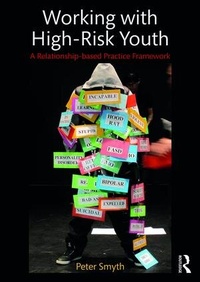
Working with High-Risk Youth
A Relationship-based Practice Framework
1st Edition
Published on 11. April 2017
Book
Paperback/Softback
230 pages
978-1-138-23449-9 (ISBN)
Description
In the child welfare system some youth do well in their lives, but far too many do not experience positive outcomes by the time they are leaving government services. The youth often feel marginalized and that they were not involved in decisions about their own lives, leaving them with a sense of hopelessness and helplessness. This book focuses on high-risk youth - whose struggles include neglect and abuse, alcohol and drug abuse, the risk of being exploited, mental health issues, and the inability to self-regulate and trust - a population of youth that government child welfare services and community agencies struggle to serve adequately. The focus has traditionally been on punishment-consequence interventions and demanding compliance, but experience and research shows they can be better served through relationship-based practice incorporating harm reduction principles, resiliency and strength-based approaches, community collaboration, and an understanding that these youth typically come from experiences of early trauma impacting their brain development and their ability to form attachments. This book provides an overview of the Get Connected practice framework and philosophy, and provides strategies for engaging and working with the most disconnected, challenging, and troubled youth in society.
Reviews / Votes
'Smyth speaks with the authority of someone who has spent his career on the frontlines of practice. More than just an easy to access summary of the theory of resilience, this book shows what it takes to reach out to our most vulnerable young people and engage them in the services they want and need.' - Michael Ungar, Dalhousie University, CanadaMore details
Language
English
Place of publication
London
United Kingdom
Publishing group
Taylor & Francis Ltd
Target group
Professional and scholarly
Professional Practice & Development
Illustrations
1 s/w Zeichnung
1 Line drawings, black and white
Dimensions
Height: 246 mm
Width: 174 mm
Weight
450 gr
ISBN-13
978-1-138-23449-9 (9781138234499)
Copyright in bibliographic data and cover images is held by Nielsen Book Services Limited or by the publishers or by their respective licensors: all rights reserved.
Schweitzer Classification
Other editions
New editions

Book
12/2023
2nd Edition
Routledge
€53.70
Shipment within 10-20 days
Additional editions
Book
04/2017
1st Edition
Routledge
€207.98
Article exhausted; check for reprint
Person
Peter Smyth, M.S.W., R.S.W., has been a social worker for over 27 years and is currently with Alberta Human Services, Edmonton Region Child and Youth Services Division, overseeing the High Risk Youth Initiative. From 2005 to 2012, he was the supervisor of the High Risk Youth Initiative. He developed a practice framework and philosophy incorporating non-traditional intervention methods to better meet the needs of this challenging population. Prior to this, he supervised the Inner City Connections partnership between government and inner city agencies. He is a co-founder of the Old Strathcona Youth Society in Edmonton, Alberta, which has served homeless and disadvantaged youth since 1998. He has written about issues confronting youth and provides consultation, training, and workshops on engaging and working with youth and understanding youth through an attachment, trauma, and brain development lens. He is also a part of the committee organizing the Allies for Youth Connections Conference (formerly the High Risk Youth Conference) which takes place every two years in Edmonton, Alberta, Canada. Peter is a sessional instructor at the University of Calgary, Faculty of Social Work, Central and Northern Alberta Region. Peter is married and has four children.
Content
Acknowledgements
Chapter 1: Introduction: A Relationship-based Practice Framework
Chapter 2: Where Do High Risk Youth Come From? Part A: The Attachment Perspective
Chapter 3: Where Do High Risk Youth Come From? Part B: The Neuroscience Perspective
Chapter 4: Why A Harm Reduction Philosophy is Essential for Working with High Risk Youth
Chapter 5: Building From Strengths and Promoting Resiliency
Chapter 6: Engaging Community, Engaging Youth
Chapter 7: Getting Connected: The Profound Importance of Relationship
Chapter 8: Broken Spirits: Addictions with High Risk Youth
Chapter 9: Strategies for Engaging and Working With High Risk Youth
Chapter 10: No Room For Error: Boundaries and Ethics and High Risk Youth
Chapter 11: Conclusion: A Reason For Optimism
References
Index
Chapter 1: Introduction: A Relationship-based Practice Framework
Chapter 2: Where Do High Risk Youth Come From? Part A: The Attachment Perspective
Chapter 3: Where Do High Risk Youth Come From? Part B: The Neuroscience Perspective
Chapter 4: Why A Harm Reduction Philosophy is Essential for Working with High Risk Youth
Chapter 5: Building From Strengths and Promoting Resiliency
Chapter 6: Engaging Community, Engaging Youth
Chapter 7: Getting Connected: The Profound Importance of Relationship
Chapter 8: Broken Spirits: Addictions with High Risk Youth
Chapter 9: Strategies for Engaging and Working With High Risk Youth
Chapter 10: No Room For Error: Boundaries and Ethics and High Risk Youth
Chapter 11: Conclusion: A Reason For Optimism
References
Index