

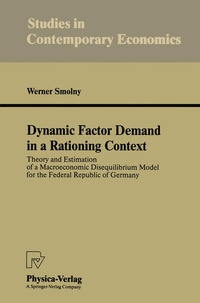
Dynamic Factor Demand in a Rationing Context
Theory and Estimation of a Macroeconomic Disequilibrium Model for the Federal Republic of Germany
Published on 30. September 1993
Book
Paperback/Softback
VIII, 242 pages
978-3-7908-0712-7 (ISBN)
Description
A macroeconomic disequilibrium model is developed for the
Federal Republic of Germany. Starting with a microeconomic
model of firm's behaviour, the optimal dynamic adjustment of
employment and investment is derived. The model of the firm
is complemented by an explicite aggregation procedure which
allows to derive macroeconomic relations. The model is
estimated with macroeconomic data for the Federal Republic
of Germany.
An important feature is the consistent introduction of
dynamic adjustment into a model of the firm. A new method is
the particular approach of a delayed adjustment of
employment and investment.
The estimation results show significant underutilizations of
labour and capital and indicate the importance of supply
constraints for imports and exports. As the most prominent
result, they reveal the importance of the slow adjustment of
employment and investment for the macroeconomic situation in
Germany and especially for the persistence of high
unemployment in the eighties.
More details
Series
Edition
Softcover reprint of the original 1st ed. 1993
Language
English
Place of publication
Heidelberg
Germany
Target group
Professional and scholarly
Research
Illustrations
VIII, 242 p.
Dimensions
Height: 235 mm
Width: 155 mm
Thickness: 14 mm
Weight
388 gr
ISBN-13
978-3-7908-0712-7 (9783790807127)
DOI
10.1007/978-3-642-51512-5
Schweitzer Classification
Other editions
Additional editions
Werner Smolny
Dynamic Factor Demand in a Rationing Context
Theory and Estimation of a Macroeconomic Disequilibrium Model for the Federal Republic of Germany
E-Book
12/2012
Physica
€96.29
Available for download
Content
I Theory.- 1 Disequilibrium models.- 2 The basic model.- 3 Extensions of the basic model.- 4 The aggregation of micro-markets.- II Empirical estimation.- 5 Specification of the model.- 6 Results.- Conclusion.