

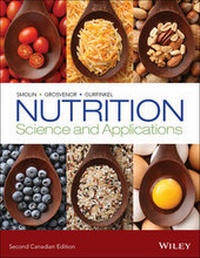
Nutrition
Science and Applications
2nd Edition
Published on 16. October 2015
Book
Hardback
888 pages
978-1-118-87838-5 (ISBN)
Description
Nutrition: Science and Applications, Second Canadian Edition guides students towards an understanding of the scientific principles underlying what they know about nutrition. The research-based scientific content is detailed and supported by figures and comprehensive real-life examples that help students easily visualize complex processes. Using a critical thinking approach, the book contains many questions and exercises that require interpretation of research results and give students an opportunity to apply the concepts learned-both as consumers and as future scientists and health professionals. This second Canadian edition of this market leading text has updated references throughout, with seamlessly integrated Canadian content and an approach that helps students develop the scientific understanding to support their personal and professional nutrition decisions.
More details
Edition
2nd Canadian Edition
Language
English
Place of publication
New York
United States
Target group
College/higher education
Dimensions
Height: 279 mm
Width: 221 mm
Thickness: 33 mm
Weight
1792 gr
ISBN-13
978-1-118-87838-5 (9781118878385)
Copyright in bibliographic data and cover images is held by Nielsen Book Services Limited or by the publishers or by their respective licensors: all rights reserved.
Schweitzer Classification
Persons
Lori A. Smolin, Ph.D received her B.S. degree from Cornell University, where she studied human nutrition and food science. She received her doctorate from the University of Wisconsin at Madison. Her doctoral research focused on B Vitamins, homocysteine accumulation, and genetic defects in homocysteine metabolism. She completed postdoctoral training both at the Harbor-UCLA Medical Center, where she studied human obesity, and at the University of California at San Diego, where she studied genetic defects in amino acid metabolism. She has published in these areas in peer-reviewed journals. Dr. Smolin is currently at the University of Connecticut, where she teaches both in the Department of Nutritional Sciences and in the Department of Molecular and Cell Biology. Courses she has taught include introductory nutrition, lifecycle nutrition, food preparation, nutritional biochemistry, general biochemistry, and biology. Dr. Smolon spent the 2001/2002 academic year in England where she was able to experience the food and nutrition culture on the other side of the Atlantic.
Mary B. Grosvenor, MS, RD, received her BA degree in English from Georgetown University and her MS in Nutrition Science from the University of California at Davis. She is a registered dietitian who worked for many years managing nutrition research studies at the General Clinical Research Center at Harbor-UCLA Medical Center. She has published in peer-reviewed journals in the areas of nutrition and cancer and methods of assessing dietary intake. She has taught introductory nutrition at the community college level and currently lives with her family in a small town in Colorado. She is continuing her teaching and writing career and is still involved in nutrition research via the electronic superhighway.
Mary B. Grosvenor, MS, RD, received her BA degree in English from Georgetown University and her MS in Nutrition Science from the University of California at Davis. She is a registered dietitian who worked for many years managing nutrition research studies at the General Clinical Research Center at Harbor-UCLA Medical Center. She has published in peer-reviewed journals in the areas of nutrition and cancer and methods of assessing dietary intake. She has taught introductory nutrition at the community college level and currently lives with her family in a small town in Colorado. She is continuing her teaching and writing career and is still involved in nutrition research via the electronic superhighway.
Content
Chapter 1: Nutrition: Food for Health
Chapter 2: Nutrition Guidelines: Applying the Science of Nutrition
Chapter 3: Digestion, Absorption, and Metabolism
Chapter 4: Carbohydrates: Sugars, Starches, and Fibre
Focus on Beyond the Basics
Chapter 5: Lipids
Focus on Alcohol
Chapter 6: Proteins and Amino Acids
Chapter 7: Energy Balance and Weight Management
Focus on Obesity
Chapter 8: The Water-Soluble Vitamins
Chapter 9: The Fat-Soluble Vitamins
Focus on Phytochemicals
Chapter 10: Water and the Electrolytes
Chapter 11: Major Minerals and Bone Health
Focus on Non-Vitamin and Non-Mineral Supplements
Chapter 12: The Trace Elements
Focus on Integrating Nutrient Function
Chapter 13: Nutrition and Physical Activity
Chapter 14: Nutrition During Pregnancy and Lactation
Chapter 15: Nutrition from Infancy to Adolescence
Focus on Eating Disorders
Chapter 16: Nutrition and Aging: The Adult Years
Chapter 17: Food Safety
Focus on Biotechnology
Chapter 18: World Hunger and Malnutrition
Chapter 2: Nutrition Guidelines: Applying the Science of Nutrition
Chapter 3: Digestion, Absorption, and Metabolism
Chapter 4: Carbohydrates: Sugars, Starches, and Fibre
Focus on Beyond the Basics
Chapter 5: Lipids
Focus on Alcohol
Chapter 6: Proteins and Amino Acids
Chapter 7: Energy Balance and Weight Management
Focus on Obesity
Chapter 8: The Water-Soluble Vitamins
Chapter 9: The Fat-Soluble Vitamins
Focus on Phytochemicals
Chapter 10: Water and the Electrolytes
Chapter 11: Major Minerals and Bone Health
Focus on Non-Vitamin and Non-Mineral Supplements
Chapter 12: The Trace Elements
Focus on Integrating Nutrient Function
Chapter 13: Nutrition and Physical Activity
Chapter 14: Nutrition During Pregnancy and Lactation
Chapter 15: Nutrition from Infancy to Adolescence
Focus on Eating Disorders
Chapter 16: Nutrition and Aging: The Adult Years
Chapter 17: Food Safety
Focus on Biotechnology
Chapter 18: World Hunger and Malnutrition