

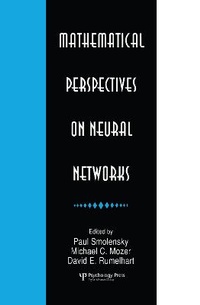
Mathematical Perspectives on Neural Networks
Published on 1. June 1996
Book
Hardback
878 pages
978-0-8058-1201-5 (ISBN)
Description
Recent years have seen an explosion of new mathematical results on learning and processing in neural networks. This body of results rests on a breadth of mathematical background which even few specialists possess. In a format intermediate between a textbook and a collection of research articles, this book has been assembled to present a sample of these results, and to fill in the necessary background, in such areas as computability theory, computational complexity theory, the theory of analog computation, stochastic processes, dynamical systems, control theory, time-series analysis, Bayesian analysis, regularization theory, information theory, computational learning theory, and mathematical statistics.
Mathematical models of neural networks display an amazing richness and diversity. Neural networks can be formally modeled as computational systems, as physical or dynamical systems, and as statistical analyzers. Within each of these three broad perspectives, there are a number of particular approaches. For each of 16 particular mathematical perspectives on neural networks, the contributing authors provide introductions to the background mathematics, and address questions such as:
* Exactly what mathematical systems are used to model neural networks from the given perspective?
* What formal questions about neural networks can then be addressed?
* What are typical results that can be obtained? and
* What are the outstanding open problems?
A distinctive feature of this volume is that for each perspective presented in one of the contributed chapters, the first editor has provided a moderately detailed summary of the formal results and the requisite mathematical concepts. These summaries are presented in four chapters that tie together the 16 contributed chapters: three develop a coherent view of the three general perspectives -- computational, dynamical, and statistical; the other assembles these three perspectives into a unified overview of the neural networks field.
Mathematical models of neural networks display an amazing richness and diversity. Neural networks can be formally modeled as computational systems, as physical or dynamical systems, and as statistical analyzers. Within each of these three broad perspectives, there are a number of particular approaches. For each of 16 particular mathematical perspectives on neural networks, the contributing authors provide introductions to the background mathematics, and address questions such as:
* Exactly what mathematical systems are used to model neural networks from the given perspective?
* What formal questions about neural networks can then be addressed?
* What are typical results that can be obtained? and
* What are the outstanding open problems?
A distinctive feature of this volume is that for each perspective presented in one of the contributed chapters, the first editor has provided a moderately detailed summary of the formal results and the requisite mathematical concepts. These summaries are presented in four chapters that tie together the 16 contributed chapters: three develop a coherent view of the three general perspectives -- computational, dynamical, and statistical; the other assembles these three perspectives into a unified overview of the neural networks field.
Reviews / Votes
Although the material is advanced and technical, the volume has a "multilayer" structure including a general overview, and there are overviews of each of the main parts (including summary tables of key results). These surveys, all written by Smolensky (John Hopkins University), provide an excellent introduction to the papers and their context, making the material accessible to upper-division undergraduates, graduate students, or faculty.-CHOICE
More details
Series
Language
English
Place of publication
Philadelphia
United States
Publishing group
Taylor & Francis Inc
Target group
College/higher education
Professional and scholarly
Dimensions
Height: 229 mm
Width: 152 mm
Weight
1156 gr
ISBN-13
978-0-8058-1201-5 (9780805812015)
Copyright in bibliographic data and cover images is held by Nielsen Book Services Limited or by the publishers or by their respective licensors: all rights reserved.
Schweitzer Classification
Other editions
Additional editions
Paul Smolensky | Michael C. Mozer
Mathematical Perspectives on Neural Networks
Book
05/2015
1st Edition
Psychology Press Ltd
€94.38
Shipment within 10-20 days
Paul Smolensky | Michael C. Mozer
Mathematical Perspectives on Neural Networks
E-Book
05/2013
1st Edition
Psychology Press Ltd
€78.99
Available for download
Paul Smolensky | Michael C. Mozer
Mathematical Perspectives on Neural Networks
E-Book
05/2013
1st Edition
Psychology Press Ltd
€79.49
Available for download
Persons
Paul Smolensky, Michael C. Mozer, David E. Rumelhart
Content
Contents: Preface: Multilayer Structure of the Book and Its Summaries. P. Smolensky, Overview: Computational, Dynamical, and Statistical Perspectives on the Processing and Learning Problems in Neural Network Theory. Part I: Computational Perspectives.P. Smolensky, Overview: Computational Perspectives on Neural Networks. S. Franklin, M. Garzon, Computation by Discrete Neural Nets. I. Parberry, Circuit Complexity and Feedforward Neural Networks. J.S. Judd, Complexity of Learning. E.H.L Aarts, J.H.M. Korst, P.J. Zwietering, Deterministic and Randomized Local Search. M.B. Pour-El, The Mathematical Theory of the Analog Computer. Part II: Dynamical Perspectives.P. Smolensky, Overview: Dynamical Perspectives on Neural Networks. M.W. Hirsch, Dynamical Systems. L.F. Abbott, Statistical Analysis of Neural Networks. K.S. Narendra, S-M. Li, Neural Networks in Control Systems. A.S. Weigend, Time Series Analysis and Prediction. Part III: Statistical Perspectives.P. Smolensky, Overview: Statistical Perspectives on Neural Networks. R. Szeliski, Regularization in Neural Nets. D.E. Rumelhart, R. Durbin, R. Goldin, Y. Chauvin, Backpropagation: The Basic Theory. J. Rissanen, Information Theory and Neural Nets. A. Nadas, R.L. Mercer, Hidden Markov Models and Some Connections with Artificial Neural Nets. D. Haussler, Probably Approximately Correct Learning and Decision-Theoretic Generalizations. H. White, Parametric Statistical Estimation with Artificial Neural Networks. V.N. Vapnik, Inductive Principles of Statistics and Learning Theory.