

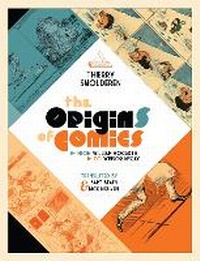
The Origins of Comics
From William Hogarth to Winsor McCay
Published on 30. March 2014
Book
Hardback
168 pages
978-1-61703-149-6 (ISBN)
Description
In The Origins of Comics: From William Hogarth to Winsor McCay, Thierry Smolderen presents a cultural landscape whose narrative differs in many ways from those presented by other historians of the comic strip. Rather than beginning his inquiry with the popularly accepted ""sequential art"" definition of the comic strip, Smolderen instead wishes to engage with the historical dimensions that inform that definition. His goal is to understand the processes that led to the twentieth-century comic strip, the highly recognizable species of picture stories that he sees crystallizing around 1900 in the United States.
Featuring close readings of the picture stories, caricatures, and humoristic illustrations of William Hogarth, Rodolphe Toepffer, Gustave Dore, and their many contemporaries, Smolderen establishes how these artists were immersed in a very old visual culture in which images--satirical images in particular--were deciphered in a way that was often described as hieroglyphical. Across eight chapters, he acutely points out how the effect of the printing press and the mass advent of audiovisual technologies (photography, audio recording, and cinema) at the end of the nineteenth century led to a new twentieth-century visual culture. In tracing this evolution, Smolderen distinguishes himself from other comics historians by following a methodology that explains the present state of the form of comics on the basis of its history, rather than presenting the history of the form on the basis of its present state. This study remaps the history of this influential art form.
Featuring close readings of the picture stories, caricatures, and humoristic illustrations of William Hogarth, Rodolphe Toepffer, Gustave Dore, and their many contemporaries, Smolderen establishes how these artists were immersed in a very old visual culture in which images--satirical images in particular--were deciphered in a way that was often described as hieroglyphical. Across eight chapters, he acutely points out how the effect of the printing press and the mass advent of audiovisual technologies (photography, audio recording, and cinema) at the end of the nineteenth century led to a new twentieth-century visual culture. In tracing this evolution, Smolderen distinguishes himself from other comics historians by following a methodology that explains the present state of the form of comics on the basis of its history, rather than presenting the history of the form on the basis of its present state. This study remaps the history of this influential art form.
More details
Language
English
Place of publication
Jackson
United States
Target group
Professional and scholarly
Illustrations
1160 black & white and color illustrations
Dimensions
Height: 305 mm
Width: 229 mm
Thickness: 17 mm
Weight
1260 gr
ISBN-13
978-1-61703-149-6 (9781617031496)
Copyright in bibliographic data and cover images is held by Nielsen Book Services Limited or by the publishers or by their respective licensors: all rights reserved.
Schweitzer Classification
Other editions
Additional editions
E-Book
03/2014
NYU Press
€24.49
Available for download
Persons
Thierry Smolderen, Angouleme, France, is a comics writer and scholar who teaches at the Ecole europeenne superieure de l'image.|Bart Beaty, Calgary, Alberta, is associate professor of communication and culture at the University of Calgary. Together, Nick Nguyen and he have translated The System of Comics by Thierry Groensteen and Of Comics and Men: A Cultural History of the American Comic Book by Jean-Paul Gabilliet, both published by University Press of Mississippi.|Nick Nguyen, Brussels, Belgium, is an independent historian and researcher. Together, Bart Beaty and he have translated The System of Comics by Thierry Groensteen and Of Comics and Men: A Cultural History of the American Comic Book by Jean-Paul Gabilliet, both published by University Press of Mississippi.