

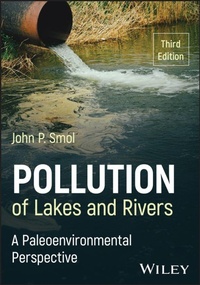
Pollution of Lakes and Rivers
A Paleoenvironmental Perspective
3rd Edition
Will be published approx. on 22. October 2026
Book
Paperback/Softback
496 pages
978-1-119-74878-6 (ISBN)
Description
In this much-expanded and revised third edition, Pollution of Lakes and Rivers: A Paleoenvironmental Perspective addresses current water quality problems from an international perspective, covering critical issues such as acidification, eutrophication, land-use changes, pollution by metals and other contaminants, invasive species, plastics, biodiversity losses, as well as a spectrum of emerging environmental problems. Recurring themes include the critical role that timescales play in environmental management and how recent climatic warming is acting as a major "threat multiplier". The book demonstrates how paleolimnological approaches can be used to interpret the physical, chemical, and biological data stored in lake and river sediments, and how this information is integral to evidence-based policy by identifying key environmental stressors and setting mitigation targets.
This updated Third Edition features new content that makes this authoritative book even more inviting:
Full color presentation throughout to aid clarity and understanding
Several new chapters, including topics focused on harmful algal blooms, paleoecotoxicology, calcium decline, salinization, plastics, and paleolimnological applications to conservation biology
Completely revised and updated throughout to ensure the best and most up-to-date coverage of the subject
Praise for the Second Edition:
"This is a very well-written and wide-ranging volume that is both instructive and topical. It is likely to prove useful as an introduction to the general area, a reference source and for teaching purposes." (The Holocene, November 2008)
"If you thought that paleolimnology was just mud, pollen, and diatoms then you will likely be both struck by the complexity of this field of research and grateful that John Smol, FRSC, has described it so clearly and broadly. Simply put, the second edition is an excellent book." (Journal of Phycology, 2008)
"John Smol has extensive experience in this field of paleoenvironmental research which he combines well with his excellent written communication skills to produce a text that is easy to read but also thought provoking." (Quaternary Science Reviews, 2009)
"If I could speak with fluidity and clarity in my lectures as consistently as John Smol writes, my students would be very grateful." (Journal of Paleolimnology, 2009)
This updated Third Edition features new content that makes this authoritative book even more inviting:
Full color presentation throughout to aid clarity and understanding
Several new chapters, including topics focused on harmful algal blooms, paleoecotoxicology, calcium decline, salinization, plastics, and paleolimnological applications to conservation biology
Completely revised and updated throughout to ensure the best and most up-to-date coverage of the subject
Praise for the Second Edition:
"This is a very well-written and wide-ranging volume that is both instructive and topical. It is likely to prove useful as an introduction to the general area, a reference source and for teaching purposes." (The Holocene, November 2008)
"If you thought that paleolimnology was just mud, pollen, and diatoms then you will likely be both struck by the complexity of this field of research and grateful that John Smol, FRSC, has described it so clearly and broadly. Simply put, the second edition is an excellent book." (Journal of Phycology, 2008)
"John Smol has extensive experience in this field of paleoenvironmental research which he combines well with his excellent written communication skills to produce a text that is easy to read but also thought provoking." (Quaternary Science Reviews, 2009)
"If I could speak with fluidity and clarity in my lectures as consistently as John Smol writes, my students would be very grateful." (Journal of Paleolimnology, 2009)
More details
Edition
3rd edition
Language
English
Place of publication
New York
United States
Target group
Professional and scholarly
Dimensions
Height: 254 mm
Width: 178 mm
ISBN-13
978-1-119-74878-6 (9781119748786)
Copyright in bibliographic data and cover images is held by Nielsen Book Services Limited or by the publishers or by their respective licensors: all rights reserved.
Schweitzer Classification
Person
JOHN P. SMOL, OC, OOnt, PhD, FRSC, FRS is a Distinguished University Professor in the Department of Biology at Queen's University (Ontario, Canada) where he founded and co-directs the Paleoecological Environmental Assessment and Research Lab (PEARL). Smol was the founding Editor of the Journal of Paleolimnology (1987-2007) and served as Editor of Environmental Reviews from 2004 - 2026. Having written or edited 25 books and authored ~800 papers, he has been awarded 7 honorary doctorates and over 100 research, teaching, and communication awards.
Content
Table of Contents
Preface to the third edition
1. There is no substitute for water
2. How long is long?
3. Sediments: An ecosystem's memory
4. Retrieving the sedimentary archive and establishing the geochronological clock: Collecting and dating sediment cores
5. Reading the records stored in sediments: The present is a key to the past
6. The paleolimnologist's Rosetta Stone: Calibrating biological assemblages to environmental variables using surface-sediment training sets
7. Acidification: Finding the "smoking gun"
8. Metals, technological development, and the environment
9. Persistent organic pollutants: Industrially synthesized chemicals "hopping" across the planet
10. Mercury -- "The metal that slipped away"
11. Eutrophication: The environmental consequences of over-fertilization
12. Greenhouse gas emissions and a changing atmosphere: A primer of tracking climatic change using lake sediments
13. Tracking the frequency, magnitude, and drivers of algal blooms in a warming climate
14. Lakewater browning, acid rain, climatic warming, and ozone depletion: The challenges of a multiple stressor world
15. Declining calcium levels in softwater lakes: When too little of something becomes a problem
16. From pavement to the pelagic zone: The salinization of surface waters
17. Erosion: Tracking the accelerated movement of material from land to water
18. Tracking species invasions and introductions through time
19. Plastics, pharmaceuticals, and other pressing issues
20. Conservation biology meets paleolimnology
21. Paleolimnology: a window on the past, a key to our future
Glossary
References
Index
Preface to the third edition
1. There is no substitute for water
2. How long is long?
3. Sediments: An ecosystem's memory
4. Retrieving the sedimentary archive and establishing the geochronological clock: Collecting and dating sediment cores
5. Reading the records stored in sediments: The present is a key to the past
6. The paleolimnologist's Rosetta Stone: Calibrating biological assemblages to environmental variables using surface-sediment training sets
7. Acidification: Finding the "smoking gun"
8. Metals, technological development, and the environment
9. Persistent organic pollutants: Industrially synthesized chemicals "hopping" across the planet
10. Mercury -- "The metal that slipped away"
11. Eutrophication: The environmental consequences of over-fertilization
12. Greenhouse gas emissions and a changing atmosphere: A primer of tracking climatic change using lake sediments
13. Tracking the frequency, magnitude, and drivers of algal blooms in a warming climate
14. Lakewater browning, acid rain, climatic warming, and ozone depletion: The challenges of a multiple stressor world
15. Declining calcium levels in softwater lakes: When too little of something becomes a problem
16. From pavement to the pelagic zone: The salinization of surface waters
17. Erosion: Tracking the accelerated movement of material from land to water
18. Tracking species invasions and introductions through time
19. Plastics, pharmaceuticals, and other pressing issues
20. Conservation biology meets paleolimnology
21. Paleolimnology: a window on the past, a key to our future
Glossary
References
Index