

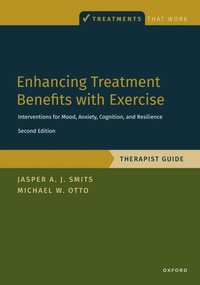
Enhancing Treatment Benefits with Exercise - TG
Component Interventions for Mood, Anxiety, Cognition, and Resilience
2nd Edition
Published on 26. September 2024
Book
Paperback/Softback
152 pages
978-0-19-094650-0 (ISBN)
Description
Exercise has powerful effects on mental health. This therapist guide, and the accompanying workbook, provide an indispensable resource for practitioners who wish to expand their therapeutic range to include exercise-based interventions. A wealth of data shows the efficacy of these interventions for the treatment of mood and anxiety disorders, cognitive enhancement, and resilience training, including resilience training applied to the control of habit disorders like smoking. This therapist guide provides a step-by-step accounting of the benefits of exercise, the application of exercise to specific conditions, recommended exercise dose and durations, and, perhaps most importantly, motivational strategies to help clients get to and succeed with exercise.
Fully revised and updated to capture the latest research in the area, this new edition also expands the content of the first edition to cover exercise for cognition, resilience, and smoking. Introductory chapters provide general guidance on strategies for initiating and maintaining exercise and are complemented by chapters devoted to the specific application of exercise to mood disorders, anxiety disorders, the enhancement of cognition, and for general resilience as might be applied in a relapse-prevention phase of treatment.
Fully revised and updated to capture the latest research in the area, this new edition also expands the content of the first edition to cover exercise for cognition, resilience, and smoking. Introductory chapters provide general guidance on strategies for initiating and maintaining exercise and are complemented by chapters devoted to the specific application of exercise to mood disorders, anxiety disorders, the enhancement of cognition, and for general resilience as might be applied in a relapse-prevention phase of treatment.
More details
Series
Edition
2nd Revised edition
Language
English
Place of publication
New York
United States
Edition type
Revised edition
Product notice
Paperback (trade)
Unsewn / adhesive bound
Dimensions
Height: 255 mm
Width: 179 mm
Thickness: 10 mm
Weight
295 gr
ISBN-13
978-0-19-094650-0 (9780190946500)
Copyright in bibliographic data and cover images is held by Nielsen Book Services Limited or by the publishers or by their respective licensors: all rights reserved.
Schweitzer Classification
Other editions
Additional editions
Jasper A. J. Smits | Michael W. Otto
Enhancing Treatment Benefits with Exercise - TG
Component Interventions for Mood, Anxiety, Cognition, and Resilience
E-Book
07/2024
2nd Edition
OUP eBook
€35.99
Available for download
Jasper A. J. Smits | Michael W. Otto
Enhancing Treatment Benefits with Exercise - TG
Component Interventions for Mood, Anxiety, Cognition, and Resilience
E-Book
07/2024
2nd Edition
OUP eBook
€35.99
Available for download
Persons
Jasper A. J. Smits, PhD, is Professor of Psychology and Director of the Anxiety & Health Behaviors Laboratory at the University of Texas at Austin. He specializes in the development and evaluation of behavioral interventions for anxiety and related disorders. With respect to exercise, he has been involved in research testing whether aerobic training can provide learning experiences (e.g., feeling safe around bodily sensations, reappraisal of stressors) essential to attaining patients' treatment goals. Following up on initial successes in this area among adults with anxiety motivated to quit smoking, he has developed a YMCA exercise-based smoking cessation intervention that is currently undergoing evaluation. Dr. Smits has authored over 250 publications, frequently provides workshops on exercise for mental health, and maintains an active private practice.
Michael W. Otto, PhD, is Professor in the Department of Psychological and Brain Sciences and Director of the Translational Research
Laboratory at Boston University. He has had a major career focus on developing and validating new psychosocial treatments, with a focus on treatment refractory populations including those with mood, anxiety, and substance use disorders. His work includes a translational research agenda investigating brain-behavior relationships in therapeutic learning. Dr. Otto's focus on hard-to-treat conditions and principles underlying behavior-change failures led him to an additional focus on health-behavior promotion, including investigations of addictive behaviors, medication adherence, sleep, and exercise. Dr. Otto has published over 475 articles and 20 books spanning his research interests, and he was identified as a "top producer" in the clinical empirical literature as well as an ISI Highly Cited Researcher. He received the APA Society of Clinical Psychology award for Distinguished Scientific Contributions to Clinical Psychology, the Elizabeth Hurlock Beckman Award from the American Psychological
Association for Mentoring, and the Toy Caldwell-Colbert Award for Distinguished Educator in Clinical Psychology. His leadership positions include serving as President of the Association of Behavioral and Cognitive Therapies, and President of Division 12 of the American Psychological Association.
Michael W. Otto, PhD, is Professor in the Department of Psychological and Brain Sciences and Director of the Translational Research
Laboratory at Boston University. He has had a major career focus on developing and validating new psychosocial treatments, with a focus on treatment refractory populations including those with mood, anxiety, and substance use disorders. His work includes a translational research agenda investigating brain-behavior relationships in therapeutic learning. Dr. Otto's focus on hard-to-treat conditions and principles underlying behavior-change failures led him to an additional focus on health-behavior promotion, including investigations of addictive behaviors, medication adherence, sleep, and exercise. Dr. Otto has published over 475 articles and 20 books spanning his research interests, and he was identified as a "top producer" in the clinical empirical literature as well as an ISI Highly Cited Researcher. He received the APA Society of Clinical Psychology award for Distinguished Scientific Contributions to Clinical Psychology, the Elizabeth Hurlock Beckman Award from the American Psychological
Association for Mentoring, and the Toy Caldwell-Colbert Award for Distinguished Educator in Clinical Psychology. His leadership positions include serving as President of the Association of Behavioral and Cognitive Therapies, and President of Division 12 of the American Psychological Association.
Content
Chapter 1
Introductory Information for Therapists
Chapter 2
Preparing for the Exercise Prescription
(Corresponds to chapters 1-4 of the client workbook)
Chapter 3
The Exercise Prescription
(Corresponds to chapters 5-6 of the client workbook)
Chapter 4
Exercise for Depressed Mood
(Corresponds to chapters 7-9 of the client workbook)
Chapter 5
Exercise for Stress, Worry, and Panic
(Corresponds to Chapter 10 of the client workbook)
Chapter 6
Exercise to Enhance Cognition
(Corresponds to Chapter 11 of the client workbook)
Chapter 7
Exercise to Enhance Resilience
(Corresponds to Chapter 12 of the client workbook)
Chapter 8
Exercise to Aid Smoking Cessation
(Corresponds to Chapter 13 of the client workbook)
Chapter 9
Intervention Issues
(Corresponds to Chapter 14 of the client workbook)
Introductory Information for Therapists
Chapter 2
Preparing for the Exercise Prescription
(Corresponds to chapters 1-4 of the client workbook)
Chapter 3
The Exercise Prescription
(Corresponds to chapters 5-6 of the client workbook)
Chapter 4
Exercise for Depressed Mood
(Corresponds to chapters 7-9 of the client workbook)
Chapter 5
Exercise for Stress, Worry, and Panic
(Corresponds to Chapter 10 of the client workbook)
Chapter 6
Exercise to Enhance Cognition
(Corresponds to Chapter 11 of the client workbook)
Chapter 7
Exercise to Enhance Resilience
(Corresponds to Chapter 12 of the client workbook)
Chapter 8
Exercise to Aid Smoking Cessation
(Corresponds to Chapter 13 of the client workbook)
Chapter 9
Intervention Issues
(Corresponds to Chapter 14 of the client workbook)