

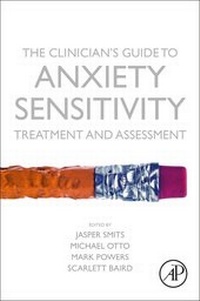
The Clinician's Guide to Anxiety Sensitivity Treatment and Assessment
Published on 26. November 2018
Book
Paperback/Softback
203 pages
978-0-12-813495-5 (ISBN)
Description
The Clinician's Guide to Anxiety Sensitivity Treatment and Assessment provides evidence-based strategies for clinicians looking to treat, assess and better understand anxiety sensitivity in their patients. The book delivers detailed guidance on the theoretical background and empirical support for anxiety sensitivity treatment methods, assessment strategies, and how clinicians can best prepare for sessions with their clients. Bolstered by case studies throughout, it highlights anxiety sensitivity as a transdiagnostic risk factor while also looking at the importance of lower-order sensitivity factors (physical, social, cognitive) in treatment planning, implementation and evaluation.
More details
Language
English
Place of publication
San Diego
United States
Publishing group
Elsevier Science Publishing Co Inc
Target group
Professional and scholarly
clinical psychologists; psychiatrists, counselors, social workers, and other mental health professionals; students, academic researchers;
Dimensions
Height: 229 mm
Width: 152 mm
Weight
340 gr
ISBN-13
978-0-12-813495-5 (9780128134955)
Copyright in bibliographic data and cover images is held by Nielsen Book Services Limited or by the publishers or by their respective licensors: all rights reserved.
Schweitzer Classification
Other editions
Additional editions
Jasper Smits | Michael Otto | Mark Powers
The Clinician's Guide to Anxiety Sensitivity Treatment and Assessment
E-Book
11/2018
Academic Press
€131.00
Available for download
Persons
Professor of Psychology at University of Texas Austin. Federally funded investigator of studies testing the efficacy of behavioral and integrative interventions for anxiety and related disorders, and has published over 150 works, 30 of which have focused on anxiety sensitivity. Dr. Smits is a member of the scientific council of the Anxiety and Depression Association of America and serves as associate editor for Journal of Consulting and Clinical Psychology, Cognitive Therapy and Research, and Journal of Anxiety Disorders. He has edited a number of books, including Anxiety in Health Behaviors and Physical Illness; Handbook of Physical Activity and Mental Health, and the Wiley Handbook of Cognitive Behavioral Therapy. Professor of Psychology, Director of the Translational Research Program at the Center for Anxiety and Related Disorders, Boston University. Dr. Otto specializes in the cognitive-behavioral treatment of anxiety, mood, and substance use disorders. He has current and past federal funding from NIMH and NIDA, and his research focuses on difficult-to-treat populations, including the application of cognitive-behavioral strategies to patients who have failed to respond to previous interventions, as well as developing novel strategies for bipolar disorder and substance use disorders. Current research includes investigations of potential moderators of CBT efficacy, as well as health behaviors ranging from medication adherence to engagement in exercise. Dr. Otto has published over 400 articles, chapters, and books, and is past President of the Association for Behavioral and Cognitive Therapies, a fellow of the American Psychological Association, and member of the Scientific Advisory Board for the Anxiety Disorders Association of America. Professor of Psychology, University of Texas Austin. Director of Trauma Research at Baylor University Medical Center. He is a federally funded investigator of studies of exposure therapy, a published author with more than 100 chapters and papers, a member of the scientific council of the Anxiety and Depression Association of America, a Beck Scholar, and Editor-in-Chief of Cognitive Behavioral Therapy. Doctoral Candidate, University of Texas Austin. Her research and clinical work focus on the implementation and dissemination of CBT techniques. She is particularly interested in facilitating the accessibility and efficiency of these interventions with the aim that treatment may be administered in diverse settings to reach a broader scope of the patient population. She is also interested in identifying determinants of treatment engagements to that clinicians are better able to gauge patient progress and anticipate and address potential barriers to treatment.
Editor
Professor, Department Liaison for Medical Affairs, Department of Psychology, The University of Texas at Austin, Austin, TX, USA
Boston University, American Psychological Association, Anxiety Disorders Association of America, USA
Baylor University Medical Center, University of Texas Austin, TX, USA
University of Texas Austin, TX, USA
Content
1. Anxiety Sensitivity as a Transdiagnostic Treatment Target
2. Assessing Anxiety Sensitivity
3. Integrating Patients' Anxiety Sensitivity Profile into One's Case Formulation and Treatment Planning
4. Treating Anxiety Sensitivity in Individuals with Anxiety Disorders
5. Optimizing Outcome for Pain Disorders by Treating Anxiety Sensitivity
6. Anxiety Sensitivity Treatment as an Aid to Smoking Cessation
7. Anxiety Sensitivity Treatment for Children and Adolescents
8. Targeting Anxiety Sensitivity as a Prevention Strategy
9. Anxiety Sensitivity and Your Clinical Practice
2. Assessing Anxiety Sensitivity
3. Integrating Patients' Anxiety Sensitivity Profile into One's Case Formulation and Treatment Planning
4. Treating Anxiety Sensitivity in Individuals with Anxiety Disorders
5. Optimizing Outcome for Pain Disorders by Treating Anxiety Sensitivity
6. Anxiety Sensitivity Treatment as an Aid to Smoking Cessation
7. Anxiety Sensitivity Treatment for Children and Adolescents
8. Targeting Anxiety Sensitivity as a Prevention Strategy
9. Anxiety Sensitivity and Your Clinical Practice