

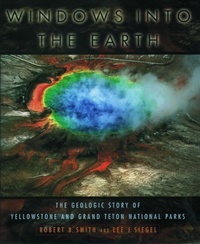
Windows into the Earth
The Geologic Story of Yellowstone and Grand Teton National Parks
Published on 27. April 2000
Book
Paperback/Softback
256 pages
978-0-19-510597-1 (ISBN)
Description
Millions of years ago, the North American continent was dragged over the world's largest continental hotspot (a hug column of molten rock rising from the earth's interior), tracing a 5 mile wide, 500 mile long path northeastward across Idaho and generating huge volcanic eruptions and earthquakes. The hotspot lifted the Yellowstone Plateau to more than 7000 feet and pushed the Northern Rockies to new heights. This book is the story of those events and how the landscape of the two great national parks was shaped by earthquakes, volcanoes, geysers and, in the uplifted Rocky Mountains, mountain glaciers. The story is also a 'window' into the earth's interior, revealing the dynamic processes within.
Reviews / Votes
"Geologist Smith and science writer Siegel team up to tell the exciting story of how Yellowstone and Grand Teton National Parks came to be."--Bob Decker, former director of the U.S. Geological Surveys Hawaiian Volcano Observatory and Professor Emeritus, Dartmouth College, and Barbara Decker, science writer"Good coverage of volcanism, tectonism, glaciation. Beautiful photos. Great field trip guides and references. Up to date."--Robert J. Carson, Whitman College
"The photographs and diagrams are spectacular.Two interesting driving tours that cover both parks introduce readers to some of the most spectacular scenery in the country and are entertaining and informative. Windows Into The Earth bridges the gap between the highly technical analyses--of the Yellowstone hotspot, volcanism and active fault dynamics--and publications written for general audiences."--American Scientist
"Windows represents the most contemporary and complete story of the geology and geophysics of Jackson Hole and Yellowstone. It will set a benchmark and should have a shelf life of geological proportions."--Jackson Hole NewsR
"The book has more than 70 illustrations, including 52 in color. The final two chapters outline a driving tour of the parks to help visitors enjoy and understand the region's wonders. Smith and Siegel offer expert guidance through this awe-inspiring terrain."--Great Falls Tribune
"The spectacular geysers and hot springs of Yellowstone are the world's best. They are in part the remains of a gigantic volcanic explosion 630,000 years ago that was a thousand times larger than the 1980 eruptions of Mount St. Helens. They also portend future volcanic action in this beautiful wonderland. Geologist Smith and science writer Siegel team up to tell the exciting story of how Yellowstone and Grand Teton National Parks came to be."--Bob Decker,
former director of the U.S. Geological Surveys Hawaiian Volcano Observatory and Professor Emeritus, Dartmouth College, and Barbara Decker, science writer
More details
Language
English
Place of publication
New York
United States
Product notice
Paperback (trade)
Unsewn / adhesive bound
Illustrations
numerous colour, halftone and line illustrations
Dimensions
Height: 258 mm
Width: 205 mm
Thickness: 20 mm
Weight
876 gr
ISBN-13
978-0-19-510597-1 (9780195105971)
Copyright in bibliographic data and cover images is held by Nielsen Book Services Limited or by the publishers or by their respective licensors: all rights reserved.
Schweitzer Classification
Other editions
Additional editions
Robert Baer Smith | Lee J. Siegel
Windows into the Earth
The Geologic Story of Yellowstone and Grand Teton National Parks
E-Book
12/2000
1st Edition
Oxford University Press
€25.99
Available for download
Robert B. Smith | Lee J. Siegel
Windows into the Earth
The Geologic Story of Yellowstone and Grand Teton National Parks
E-Book
05/2000
1st Edition
OUP eBook
€25.99
Available for download
Persons
Robert B. Smith is a professor of geology and geophysics at the University of Utah and a fellow of the American Geophysical Union and the Geological Society of America. He has spent his career studying the Yellowstone-Teton region. Lee J. Siegel has written about science since 1976, most recently as science editor of The Salt Lake Tribune. He contributed to the Pulitzer Prize-winning coverage of the 1980 Mount St. Helens
eruption by The Daily News of Longview, Washington, and in 1996, he won the Utah Seismic Safety Commissions first annual Outstanding Contribution to Earthquake Safety in Utah Award.
eruption by The Daily News of Longview, Washington, and in 1996, he won the Utah Seismic Safety Commissions first annual Outstanding Contribution to Earthquake Safety in Utah Award.
Content
Preface ; 1. A Land of Scenery and Violence ; 2. In the Wake of the Yellowstone Hotspot ; 3. Cataclysm! The Hotspot Reaches Yellowstone ; 4. How Yellowstone Works ; 5. The Broken Earth: Why the Tetons are Grand ; 6. Ice Over Fire: Glaciers Carve the Landscape ; 7. Future Disasters ; 8. Grand Teton Tour ; 9. Yellowstone Tour ; References