

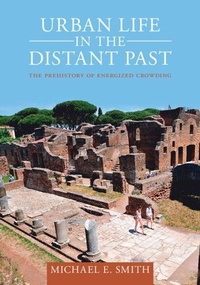
Urban Life in the Distant Past
The Prehistory of Energized Crowding
Published on 22. August 2024
Book
Paperback/Softback
338 pages
978-1-009-24900-3 (ISBN)
Description
In this book, Michael Smith offers a comparative and interdisciplinary examination of ancient settlements and cities. Early cities varied considerably in their political and economic organization and dynamics. Smith here introduces a coherent approach to urbanism that is transdisciplinary in scope, scientific in epistemology, and anchored in the urban literature of the social sciences. His new insight is 'energized crowding,' a concept that captures the consequences of social interactions within the built environment resulting from increases in population size and density within settlements. Smith explores the implications of features such as empires, states, markets, households, and neighborhoods for urban life and society through case studies from around the world. Direct influences on urban life - as mediated by energized crowding-are organized into institutional (top-down forces) and generative (bottom-up processes). Smith's volume analyzes their similarities and differences with contemporary cities, and highlights the relevance of ancient cities for understanding urbanism and its challenges today.
Reviews / Votes
'This book presents a wealth of information on early cities in a synthetic and comparative framework, analyzed with a consistent methodology that embraces clear definitions, quantification, and statistical analysis. For those reasons and others, scholars interested in early cities and urbanism will find the book to be essential reading, and it deserves a wide audience.' Michael W. Love, American Antiquity 'This volume challenges much of archaeology's deeply ingrained conventional wisdom concerning the origins and attributes of early urbanism ... Readers will find much in this volume to be essential and, in fact, foundational to any study of urban development. Smith has laid out a truly thought-provoking and challenging manifesto that will be critical reading for students and scholars of urbanism and a key addition to their libraries.' Thomas E. Emerson, American Journal of Archaeology 'Smith has produced a thorough, well-illustrated culmination of his lifework whose topics will resonate with scholars and practitioners who care about and study cities. ... Highly recommended.' M. T. Stark, CHOICE 'This book is a good introduction to urbanism in archaeology. The content will be helpful for graduate students seeking to identify critical issues and ways to develop the discipline ... and researchers within and adjacent to urban archaeology will find Smith's global approach, propositions and polemics, thought provoking. One of my favourite aspects of the book is the inclusion of 29 case studies that, crucially, include critical discussion of both empirical evidence and broader comparative insights ... Already, the book has had an impact on researchers doing important work at the interface of archaeology, urbanism and sustainability.' Michael Leadbetter, AntiquityMore details
Series
Language
English
Place of publication
Cambridge
United Kingdom
Edition type
New edition
Product notice
Paperback (trade)
Illustrations
Worked examples or Exercises
Dimensions
Height: 254 mm
Width: 178 mm
Thickness: 18 mm
Weight
585 gr
ISBN-13
978-1-009-24900-3 (9781009249003)
Copyright in bibliographic data and cover images is held by Nielsen Book Services Limited or by the publishers or by their respective licensors: all rights reserved.
Schweitzer Classification
Other editions
Additional editions
Book
03/2023
Cambridge University Press
€134.50
Shipment within 15-20 days
Person
Michael Smith is Professor in the School of Human Evolution and Social Change at Arizona State University. An archaeologist who has directed excavations at Aztec sites, he has forged a new approach to the scientific and comparative analysis of early cities based on transdisciplinary research projects that link ancient and contemporary urbanism. He has published fifteen books and more than 150 articles.
Content
1. Premodern cities and the wide urban world; 2. The prehistory of energized crowding; 3. The size of cities and settlements; 4. States, cities, and power; 5. Markets, crafts, and urban life; 6. Top-down insitutions and the scale of urban life; 7. Generative forces and urban life; 8. The value of premodern cities today.