

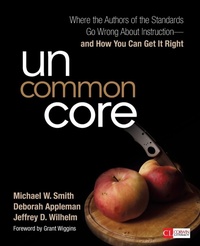
Uncommon Core
Where the Authors of the Standards Go Wrong About Instruction-and How You Can Get It Right
1st Edition
Published on 19. June 2014
Book
Paperback/Softback
224 pages
978-1-4833-3352-6 (ISBN)
Description
Let's face it, weak rivets notwithstanding, the Titanic wouldn't have sunk if the iceberg had been spotted in time. And let's face it, the CCSS won't be classroom-worthy unless practitioners chart our course. Depend on Michael Smith, Deborah Appleman, and Jeff Wilhelm to help you navigate through some potentially treacherous waters.
Uncommon Core puts us on high-alert about some outright dangerous misunderstandings looming around so-called "standards-aligned" instruction, then shows us how to steer past them-all in service of meeting the real intent of the Common Core. Smith, Appleman, and Wilhelm counter with teaching suggestions that are true to the research and true to our students, including how:
Reader-based approaches can complement text-based ones
Prereading activities can help students meet the strategic and conceptual demands texts place on them
Strategy instruction can result in a careful and critical analysis of individual texts while providing transferable understandings
Inquiry units around essential questions can generate meaningful conversation and higher-order thinking about those texts
Selection criteria that consider interpretive complexity can take us so much farther than those that consider textual complexity alone
Given the number of strategies, lesson ideas, and activities in the book, Uncommon Core is really less about the standards and more about timeless, excellent teaching and how to use it like never before to meet the Core ideals. Let's put instruction where it belongs: back in the hands of the experts.
"Finally! A book with more light than heat on the issue of standards and their implications for learning."
--GRANT WIGGINS
Coauthor of Understanding by Design
Uncommon Core puts us on high-alert about some outright dangerous misunderstandings looming around so-called "standards-aligned" instruction, then shows us how to steer past them-all in service of meeting the real intent of the Common Core. Smith, Appleman, and Wilhelm counter with teaching suggestions that are true to the research and true to our students, including how:
Reader-based approaches can complement text-based ones
Prereading activities can help students meet the strategic and conceptual demands texts place on them
Strategy instruction can result in a careful and critical analysis of individual texts while providing transferable understandings
Inquiry units around essential questions can generate meaningful conversation and higher-order thinking about those texts
Selection criteria that consider interpretive complexity can take us so much farther than those that consider textual complexity alone
Given the number of strategies, lesson ideas, and activities in the book, Uncommon Core is really less about the standards and more about timeless, excellent teaching and how to use it like never before to meet the Core ideals. Let's put instruction where it belongs: back in the hands of the experts.
"Finally! A book with more light than heat on the issue of standards and their implications for learning."
--GRANT WIGGINS
Coauthor of Understanding by Design
Reviews / Votes
"This book represents what we should all be doing with the CCSS-making suggestions for modifying them so that they stand a chance of achieving the goals behind them. Unless the CCSS are a living document that can be shaped and reshaped by the educators and students who are held accountable to them, they will fail. Read this book to help them succeed." -- P. David Pearson, Professor of the Graduate School of Education "Finally! A book with more light than heat on the issue of standards and their implications for learning. This is a well-argued, even-handed, and clear-headed look at the need to distinguish the value of the Common Core Standards from some of the questionable views of teaching and learning that standards writers and promoters have been expressing. . . . Every teacher of reading, supervisor, and district leader will find value in this text." -- Grant Wiggins, Coauthor of Understanding by Design "Talk about overdue! This book is an urgently needed corrective to the oversights, overreaches, and idiosyncratic weirdness of the Common Core Standards and what their authors say about how they should be taught. These authors aren't standards-bashing; they stipulate that the Common Core has 'the capacity to provide a real opportunity for progressive change.' . . . Thank goodness three of our best teacher-thinkers have come forward to speak truth to Zombie literacy. " -- Harvey "Smokey" Daniels, Coauthor of The Best-Kept Teaching Secret "Michael Smith, Deborah Appleman, and Jeff Wilhelm seek to salvage the Common Core State Standards from both their friends and their enemies. On the one hand, they systematically debunk the destructive pedagogy that many friends of the Standards have advocated. . . . On the other hand, they demonstrate to those who would reject the standards how they can enrich good practice as it has emerged from the last thirty years of research in reading and writing instruction. Readable, classroom friendly, and realistic, Uncommon Core is a must read for everyone struggling with the current wave of curriculum reform." -- Arthur Applebee, Distinguished Professor & Director "Prompted primarily by David Coleman's ill-informed interpretation of the instructional implications of the CCSS, Smith, Appleman, and Wilhelm have written an important and compelling book describing the kinds of instruction that will help teachers and students actually achieve the goals of the Common Core. With lucid descriptions and a host of classroom-tested examples, the authors demonstrate 'Where the Authors of the Standards Go Wrong About Instruction and How You Can Get It Right.'" -- Michael F. Graves, EmeritusMore details
Series
Language
English
Place of publication
Thousand Oaks
United States
Publishing group
SAGE Publications Inc
Target group
Professional and scholarly
Dimensions
Height: 235 mm
Width: 191 mm
Thickness: 12 mm
Weight
428 gr
ISBN-13
978-1-4833-3352-6 (9781483333526)
Copyright in bibliographic data and cover images is held by Nielsen Book Services Limited or by the publishers or by their respective licensors: all rights reserved.
Schweitzer Classification
Persons
Michael W. Smith, a professor in Temple University's College of Education, joined the ranks of college teachers after eleven years of teaching high school English. His research focuses on understanding both how adolescents and adults engage with texts outside school and how teachers can use those understandings to devise more motivating and effective instruction inside schools. Deborah Appleman is Professor of Educational Studies and Director of the Summer Writing Program at Carleton College in Northfield, Minnesota. Her primary interests include adolescent response to literature, multicultural literature, and the teaching of literary theory to high school students. A high school English teacher for nine years, Deborah works weekly in urban and suburban high schools. A classroom teacher for fifteen years, ?Jeffrey D. Wilhelm? is currently Professor of English Education at Boise State University. He works in local schools as part of a Virtual Professional Development Site Network sponsored by the Boise State Writing Project, and regularly teaches middle and high school students. Jeff is the founding director of the Maine Writing Project and the Boise State Writing Project.
Content
Foreword by Grant Wiggins
Acknowledgments
Chapter 1. The Promise and the Peril of the Common Core State Standards
What's to Like About the CCSS
What's to Worry About
What the Standards Leave Out
Chapter 2. Old Wine in Broken Bottles: The Common Core State Standards and "Zombie New Criticism"
A Lesson From the Classroom
Where the Authors of the Standards Go Wrong About Connecting Texts With Lived Experience
How You Can Get It Right
Sticking With the Standards (Not With the Instructional Mandates That Showed Up Later)
Chapter 3. Using the Most Powerful Resource We Have for Teaching Students Something New: The Case for Background Knowledge
Where the Authors of the Standards Go Wrong About Pre-Reading Instruction
Why It Matters
Preparing Students to Comprehend
How You Can Get It Right: Five Strategies That Connect Students With Critical Concepts
Moving Students to Independence
Chapter 4. Teaching for Transfer: Why Students Need to Learn How to Attend to Any Text
Where the Authors of the Standards Go Wrong About Closed-Ended, Text-Based Questions
Why It Matters
How You Can Get It Right: Six Strategies That Increase Comprehension and Independence
Moving Students to Independence
Chapter 5. No Text Is an Island: How to Get Students Farther With Text-by-Text Sequencing
Where the Authors of the Standards Go Wrong About Text-to-Text Connections
Why It Matters
How You Can Get It Right: Three Strategies for Developing Knowledge Across Texts
Chapter 6. Aiming for Complex Interpretation: How to Be Street Smart About Choosing Complex Texts
Where Interpretations of the Standards Get It Wrong
Three Ways to Choose the Right Books for Your Kids
Chapter 7. Putting Our Money Where Our Mouths Are: Our Unit for Teaching "Letter From Birmingham Jail"
David Coleman on King's "Letter"
An Alternative Approach: Our Unit for Teaching the "Letter"
A Sample Unit: "Letter From Birmingham Jail"
A Summary of This Unit's Approaches
Principles of Practice
Accountability and Assessments
Final Thoughts
References
Index
Acknowledgments
Chapter 1. The Promise and the Peril of the Common Core State Standards
What's to Like About the CCSS
What's to Worry About
What the Standards Leave Out
Chapter 2. Old Wine in Broken Bottles: The Common Core State Standards and "Zombie New Criticism"
A Lesson From the Classroom
Where the Authors of the Standards Go Wrong About Connecting Texts With Lived Experience
How You Can Get It Right
Sticking With the Standards (Not With the Instructional Mandates That Showed Up Later)
Chapter 3. Using the Most Powerful Resource We Have for Teaching Students Something New: The Case for Background Knowledge
Where the Authors of the Standards Go Wrong About Pre-Reading Instruction
Why It Matters
Preparing Students to Comprehend
How You Can Get It Right: Five Strategies That Connect Students With Critical Concepts
Moving Students to Independence
Chapter 4. Teaching for Transfer: Why Students Need to Learn How to Attend to Any Text
Where the Authors of the Standards Go Wrong About Closed-Ended, Text-Based Questions
Why It Matters
How You Can Get It Right: Six Strategies That Increase Comprehension and Independence
Moving Students to Independence
Chapter 5. No Text Is an Island: How to Get Students Farther With Text-by-Text Sequencing
Where the Authors of the Standards Go Wrong About Text-to-Text Connections
Why It Matters
How You Can Get It Right: Three Strategies for Developing Knowledge Across Texts
Chapter 6. Aiming for Complex Interpretation: How to Be Street Smart About Choosing Complex Texts
Where Interpretations of the Standards Get It Wrong
Three Ways to Choose the Right Books for Your Kids
Chapter 7. Putting Our Money Where Our Mouths Are: Our Unit for Teaching "Letter From Birmingham Jail"
David Coleman on King's "Letter"
An Alternative Approach: Our Unit for Teaching the "Letter"
A Sample Unit: "Letter From Birmingham Jail"
A Summary of This Unit's Approaches
Principles of Practice
Accountability and Assessments
Final Thoughts
References
Index